Violent Clashes Erupt at Pro-Palestine Protests Across Australian Cities
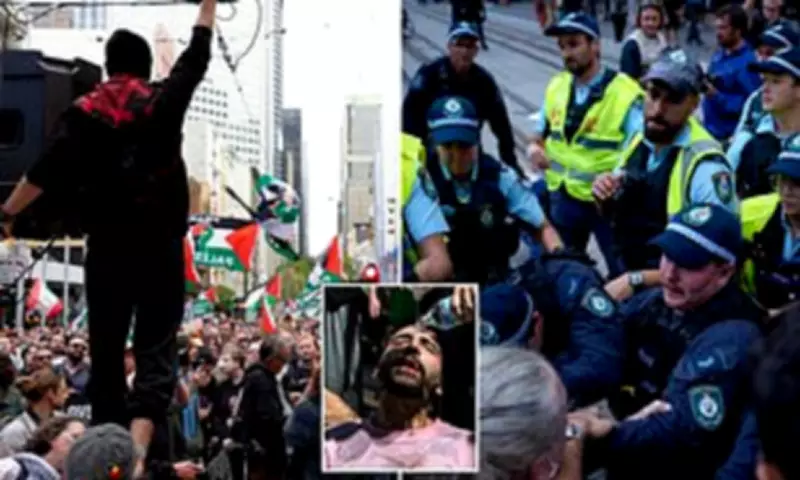
Dozens of arrests have been made following violent confrontations at pro-Palestine protests in Sydney and Melbourne on Monday night. Rallygoers were pepper-sprayed and punched as tensions escalated, with police defending their involvement in the altercations.
Police Defend Actions Amidst Social Media Scrutiny
New South Wales Police Assistant Commissioner Peter McKenna has staunchly defended officers seen in footage on social media engaging in violent altercations with protesters in Sydney. The demonstrators had marched from Town Hall towards Parliament House in a highly charged atmosphere.
'It's very early in the investigation, but what I can confirm is that police were involved in violent confrontations throughout the night, over a number of hours,' Commissioner McKenna stated late on Monday. 'If you take just 30 seconds of any video and judge based on that isolated segment, you're probably not doing the right thing and likely not putting all the pieces together as they truly need to be understood. I absolutely believe the police actions were justified tonight.'

He indicated that body-worn camera footage from the officers could potentially be released to provide fuller context. NSW police later confirmed that 27 protesters had been arrested in Sydney, including 10 individuals who allegedly assaulted officers during the confrontations.
Massive Protests Target Israeli President's Visit
The massive demonstrations were organized in opposition to Israeli President Isaac Herzog's visit to Australia. While protests raged outside, President Herzog attended a 'light and solidarity' event at the Sydney International Convention Centre, creating a stark contrast between the official reception and public dissent.
In Melbourne, approximately 5,000 people gathered and marched from Flinders Street Railway Station to the State Library, with some continuing to Parliament House. Victorian Police confirmed one arrest—a 20-year-old woman who allegedly burnt two flags, causing minor fire damage to a tram stop near Parliament. She is expected to be charged on summons with wilful damage.
Prominent Speakers Condemn Government Actions
Former Australian of the Year Grace Tame delivered a powerful speech outside Sydney's Town Hall earlier in the evening. 'What a backwards world it is when a so-called democracy silences and surveils academic research, art, music and sports while funding genocide,' she declared. 'A so-called democracy that punishes peaceful protesters like ours but welcomes a war criminal with open arms.'
Tame urged the crowd to mobilize more broadly: 'What I want you to do after you leave here today is look around you—amongst your colleagues, amongst your friends and your family—and find as many people as you can who have not come to a protest and bring them along next time because we need everyone. We have to continue to mobilise and we have to continue to globalise. Say it with me, from Gadigal to Gaza, globalise the intifada.'
The crowd responded with chants of 'From the river to the sea, Palestine will be free' as Tame spoke, creating an atmosphere of determined resistance.
Legal Challenges and Security Measures
Just before the protest began, organizers from the Palestine Action Group learned that their attempt to overturn a NSW government declaration designating President Herzog's visit as a major event had been rejected. Less than 45 minutes before the Sydney protest was scheduled to start, NSW Supreme Court Justice Robertson Wright dismissed the challenge to the government's declaration.
The NSW government had passed laws following December's Bondi Beach terror attack that restricted protections typically granted to authorized protests. These temporary powers—which can be extended for up to three months after a terror event—were fortified by the major event declaration announced on Saturday. While not banning the protest outright, the declaration subjected it to significantly tightened restrictions and heightened security measures.

Diverse Voices Unite in Protest
Alongside Grace Tame, several other prominent figures addressed the Sydney crowd, which waved a sea of red, white and green Palestinian flags. Greens senator Mehreen Faruqi, First Nations advocate Lizzie Jarrett, and Jewish academic Antony Loewenstein all spoke to the cheering demonstrators.
'Israel's actions endanger all of us, including Jews, because what Israel is doing claims to be in our name,' Loewenstein asserted. 'Believe me when I say, it is not in my name.'
Approximately 500 officers monitored the Sydney protest from perimeter positions and surrounding rooftops, with some equipped with sniper rifles. Helicopters hovered overhead throughout the event before police demanded that protesters disperse after the scheduled program concluded.
Melbourne Rally Demands International Accountability
In Melbourne, speaker Omar Hassan rallied demonstrators waving Palestinian flags outside Flinders Street Station. The crowd chanted demands for the Israeli president to be tried in the International Criminal Court before marching through the city center.
'We cannot stay silent while a war criminal tours our country, while this government rolls the red carpet out for someone who has literally signed off on the mass murder of children, men and women,' Hassan declared passionately.
Independent senator Lidia Thorpe strongly criticized the federal government's decision to invite President Herzog to Australia, calling it 'a joke.' She stated unequivocally, 'If you want us to be respectful, you do not invite anybody to this country who commits genocide.'
Controversial Background of Visiting President
While President Herzog's role is largely ceremonial in Israel's political structure, he has sparked significant outrage for being photographed signing an Israeli artillery shell—an image that has circulated widely in protest materials. Additionally, a United Nations inquiry found that his comments following the Hamas terror attack on Israel on October 7, 2023, could reasonably be interpreted as incitement for genocide. In those remarks, President Herzog described Palestinians as 'an entire nation out there that is responsible' for the attacks.
The protests represent growing international concern about the ongoing conflict in Gaza and increasing scrutiny of Australia's diplomatic relationships with nations involved in controversial military actions. The events highlight deepening divisions within Australian society regarding foreign policy and human rights advocacy.