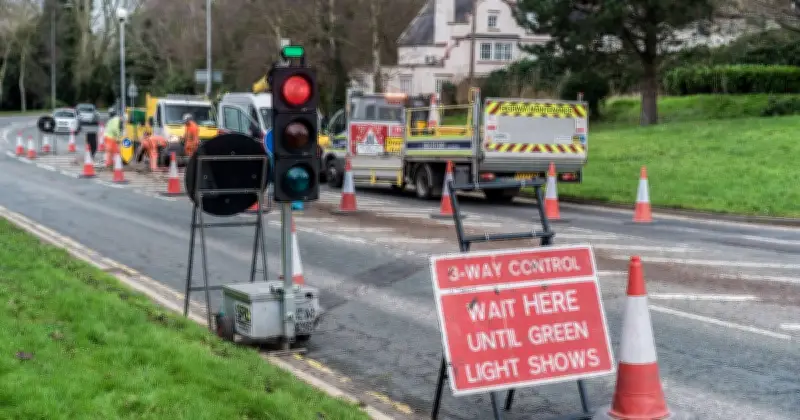
A barrister has clarified what motorists can and cannot do when temporary traffic lights remain stuck on red, noting that proceeding through a red light in such circumstances could leave drivers vulnerable to prosecution.
Barrister Daniel J. ShenSmith addressed the question many drivers face when temporary lights appear stuck on red: whether to wait or proceed. He stated that the law is outlined in Section 36 of the Road Traffic Act 1988, which stipulates that drivers must not contravene a red illuminated light.
Entirely broken lights
Daniel explained that of the two scenarios that might occur, the one concerning lights that have failed entirely is "slightly easier" to handle, as the position is explicitly outlined in Rule 176 of the Highway Code.

It states: "You MUST NOT move forward over the white line when the red light is showing. Only go forward when the traffic lights are green if there is room for you to clear the junction safely, or you are taking up a position to turn right. If the traffic lights are not working, treat the situation as you would an unmarked junction and proceed with great care."
Daniel states this clearly covers situations where the lights are not functioning at all: drivers should treat it as an unmarked junction and proceed cautiously. Yet he notes it is not as straightforward when the set-up is more "nuanced".
The lights are stuck on red
He outlined a scenario in which the traffic light remains red. It becomes apparent the signals are malfunctioning, particularly if drivers have watched several streams of traffic pass from the opposite direction without their light switching to green.
Daniel explained on the BlackBeltBarrister YouTube channel: "This is not entirely straightforward because a broken light in that way is still illuminated, and so it doesn't automatically count as not working under the Highway Code. And so the legal reality here is that it would still be a contravention of that traffic signal if you decide to proceed."
Should a driver choose to pass through a red light after concluding it has cycled three times without changing, they would "technically" still be breaching the red light, and it is "highly dangerous" owing to the risk of oncoming traffic. He added: "You might ultimately be liable for that, and there is, of course, no strict time limit after which you are permitted to contravene a red light. You are simply not allowed to do it, and the police can and quite likely will prosecute you for it."
Potential solutions
Regarding a remedy, Daniel advises that drivers must first wait for "several cycles" to establish, beyond any doubt, that the light is faulty. Secondly, they must ring the site number displayed on the sign to notify those responsible. Any such call would need to be made "hands-free", as holding a phone while driving constitutes a separate offence.
Should a driver ultimately decide to proceed past the red light, having concluded it was "absolutely clear" that it was malfunctioning and there was no alternative, "you might still be prosecuted" if witnessed doing so. Daniel suggests drivers could tell the police that they exhausted every option available, including dialling the number. He notes that the broken red light scenario is not defined in the Highway Code, but could be raised as a defence if charges are brought.
Legal reality
He added: "But apart from all that, the law is relatively clear. If there's a red light, you must obey it. So there's no law that says you can contravene it because you think it's broken, unless it's just not illuminated at all and it's not working at all, in which case you deal with it as an unmarked junction."
Daniel explains that the outcome may well hinge on what transpires in court. Jumping a red light is a strict-liability offence — meaning culpability can be established regardless of intent — but, as he puts it: "Is it in the public interest to prosecute you?"