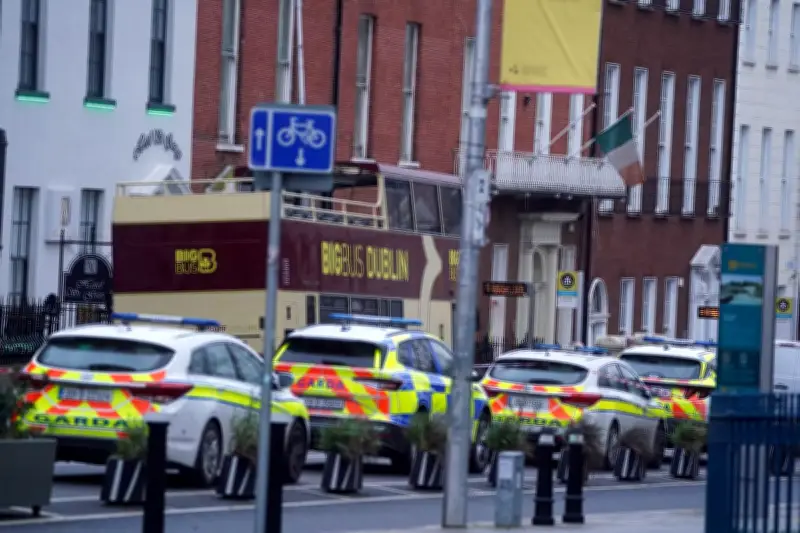
The judge presiding over the trial of a man accused of attempting to murder three young children in a Dublin stabbing three years ago has informed the jury that alternative verdicts are available on the attempted murder charges. Riad Bouchaker, 52, of no fixed address, faces charges related to an attack on Parnell Square East on November 23, 2023.
Charges and Pleas
Bouchaker is charged with the attempted murder of two girls, aged five and six, and a five-year-old boy. He also faces charges of intentionally or recklessly causing serious harm to care worker Leanne Flynn, assaulting two young children and a teenager, and producing a 36cm kitchen knife. He has pleaded not guilty to all eight charges. One of the alleged victims, a five-year-old girl, is now non-verbal and uses a wheelchair, the court previously heard.
Judge's Instructions on Verdicts
Mr Justice Tony Hunt told the jury that in addition to guilty or not guilty verdicts, they could return a verdict of “intentionally or recklessly caused serious harm” on the attempted murder charges. For the charges involving the five-year-old boy and six-year-old girl, verdicts of assault causing harm were also available. The judge emphasised that for a guilty verdict of attempted murder, the act “must be an attempt to kill someone,” not merely to frighten or cause serious harm. He stated that the level of injury is not “decisive” but can be a factor. The intention must be “cheek by jowl with an actual killing,” and the jury must determine that the accused had “a specific intention to kill” at the time of the actions.
Assessing Intention
Mr Hunt explained that intention cannot be assessed by a machine but must be inferred from primary and secondary facts. “You must assess the evidence, you must assess the facts and the inference that can be drawn from the evidence” to determine Bouchaker’s purpose regarding the attempted murder charges.
Assault Causing Harm Charge
Regarding the charge of assault causing harm to a teenager, the judge noted that the teenager “took a risk” by intervening but urged the jury not to see this “as a form of consent.” He said that running a risk to defend someone else does not imply consent to assault, and a knife nick “is certainly capable of constituting harm.” The jury must decide if it is beyond a reasonable doubt. He encouraged them to consider whether the force was unlawful, direct or indirect, and whether Bouchaker acted intentionally or recklessly.
Possession of Knife Charge
On the eighth charge, possession of a kitchen knife, Mr Hunt said that if the jury is not satisfied with an attempted murder verdict but finds an “assault-type” offence, that would not “preclude” a conviction on this charge.
Summary of Evidence
Summarising the evidence, Mr Hunt described CCTV footage as a useful “yard stick” to measure the accuracy of other testimony. He noted there were 16 witnesses, illustrating how memory is “hugely subject to fallibility” and people “genuinely doing their best but not being accurate.” He called the incident “shocking and horrendous,” noting that “nobody was expecting to be confronted with anything of this kind,” which is relevant in assessing witness accounts. According to CCTV, the time between Bouchaker “moving in” and the intervention of others lasted around 15 seconds, but he encouraged the jury to verify this themselves. Mr Hunt said he would conclude his charge to the jury in the afternoon.