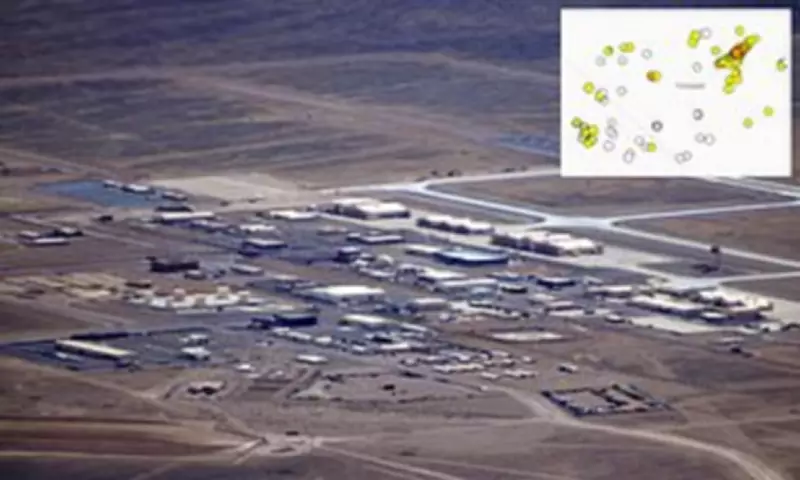
Seismic Swarm Strikes Sensitive Nevada Military Corridor
A significant seismic event has unfolded in a highly restricted region of central Nevada, with at least 127 earthquakes recorded since Saturday. The latest tremor was detected on Wednesday, marking a concentrated period of geological activity in an area dense with major US military and nuclear-related installations.
Proximity to Classified Facilities Raises Eyebrows
The earthquake swarm has occurred in the vicinity of the Tonopah Test Range, a remote military installation sometimes colloquially referred to as 'Area 52'. This highly classified facility, operated by the Department of Energy and the Department of Defense, has long been associated with America's nuclear weapons programs.
While not primarily used for nuclear detonations, the range has historically been crucial for testing how nuclear weapons would be delivered. This includes experiments where aircraft drop non-nuclear versions of bombs to study their performance, along with missile and aircraft testing. During the Cold War, the site hosted experiments involving mock nuclear bombs dropped to simulate real weapons deployments.

Scientific Explanation Points to Natural Causes
The seismic activity, ranging from magnitude 3.3 down to approximately 1.4, is located outside the currently active Nevada National Security Site. Scientists assert that the large number of earthquakes is most likely linked to the region's natural geology rather than human activity.
The area sits within the vast Basin and Range Province of the western United States, where the Earth's crust is slowly pulling apart. As the land stretches, stress accumulates along hundreds of underground faults that periodically slip, triggering earthquakes. This geological process frequently produces earthquake swarms—clusters of dozens or even hundreds of small tremors occurring in the same location over a short period.
Nevada ranks among the most seismically active states in the country, and such swarms are relatively common across the Basin and Range region. Experts emphasize that the latest tremors, despite their proximity to sensitive military installations, are most probably the result of natural tectonic movement.
Historical Context and Contemporary Tensions
This region of Nevada carries a profound historical legacy of being used for testing America's weapons of mass destruction. Activities related to such testing can, in theory, cause seismic tremors similar to those experienced over the past week.
The seismic swarm began on Saturday, a timeframe that coincided with reported US and Israeli military actions against Iran. Furthermore, the final remaining nuclear weapons treaty between the US and Russia expired in early February, just weeks before this concentrated earthquake activity was detected.
In a notable policy shift from late October 2025, former President Donald Trump ordered the US military to resume nuclear weapons testing, citing the need to keep pace with alleged testing by Russia and China. However, there has been no official announcement from the US government indicating that full-scale nuclear explosive testing has resumed at any domestic site.
The Nevada National Security Site, formerly known as the Nevada Test Site, served as the primary location for US nuclear weapons testing during the Cold War. Between 1951 and 1992, more than 900 nuclear tests were conducted there, with many later experiments performed as underground detonations. While full nuclear explosions have not occurred for decades, the site remains active today, hosting subcritical nuclear experiments and research designed to ensure the safety and reliability of the nation's nuclear arsenal.
Given the absence of confirmed testing resumption, the prevailing scientific assessment suggests the earthquake swarm represents a prolonged stretch of normal, albeit notable, geological activity in this seismically active and historically significant region.