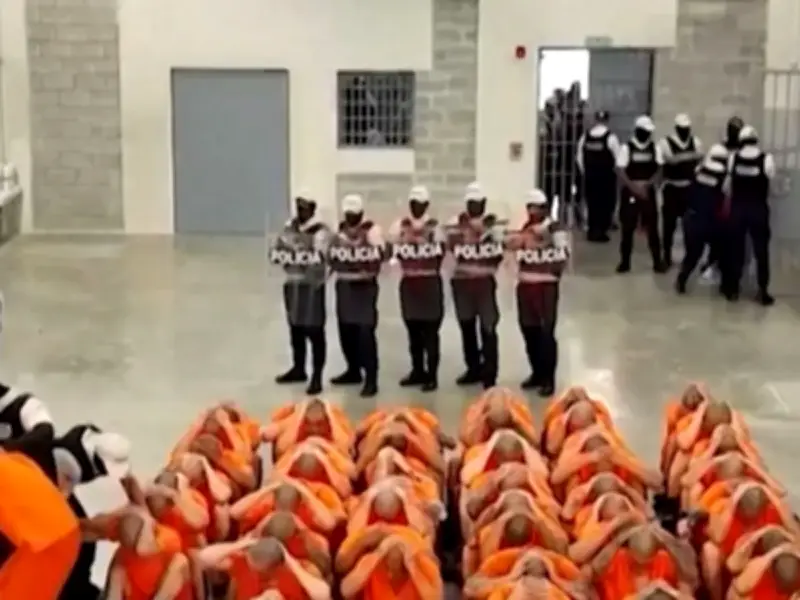
Costa Rica has transferred 123 handcuffed inmates to a newly built maximum-security mega-prison, signalling a decisive shift in its approach to violent crime. The facility, named the High Containment and Organised Crime Centre, is capable of housing 5,100 prisoners, roughly a fifth of the country's entire inmate population.
New images show the inmates handcuffed at the wrists, shackled at the ankles, and dressed in matching orange uniforms with shaved heads as they were transported to the complex. The scenes have drawn comparisons to El Salvador's crackdown on criminals last year.
Modeled on El Salvador's Blueprint
The prison was created with direct involvement and guidance from El Salvador, lifting key elements from the approach of Salvadoran President Nayib Bukele. His divisive mega-jail and extensive mass-detention tactics attracted sharp human rights condemnation despite dramatically reducing local crime figures.
For Costa Ricans, the development marks a stark watershed moment. Previously regarded as a peaceful sanctuary in an unstable region, the nation has become ensnared in an escalating violent crime emergency.
Rising Drug Trafficking and Violence
Over recent years, global drug trafficking organisations and heavily armed criminal groups have transformed the country into a vital transit and storage centre for South American cocaine destined for the United States and Europe.
The illegal commerce has unleashed savage territorial conflicts, calculated killings, and unprecedented murder rates, exhausting public tolerance and driving authorities towards aggressive, no-compromise law enforcement.
Hardline Strategy and Prison Conditions
State representatives maintain the hardline strategy is essential to break the power of imprisoned gang leaders, severing the communication channels exploited to control criminal enterprises and coordinate assassinations from custody.
The prison is modelled on El Salvador's infamous CECOT institution, a 23-hectare facility that can hold up to 40,000 inmates. Inmates sleep on multi-level metal bunks without mattresses in cells holding over 100 people each. Lights remain on 24/7, and prisoners have no access to books, TVs, internet, or outside communication. Prisoners are isolated with no family or media visits, and face strict movement restrictions.
The disturbing photographs of subdued, shaven-headed inmates crammed inside the complex represent a bleak new chapter: the region's most celebrated peaceful democracy is now officially battling fire with fire.