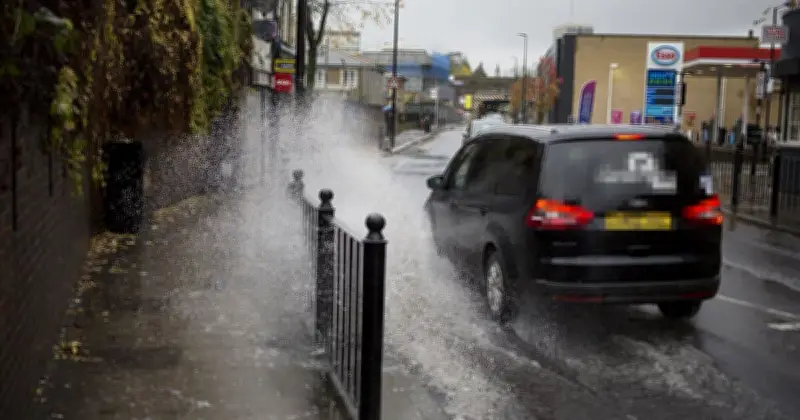
Motorists who splash pedestrians while driving through puddles could face a hefty fine and penalty points, according to legal experts. As Storm Austen brings wet weather across parts of Britain, drivers are being urged to take extra care due to reduced visibility and longer braking distances.
John Kusknick, Legal Director of the National Accident Helpline, advised that pedestrians who are splashed can report the incident to the police. He recommended noting the vehicle's registration number, along with the time, date and location of the incident.
What to Do If You Are Splashed
Kusknick said: "If you've witnessed someone driving irresponsibly, or perhaps you've been splashed as a result, you can report it to the police. It's worth taking note of the vehicle's registration number, along with the time, date and location of the incident."
He added: "Having video evidence can really help support your report. If you weren't able to capture anything on your phone, it's worth checking whether there were any CCTV or traffic cameras nearby that may have recorded what happened," although he voiced scepticism about such an incident leading to a formal investigation.
Potential Penalties for Careless Driving
Jeanette Miller from Geoffrey Miller Solicitors warned that splashing someone is likely to be treated as the offence of inconsiderate or careless driving. She said: "Splashing someone is likely to be treated as the offence of inconsiderate or careless driving."
According to her website, a charge of careless driving, also referred to as inconsiderate driving or driving without due care and attention, can only be upheld if prosecutors demonstrate that the motorist's driving dropped below the standard expected of a competent driver or that they failed to show reasonable consideration for other pedestrians and vehicles on the road.
Jeanette explained: "This carries between three to nine penalty points, a possible driving disqualification and an unlimited fine based on an offender's income. However, although less likely, it could arguably amount to the more serious offence of a common assault."
Understanding Common Assault
She continued: "An act by the defendant (which can include words, gestures, or conduct or in this example, splashing a pedestrian!). The victim apprehends immediate unlawful violence. The victim does not have to be frightened, merely anticipate that unlawful force may be used imminently."
"The defendant acts intentionally or recklessly as to causing that apprehension." She emphasised that physical contact is not necessarily required for an assault to have occurred. "A raised fist, threatening gesture, or even words can amount to an assault if they cause the victim to anticipate immediate unlawful violence."
"By contrast, battery is the actual application of unlawful force to another person. The two offences are commonly charged together as 'common assault' under section 39 Criminal Justice Act 1988," she added.
Jeanette noted that those found guilty of careless driving could face a substantial financial penalty, "based on an offender's net weekly income. Typically calculated at 150% of someone's net weekly income." For someone earning £500 after tax per week the fine could be £750, and for someone earning £5000 after tax per week, the fine could be £7500.
For careless or inconsiderate driving under Section 3 of the Road Traffic Act 1988, the current Sentencing Council guideline uses fine bands based on an offender's relevant weekly income, with 150 per cent being the starting point for a Band C fine.
The Highway Code advises drivers to take extra care in wet weather, including keeping well back from the vehicle in front, easing off the accelerator if steering becomes unresponsive, and remembering that stopping distances are at least twice as long on wet roads. Drivers should also take extra care around pedestrians, cyclists, motorcyclists and horse riders.