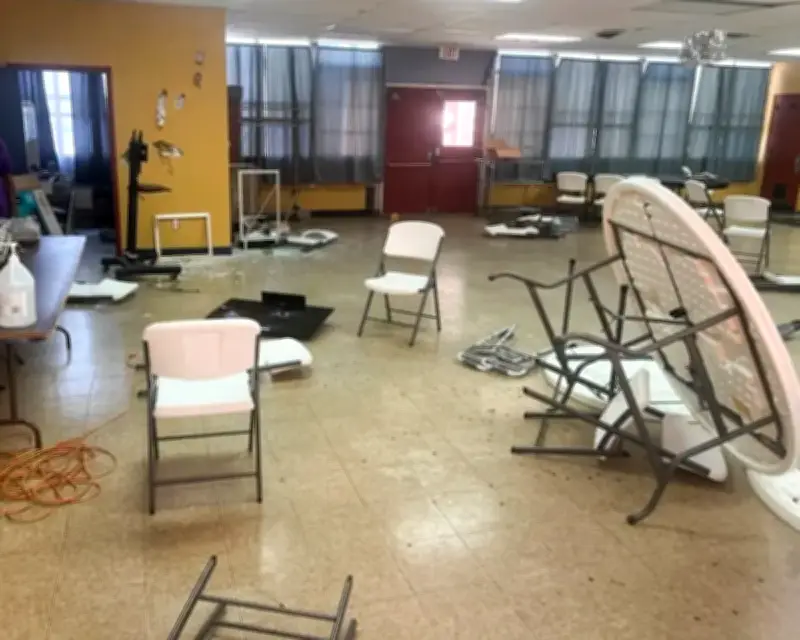
The Westwood Islamic Community Center in Cincinnati, Ohio, was attacked for the third time in seven years, with members expressing doubt that the FBI will investigate it as a hate crime. The latest attack occurred amid Islamophobic blowback against Arab and Muslim Americans running for political office.
Third break-in at Westwood center
Board member Nashid Shakir described how assailants used wire cutters to break into the center in the early hours of 3 August. “They cut the wire and broke the window to get in. They broke into the office, too. It was total disarray,” said Shakir, who has been a member since the 1960s.
Smashed glass was still evident on two posters containing lines in Arabic from the Quran on the center’s walls. Valuables including a surveillance camera and television monitors were stolen, and swear words including the word “die” and other profanity were written on a whiteboard.

The center, which houses a mosque and food pantry in an underserved, majority-Black neighborhood in west Cincinnati, was previously broken into with racist comments graffitied on its walls. “The police came out and they checked the boxes for making a report. But we haven’t had any follow-through,” said Shakir.
Political context and Islamophobic rhetoric
The attack came against the backdrop of a rise in Arab and Muslim American politicians running for office in the US, and a series of Islamophobic comments from Republican politicians and far-right figures. In Michigan, Democratic senatorial candidate Abdul El-Sayed has been targeted by conservative and rightwing voices following his primary win on 4 August. A report by the Center for the Study of Organized Hate (CSOH), a Washington DC-based thinktank, found that targeting of El-Sayed increased twentyfold since the election.
On 10 August, Trump told reporters from the Oval Office that “we have jihadists being elected all over the place”. In March, the Council on American-Islamic Relations (Cair) reported an unprecedented rise in Islamophobic incidents and discrimination nationwide last year. In May, three people were killed by two attackers at a mosque in San Diego.
“What we are seeing right now is a very organized and coordinated campaign to generate fear and hysteria about Muslims for electoral gain, to justify domestic policies, and build support for foreign wars,” said Raqib Naik, executive director of the CSOH. “The idea that Muslims are coming to ‘take over’ America is more mainstream. It is a continuation of post-9/11 Islamophobia, but in many ways, it has become uglier and more blatant. We are now at a point where 65 members of Congress have formed a so-called ‘Sharia-Free America caucus.’”
The caucus, formed last December by Texas Republican representatives Keith Self and Chip Roy, has representatives from 17 states. “What is particularly worrying is that bigotry once largely confined to fringe anti-Muslim groups is now being repeated and amplified from the highest office in the country, by elected officials, billionaires and major political influencers,” said Naik.
Local response and security concerns
In Ohio, Somali Americans have been subjected to Trump-fueled violence and immigration crackdowns. Last winter, ICE agents, rightwing influencers and other provocateurs descended on childcare and other facilities run by Somali Americans in Columbus following false claims from Trump that members of the community were “ripping off the country”.
Muslim leaders say that no suspects in the Westwood Islamic Community Center attack have yet been apprehended. Tala Ali, a community organizer at Cair-Ohio and a Cincinnati resident, says she does not intend to approach the FBI to ask them to investigate the attack as a hate crime. “I don’t have trust in authorities to find who’s behind this. We have had incidents where the largest mosque in Cincinnati was bombed,” she said.

In December 2005, two pipe bombs exploded outside Cincinnati’s Clifton mosque, causing significant damage to a door and windows. The explosions happened two hours after worshippers had gathered to pray, and no one has ever been charged. “Our focus now is to get local authorities just to acknowledge it and condemn it and any acts of bias, intimidation [or] violation against the Muslim community and the Black community,” said Ali. “I think that this was an identity-motivated targeting, so by definition because of that [it’s a hate crime].”
With about 25 people gathering to pray at the center’s mosque on most Fridays, the local Muslim community is working to find support to improve security at houses of worship around Cincinnati, including at the community center, which at the time of the attack had no security cameras.
Shakir said he has been surprised by the positive response from the wider Cincinnati community but not by the rhetoric from the White House. “I take what [Trump] says with a grain of salt even though I know there’s a part of the country that takes what he says as gospel,” he said.
Ali said the local Muslim community would like to apply for federally funded grants through the Federal Emergency Management Agency that specifically tailor to non-profits in need of security assistance. But because of who’s in government, she said, locals aren’t sure about seeking that out. “Look at the culture and the environment that we live in. Do you want to bring that into your house [of worship]?” she said. “Because, will these people really protect you, or will they use it, as they have historically used it, to access what we do in our community?”