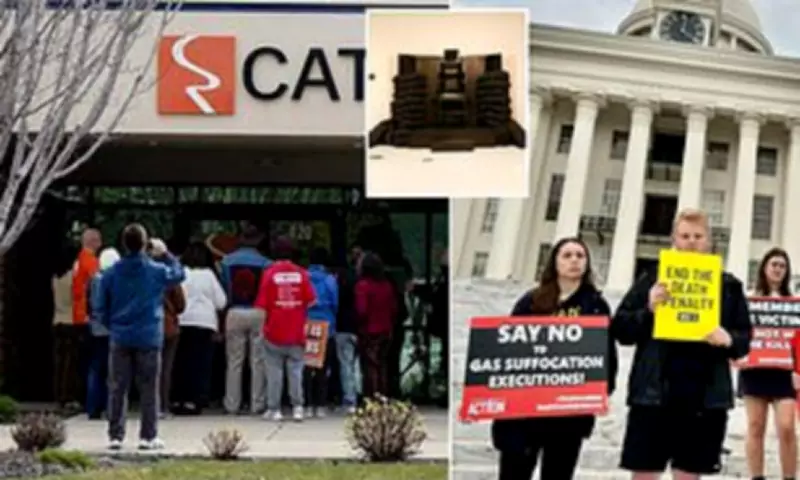
Idaho's Firing Squad Execution Chamber Design Sparks Widespread Protests
An Idaho engineering firm tasked with designing a specialized firing squad chamber for death-row executions has faced significant public backlash, with protesters condemning the project as "sick and wrong." The controversy emerges as Idaho prepares to implement firing squads as its primary execution method starting July 1, according to state officials.
Expensive Facility Draws Public Outcry
The Idaho Department of Corrections has confirmed that construction is underway on a $911,000 execution facility in Boise. This substantial investment has drawn criticism from various advocacy groups who question both the method and the expenditure. A large demonstration gathered outside the offices of Cator Ruma & Associates, the engineering firm responsible for the chamber's design, with protesters objecting to the facility's opening, its considerable cost, and the execution method itself.
Jan Powell of Idahoans Against the Death Penalty articulated a fundamental concern shared by many opponents: "As long as our legal system is capable of making mistakes, it must not be entrusted with the power to kill." This sentiment was echoed by Abraham Bonowitz, Executive Director of Death Penalty Action, who characterized the facility as "essentially a stadium for witnessing executions by shooting" funded by Idaho taxpayers.

Divergent Perspectives on Execution Methods
While protesters voiced strong opposition, some state lawmakers defended the transition from lethal injection to firing squads. Representative Bruce Skaug maintained that the firing squad represents "the most humane method" of carrying out executions. He acknowledged differing viewpoints while emphasizing legal realities: "I respect people who don't want the death penalty, but that is the law... for certain terrible situations."
The protest, organized by national anti-death penalty groups Death Penalty Action and Worth Rises, attracted diverse participants including faith leaders, organization members, and individuals with direct experience of what they describe as the "traumatizing" nature of executions. Among attendees was Randy Gardner, whose brother was the last person executed by firing squad in Utah in 2010. Gardner revealed disturbing details from his brother's autopsy, noting that "all four shooters' shots were off-center." He shared his family's trauma, stating, "Not only me and my family, but jurors, executioners and wardens have been traumatized by this."
Corporate Involvement Under Scrutiny
Protest organizers identified additional companies contracted by the Department of Corrections for the project: Utah-based Okland Construction and Indiana-based Elevatus Architecture. Celina Chapin, chief advocacy officer with Worth Rises, explained that the primary objective of these demonstrations is to pressure companies participating in execution facility construction. Bonowitz emphasized this strategic focus, noting that "the chamber cannot be built unless somebody is willing to build it."
Worth Rises released excerpts from November email exchanges between Elevatus Architecture contractors that discussed technical details of the chamber with what Chapin described as "very business as usual" tone. The emails included discussions about drainage systems, sound considerations for adjacent rooms, and questions about utilizing suppressors and subsonic ammunition to manage acoustic goals. One email specifically addressed floor drainage requirements, stating, "It's OK if they have to mop/squeegee liquids to the drain. Sloping the floor will not be cost effective."
Legislative Background and Practical Challenges
The new execution chamber construction follows legislation passed by Republican lawmakers that established firing squads as the primary execution method, building upon a 2023 law that had designated it as a backup to lethal injection. This policy shift comes after years of difficulties with lethal injection protocols in Idaho, which has not carried out an execution since 2012. The most recent attempt to execute convicted killer Thomas Creech two years ago failed when medical personnel determined that IV access could not be established.

Despite ongoing protests, Idaho Department of Corrections officials confirm that construction is progressing to meet the July 1 deadline, with staff training scheduled to follow completion. Key procedural decisions remain pending, including whether executions will utilize a manned squad or remote-controlled firing system. Officials have stated that a finalized standard operating procedure will be released once all details are completed.
Protest organizers announced plans to present over 2,000 petition signatures and a letter from more than 30 interfaith leaders urging Cator Ruma & Associates to withdraw from the project and commit to avoiding execution-related work in the future. Chapin summarized the broader sentiment: "We're really representing thousands of people who don't believe that we should have the death penalty at all."