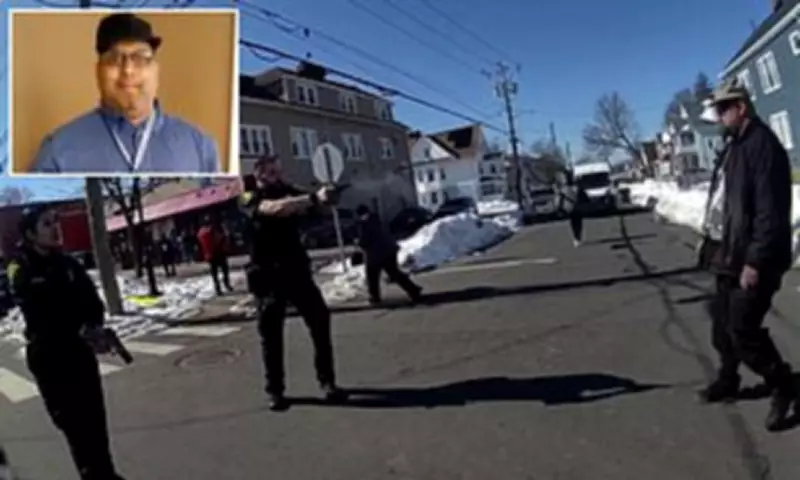
A former Hartford police officer has been charged with first-degree manslaughter for the fatal shooting of a Black man suffering from a mental health crisis in February, following a monthslong investigation by the Connecticut Inspector General's office.
Officer Joseph Magnano, 23, was fired by the Hartford Police Department after he shot and killed Steven Jones, 55, who was seen wielding a knife in police body camera footage. Inspector General Eliot Prescott concluded that Magnano failed to de-escalate the situation and did not make a reasonable attempt to use non-lethal force, according to an arrest warrant. Prescott also stated that Jones 'did not pose an imminent threat to bystanders' and that Magnano had 'ample space' to back away from him.
Magnano turned himself in on Monday and was released on a $50,000 bond. He faces a maximum sentence of 20 years in prison if convicted.

Union President Criticizes Arrest
Sgt. James Rutkauski, president of the Hartford Police Union, criticized the arrest, calling it a blow to morale and warning that it would deter potential recruits. 'This is a nail in the coffin. I do not know how you're going to get police officers to come to the city now,' Rutkauski told WTNH-TV.
Hartford Mayor Arunan Arulampalam, who fired Magnano on March 27, praised the inspector general for leading a swift investigation, expressing hope that it would help restore trust in the police force.
Details of the Incident
On February 27, police were dispatched to Jones's apartment after his sister called 911, reporting that he had cut himself with a large knife and was suicidal. Photos taken by officers show a large blood stain on his front stoop from the self-inflicted wound. Jones had a history of mental illness, and multiple officers arrived to find him brandishing the knife.
Before Magnano arrived, one officer deployed a Taser on Jones, but it failed to subdue him. Jones continued to approach officers aggressively before standing in the middle of the street, largely motionless. Officers and bystanders repeatedly urged Jones to drop the knife, with residents begging officers not to shoot him due to his mental health issues.
At approximately 11:12 a.m., Magnano arrived and quickly drew his weapon on Jones, who began walking slowly toward him. 'Drop the knife! You're going to get shot! Drop the knife!' Magnano shouted, according to body camera footage. Seconds later, he fired nine shots at Jones, who collapsed to the pavement. The shots were fired 34 seconds after Magnano arrived. Jones died from his wounds on March 3, and the medical examiner ruled his death a homicide.
Conflicting Accounts
Officer Jackeline Torres stated in her sworn testimony that she asked Magnano if he had a Taser, and he confirmed he did not. Magnano claimed he positioned himself in front of a large group of civilians to protect them from Jones, who he believed had the 'intention to harm me, another officer or a nearby citizen.' He said he had 'limited space behind me, which would prevent me from creating any more space between myself and Jones.'
However, the inspector general argued that Magnano should have actively moved bystanders out of harm's way before resorting to shooting. 'To the extent Magnano subjectively believed that Jones posed a risk of serious physical injuries to bystanders in the area, Magnano made no effort to move bystanders out of any perceived harm's way,' the arrest affidavit stated. It also noted that 'at the time Magnano discharged his firearm, Jones did not pose an imminent threat to bystanders because the bystanders were walking away from Jones and no longer in close proximity to him.'
Reactions
Rutkauski defended Magnano, saying he was 'defending his fellow officers, the community, himself.' Civil rights attorney Ben Crump, representing Jones's family, called the charge 'a necessary and meaningful step toward accountability.' Crump added, 'Stevie was in the middle of a mental health crisis, and instead of receiving the care he needed, he was shot nine times. This charge reflects what the family has known all along, that what happened to Stevie was not justified.'