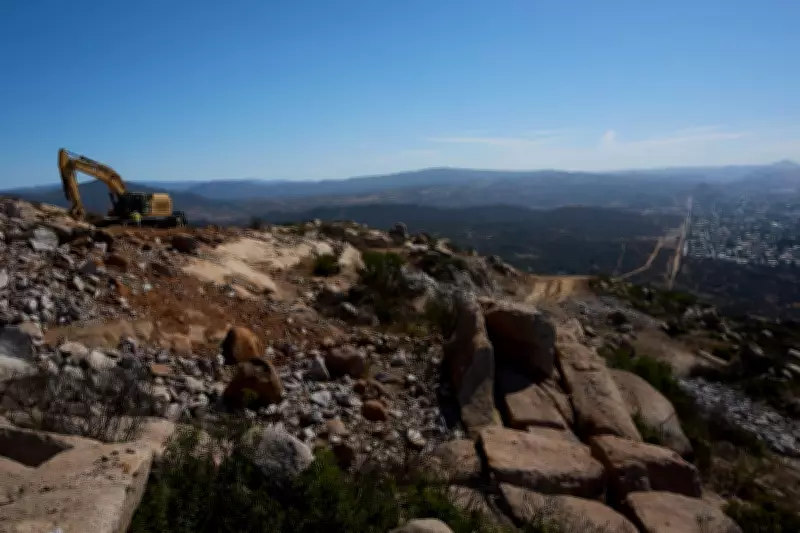
Indigenous leaders have voiced strong objections, asserting that federal contractors are desecrating sacred Native American places and cultural sites at an unprecedented rate in the rush to construct more barriers along the U.S.-Mexico border. The accelerated construction, which began in earnest this year after the Department of Homeland Security waived cultural and environmental laws, has sparked outrage among tribal communities.
Sacred Mountain Under Attack
Norma Meza Calles, a Kumeyaay Nation tribal leader, described the profound spiritual importance of Kuuchamaa Mountain, which straddles both countries. She explained that in the tribe's creation story, a shaman transformed into the mountain, making it a sacred site akin to a church. However, the silence during her reflection sessions is now broken by the sound of rock crushing, as federal contractors blast and bulldoze the mountain to make way for new wall sections.
Emily Burgueno, a California member of the Kumeyaay Nation, emphasized the deep connection between the tribe and the land, noting that the words for 'body' and 'land' are identical in the Kumeyaay language. She expressed dismay at the lack of consent for the use of dynamite on the mountain. The Kumeyaay Nation, comprising over a dozen tribes in California and Baja California, Mexico, has met with DHS officials and is considering legal action.

Destruction of Ancient Geoglyph
In Arizona, DHS contractors last month carved through a 1,000-year-old fish-shaped geoglyph known as 'Las Playas Intaglio' in the Cabeza Prieta National Wildlife Refuge. The Tohono O'odham Nation had pointed out the site to contractors to avoid it. Chairman Verlon Jose called the destruction a devastating and avoidable loss, emphasizing the site's irreplaceable historical and cultural value.
U.S. Customs and Border Protection acknowledged that a contractor 'inadvertently disturbed' the site on April 23 but vowed to protect the remaining portion. Commissioner Rodney Scott is engaging with tribal leaders to determine next steps. Members of the Inter-Tribal Association of Arizona traveled to Washington last month to lobby against new wall construction, meeting with Homeland Security Secretary Markwayne Mullin, who listened but reiterated the intent to build walls as quickly as possible.
Rampant Construction Despite Low Crossings
The Trump administration argues that the barriers are essential to prevent illegal immigration and drug trafficking, aiming to cover at least 1,400 miles of the border. Over $46 billion has been allocated to the effort. CBP has awarded contracts or begun construction on over 600 miles of new wall, with double walls planned or under construction along an additional 370 miles. In Arizona, heavy machinery is extending a double wall that could block a wildlife corridor for endangered ocelots and jaguars, which the Tohono O'odham consider spiritual guardians.
Other Sites Affected
In New Mexico, crews set off blasts on Mount Cristo Rey, a pilgrimage site topped with a limestone crucifix. CBP is seeking to seize a strip of the mountain owned by the Roman Catholic Church, prompting the Diocese of Las Cruces to seek a court order denying the land transfer on religious liberty grounds. In western Texas, the federal government notified ranchers of interest in land containing ancient pictographs and petroglyphs. After community backlash, plans for a 30-foot wall in that area were scrapped in favor of surveillance technology and vehicle barriers.
Legal Protections and Tribal Response
Desecrating a sacred Native American site on federal or tribal land is a felony, punishable by imprisonment and fines. Kuuchamaa Mountain, also known as Tecate Peak, is listed on the National Register of Historic Places, with a note that disturbing its natural state would be sacrilegious. Despite this, construction continues. Tribal leaders are exploring legal avenues and lobbying efforts to protect their heritage.
Sarah Livia Brightwood Szekely, who runs the Rancho La Puerta wellness resort near Kuuchamaa, noted the mountain's healing energy and the deep relationship many people have with it. Meza Calles leads walks to teach guests about the mountain's significance, where traditional coming-of-age ceremonies once lasted 40 days. She expressed sadness over the destruction but vowed to continue the fight.