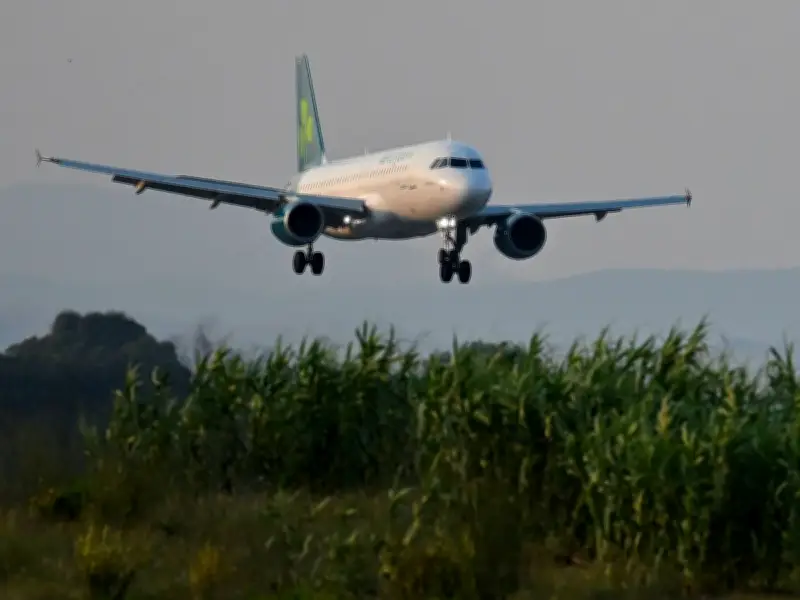
An Aer Lingus pilot who admitted he "may have been tired" triggered a mid-air alert over Dublin after switching off the autopilot to hasten a landing, an investigation has found. The 146 passengers aboard the January 2025 flight from Faro, Portugal, to Dublin Airport endured a sharp 44-degree bank—far exceeding the standard 33-degree safety threshold—during a failed approach to the runway.
Official report details
An official report by the Air Accident Investigation Unit (AAIU) described the incident as an "aircraft upset," a term used when an aircraft inadvertently moves beyond its intended flight boundaries. Based on the recently published findings, the flight's captain told investigators he "did not sleep well the night before the flight and that he may have been tired." The incident occurred on January 14, 2025, as the crew attempted to shorten their route to the runway.
Despite air traffic controllers explicitly asking whether the pilots required "extra track miles" to align their descent correctly, the crew continued. But as they arrived too high and too fast, the captain disconnected the autopilot to fully deploy the aircraft's speed brakes. This decision to fly manually resulted in "degraded situational awareness," according to the AAIU.

Sequence of events
The crew attempted a descending "orbit" to the right to reduce altitude, which caused the severe 44-degree bank. During the sharp turn, the Airbus A320's speed plummeted dangerously low, dropping below the minimum recommended speed (VLS) designed to prevent a stall on two separate occasions. A potential catastrophe was avoided when the aircraft's automatic low-speed protection systems activated according to safety protocols.
Throughout the incident, the flight directors briefly vanished from the cockpit displays before the commander applied takeoff thrust to stabilize the aircraft. Amid the chaos, the jet climbed to 4,200 feet, exceeding its authorized altitude of 3,500 feet. The pilots successfully aborted the landing attempt, requested radar vectors for a second approach, and landed safely without further issues.
Aftermath and safety measures
Following the incident, Aer Lingus prohibited pilots from performing orbit maneuvers during approaches, except during training. The airline also began advising crews to execute a go-around if there is any uncertainty about a safe landing. Thanks to these proactive safety measures, the AAIU concluded its report without issuing additional safety recommendations.