FBI Agent's Endless Surveillance: Grateful Dead Soundtrack to Infamous Lufthansa Heist
For former FBI special agent Neil Moran, the Grateful Dead song "Casey Jones" will forever echo in his mind, an indelible soundtrack to one of America's most notorious crimes. For over a month during the harsh winter of 1978-79, Moran conducted round-the-clock surveillance on mobster Angelo Sepe, hoping to uncover evidence about the largest cash robbery in U.S. history at that time.
The Heist That Shocked America
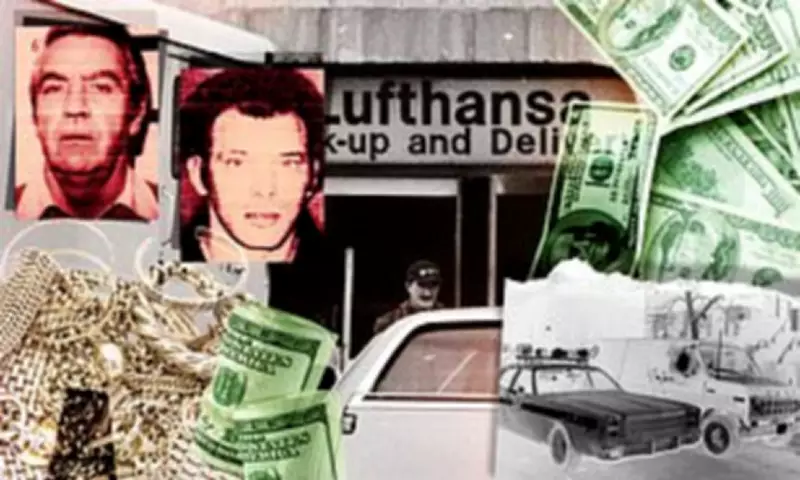
On December 11, 1978, six armed men associated with the Lucchese crime family stormed the Lufthansa Airlines cargo terminal at New York's JFK Airport. In a meticulously executed 64-minute operation, they made off with $5.8 million in untraceable cash and jewels—equivalent to approximately $30 million today. The brazen theft would later inspire Martin Scorsese's classic film Goodfellas, but in its immediate aftermath, it triggered a brutal wave of violence as Mafia members systematically eliminated anyone connected to the crime.
Graveyard Shift Surveillance
Assigned to the FBI's truck hijacking division in New York, the young agent Moran drew the unenviable graveyard shift—10 p.m. to 6 a.m.—tracking Sepe's every move through the snowy streets of Queens, Brooklyn, and Manhattan. "I got to know him very well," Moran recalled to the Daily Mail. "He was a huge fan of the Grateful Dead, and he had 'Casey Jones' blaring over the air all the time. There's a line in the song 'Driving that train, High on cocaine' that all of us following him still joke now that we'll be able to hear in our minds even on our deathbeds."

Sepe's choice of vehicle made surveillance somewhat easier for the FBI team. Just days after the multi-million-dollar robbery, the mobster purchased a flashy 1979 Ford Thunderbird—one of the most desirable cars in his Italian-American neighborhood of Ozone Park, Queens. "It was an easy car to follow because the taillights were so distinctive," Moran noted, "like two horizontal bars, so you could easily see him in traffic many cars ahead."
Frustrating Investigation Amidst Musical Repetition
The surveillance operation proved frustratingly unproductive despite its intensity. Between Sepe's constant club-hopping and domestic arguments with his wife that frequently erupted during the overnight hours, Moran heard little of evidentiary value. "Just when we thought he was going to talk about something useful," the agent remembered, "she'd say something and he'd start screaming at her and she'd be screaming back at him—and the Grateful Dead would still be playing in the background."
After approximately a month of tailing Sepe, the FBI obtained authorization to install listening devices in the mobster's vehicle. The primitive recording technology of the late 1970s required agents to remain dangerously close to their target to capture audio, necessitating frequent rotation of surveillance teams to avoid detection. Despite these efforts, Moran believes the mobsters were aware they were being watched. "They knew we were around," he said. "Which is why Jimmy Burke didn't want them spending money because word would get out."
Bloody Aftermath and Failed Prosecutions
As the investigation stalled, bodies began piling up across New York. James "Jimmy the Gent" Burke—the alleged mastermind behind the heist—reportedly ordered the elimination of anyone who might compromise the operation or draw attention through conspicuous spending. The first victim was Parnell "Stacks" Edwards, who had failed to properly dispose of the van used in the robbery. He was followed by bookkeeper Marty Krugman, Burke associate Louis "Roast Beef" Cafora and his wife Joanna, and numerous others connected to the theft.
By February 1979, the FBI had gathered enough evidence to arrest Sepe, though prosecutors acknowledged they lacked sufficient proof for conviction. Moran participated in the Saturday afternoon takedown, pulling over Sepe's Thunderbird in Jamaica, Queens—with Burke coincidentally riding in the passenger seat at that moment. "Needless to say, he didn't end up cooperating, and we didn't have enough for a conviction," Moran admitted.

Legacy of an Unsolved Crime
The Lufthansa heist remains one of the most infamous unsolved crimes in American history. Only one person—Lufthansa cargo supervisor Louis Werner—was ever convicted for involvement, receiving a 15-year prison sentence. The stolen cash and jewels were never recovered. Most participants met violent ends: Sepe and his girlfriend were found shot execution-style in a Brooklyn basement apartment in 1984, while Burke died in prison in 1996 after being convicted on unrelated charges.
More than three decades after the robbery, a surprising development occurred when aging Bonanno crime family capo Vincent Asaro was charged in 2014 for his alleged role. Despite testimony from his own cousin, Asaro was acquitted at trial, leaving the heist officially unresolved.
For Moran, who lived through the real events, the cinematic portrayal in Goodfellas rings remarkably true. "When me and my colleagues watched the movie," he recalled, "I remember we said 'Oh my gosh, there's Angelo's car.' They went to the trouble of putting the exact car and color we followed every day there in the background of one scene. It was quite accurate." The agent will share his firsthand account at the Hamptons Whodunit festival, a mystery and true crime event scheduled for April 2026.