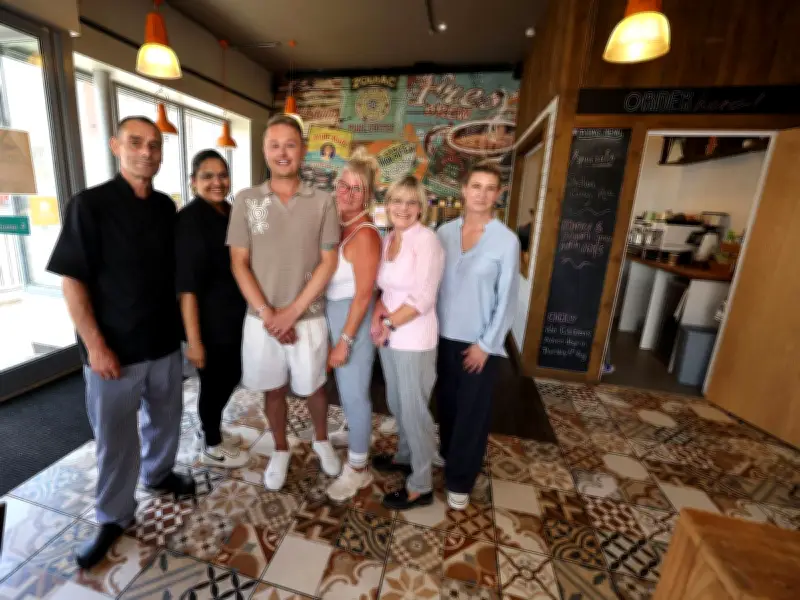
Children as young as 12 in Birkenhead are seeking help for ketamine addiction, with the drug available for as little as £6 a gram, according to Nightingales Hub, a charity that provides addiction support and other services.
Nightingales Hub, which operates from a café on Argyle Street, offers a discreet frontline in the battle against addiction, poverty, and poor health. People can access drug and alcohol support, therapy, nursing clinics, and wellbeing sessions without drawing attention to themselves. The charity also provides free hot meals twice a week, with no referral, assessment, or means test.
Alarming increase in young users
Director Nicki Heywood, 51, said the organisation is seeing an alarming increase in young people needing support for ketamine addiction, with some service users aged just 12. She told the ECHO: "It's just blown up. The physical effects [of ketamine] happen so quick. Within six to 12 months, irreversible damage happens."

"We call it a pocket money addiction because that's how cheap it is. You can get it for £6 or £7 a gram now. Kids are using their dinner money to buy it. A lot of kids are passing blood in their urine. A lot of them can't get out of bed to do their therapy because they're that unwell. It's heartbreaking. It's hard to see."
Heywood added: "It's a whole different drug to deal with and we're learning every day."
Health inequalities highlighted
The charity's work comes as new figures reveal stark health inequalities in Wirral. According to data published last week by the Office for National Statistics (ONS), Birkenhead Central has one of the lowest healthy life expectancies in England and Wales. Boys born between 2019 and 2023 can expect to live just 47.8 years in good health, while girls can expect 50.5 healthy years. Nearby Tranmere also ranked among the 10 lowest areas for men's healthy life expectancy, at 49.7 years.
These figures contrast sharply with the national average of 65.3 healthy years for men and 66.8 years for women in England. For the team at Nightingales, the statistics confirm what they see daily.
Intergenerational addiction
Heywood, who drew on her own experiences to help shape the organisation, believes deprivation and lack of opportunity have contributed to addiction becoming entrenched across generations. She said: "Birkenhead is a dry area; it's a ghost town. The decline is unbelievable. People lost their jobs, then ended up drinking, then we had a heroin epidemic. It just became intergenerational. We often have people in from the same family but different generations with different types of addiction. It's about breaking that vicious cycle."
Fellow director Jai Roscoe, 39, said demand for support had continued to grow during his 18 months with the organisation. "It's a beast, it grows. It's an epidemic in Birkenhead," he said. "When I first started it was mainly middle-aged men, but the longer I've been here, the more it's started to change. I'm stood at the door on a Tuesday or Thursday night and there's children in school uniforms coming over."
"They know they're probably not getting fed tonight so they've come to us because they know we'll feed them. Our door isn't means tested. We feed men in suits who've been working all day but still don't have enough money in their wallet to pay for food. We have a homeless pregnant woman coming in every day. We don't judge. You could be wearing branded clothes from top to bottom, but we don't know what's in your bank."
Learned behaviour and recovery
Roscoe said many of those seeking help have grown up surrounded by addiction. "A lot of it's learned behaviour," he said. "Because of the situation they're in, it's almost like they live in a bubble and it becomes acceptable within that household. As soon as addiction grabs hold of you, a lot of your inhibitions and responsibilities disappear. Drugs, alcohol and addiction become your number one priority, and often children watch that and internalise that."

Around 80% of Nightingales' staff are former service users who are now in recovery or have rebuilt their lives after addiction. Heywood said: "What we do is teach people that there is another life. A lot of people with addiction are pension age 20 years before they should be. There's so much stigma and discrimination against people struggling with addiction. It's about giving people a safe place where they don't feel judged."