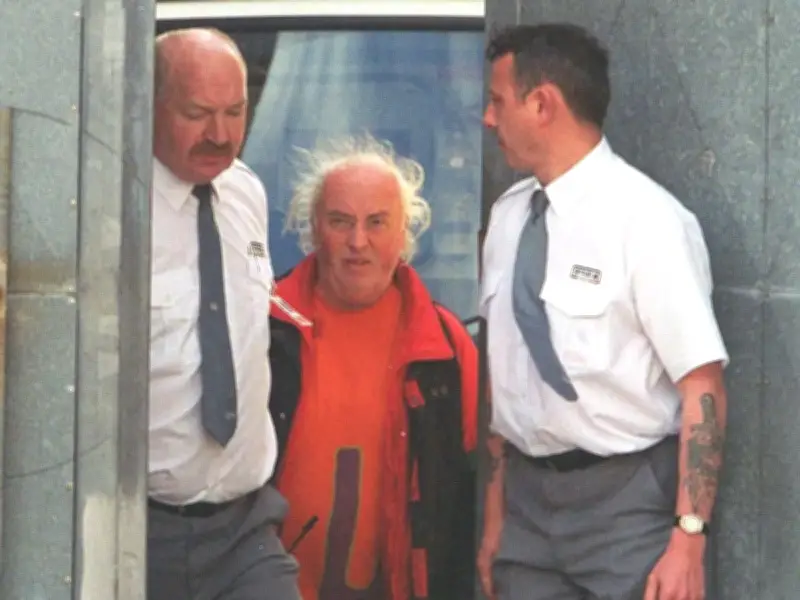
Kevin Morrison, a 59-year-old man who murdered a 74-year-old widow in her own home in 1996, was caught only because his greed led him to inform on an innocent friend. Morrison, a known police informant, told detectives that his friend Keith Darlington had confessed to the murder, but in doing so, he accidentally incriminated himself by revealing details only the killer would know.
The murder of Alice Rye
Alice Rye was a 74-year-old widow, a mother of three, living alone in a spacious four-bedroom house in up-market Spital, where she had lived since the 1950s. Her husband, Colin, had died in 1986; her children lived far away in the south of England and South Africa. Justin Mote, reverend of the Holy Trinity Church where she attended every Sunday, described her as "a popular lady - elegant, dignified, a woman of poise". She was a member of the church's friends group and the Brimstage Women's Institute, and enjoyed embroidery and tapestry.
At around 11am on December 10 1996, the last day of her life, she went to her local Spar and bought a newspaper and a can of Guinness. She returned home, warmed up some home-made stew in the microwave and ate it while watching TV as usual. It was sometime that afternoon that Morrison showed up at her door, possibly posing as a telephone engineer or other official. After conning his way inside, the pair went upstairs, and this was where Morrison produced a knife.

A gruesome discovery
Alice was found at 8.20am the following day by her neighbours, who had gone to check on her. She had been bound to a bed, gagged with a towel, strangled and stabbed in the chest. In a gruesome final act of violation, two black "Kitchen Devil" knives had been pushed into her eyes. Morrison's motive for the brutal murder was a simple one: money. He had identified Alice as an easy target after scouring the Electoral Roll for a woman living alone, then tortured her after she refused (or was unable to) provide the PIN for her bank card.
Detectives were called to a scene of horror. Forensic experts retrieved 52 individual sets of fingerprints from the house, some dating back six years, and gradually eliminated all but 20. But none of these belonged to Morrison, as he had come prepared with gloves. Over the next two years, 1,373 witness statements were taken, 5,420 inquiries made, 6,222 homes visited, 7,729 names recorded, 1,700 vehicles checked, adding up to 60,000 police man-hours.
Greed leads to downfall
But Morrison evaded their investigation, and might have gotten away with it, if not for that particular vice which led him to commit the hideous crime - greed. Eager to claim a reward in return for information leading to the killer, Morrison told detectives his friend Keith Darlington had confessed to the murder. In doing so, he accidentally incriminated himself, as he told police details they believed only the killer would know. A pair of Alice's knickers, stained with Morrison's DNA, were found in a lock-up used by Morrison in Ellesmere Port. The twisted killer had taken them as a trophy.
Speaking to the Liverpool Post in 1999, Detective Superintendent Dave Smith said: "He came to us and said his friend Keith Darlington was responsible. We became suspicious and eventually he gave us details about Alice's murder we believed only the killer would know - things like the bedroom blinds being shut and the knives being taken from a drawer in the kitchen."If he'd kept quiet, it's possible we would never have got him."
Conviction and later life
Morrison denied murder, but was found guilty following a trial in July 1999. He received a life sentence and was ordered to serve 18 years before being eligible for parole. Morrison was described in court as "a lunatic, a cruel man - a man of some sexual oddity." His eccentric lifestyle was detailed by the Liverpool Echo in July 1999, in a special report which delved into his troubled past and later life on an Ellesmere Port caravan park.

It was believed Morrison - one of nine children - spent time at a Catholic reform school in Nantwich at around the age of 12. At the age of 14, the ex-Sea Scout was expelled from St Anselm's College in Birkenhead after stealing biscuits from the tuck shop, a former schoolmate said. This was the final straw for the devout Congregation of Christian Brothers, who encouraged Morrison's parents to look elsewhere for help with their son's education.
His former schoolmate told the ECHO: "Morrison was a very cunning, devious lad who would get others into trouble to save his own skin. I got the impression he was reasonably clever, but he would never apply himself and preferred to be disruptive and say he didn't care if he got into trouble. Although I was shocked when I heard about his arrest in connection with the murder, the more I thought about it, the more I began to realise that even in those early days at school he was showing disturbing signs. He was often very aggressive, although not a bully. After he left the school I never heard about him again until a police officer friend who was involved in the Rye case rang me to say the man accused of the murder was an Old Anselmian. As soon as he said Morrison's name, I got a vision of a scowling schoolboy."
The 1999 report continued: "In adulthood Morrison drifted from job to job, working mainly on farms in Cheshire and south Wirral and as an odd job man, landscape gardener, window cleaner and taxi driver."He also spent some years in the Army, but the reasons for leaving are not known. In 1966 he was convicted of conning his way into people's houses by posing as a telephone engineer, a tactic police believe he used to trick Mrs Rye." In 1995, Morrison moved into a caravan on the Pinfold Centre park in Poole, near Nantwich. Living with his adult daughter and his dog, Sabre, he washed using cold water from a small plastic container and cooked his meals on a gas-powered portable stove.
Mark Hocknell, who owned the caravan park, told the ECHO: "Because of the state of the caravan I made him stay at the back of the site, because if someone had driven through the front entrance and saw his caravan, they would have turned round and left. There was very little contact between us while he was here. I used to see him coming and going and that was about it. He did not cause us any problems and paid for his stay every week."
Morrison was moved to Strangeways Prison in Manchester, where he spent long hours doing crosswords and other word puzzles. His daughter remained in the caravan for a short time, then moved out, and the caravan was scrapped. A member of Morrison's defence team said: "He was fascinated by riddles and loved to tease people giving twisted answers and trying to trip people up with his contorted explanations and arguments. He was not unintelligent but he considered himself far more intelligent than he actually was."
In 2010, Morrison failed in a High Court bid for early parole. His lawyers argued that the minimum jail period should have been 14 years or at most 15 years. But the judge disagreed - and said, had she been sentencing, the minimum term would have been 20 years.