Firework-related injuries to children have surged by two thirds in just one year, and police warn that pyrotechnics are now more powerful than ever before. A senior burns nurse has described the life-changing “blast injuries” she sees each year, and new control zones are set to come into force in Scotland’s biggest cities within days.
Specialist nurse warns of life-changing injuries
Sharon Ramsay, a paediatric specialist at the Scottish National Burns Centre – which deals with more than a third of the country’s fireworks cases – said: “Fireworks can cause devastating injuries in a matter of seconds, and every year we see children suffering serious burns and blast injuries around Bonfire Night. These injuries can be life-changing, particularly when they involve the hands, face or eyes, with some children needing surgery and long-term treatment, or having to live with permanent scarring or disability.”
Ramsay added: “Bonfire Night should be an occasion for families to enjoy, and nobody wants that enjoyment to end with a child being injured. With a little care and by keeping children safely away from fireworks, these injuries can be avoided. Fireworks are explosives and should always be treated with respect. What might seem like a bit of fun can very quickly have lifelong consequences.”
Boy’s spark injury and hospital treatment
One mother told how her young son, Kian Houston, was left with a serious wound to his neck and chest when a spark fell from the sky and got trapped in his jacket as he headed to a local display. Sharlene said: “Kian, my husband and Kian’s sister, Emeli and I went to a locally organised fireworks display and had parked about a mile away from where it was taking place. When we got out the car, I was zipping Kian’s jacket up and heard a firework going off above us in the sky. Somehow one of sparks from the firework had managed to go down under his chin and got trapped underneath his jacket. Luckily his sister had managed to push him out the way of another one that was heading for his face. His full chest was a massive bubble immediately after the burn.”
The family went to a nearby supermarket and applied cold water to the burn for 20 minutes and drew around the burn to check if it was spreading. Sharlene said: “As the minutes were going on it was getting worse and worse, and then a large bubble developed, so we took him to hospital. After being assessed, the hospital had started to mark his leg out for a skin graft as they were expecting it to really serious, but thankfully he responded really well to the IV antibiotics and spent a few days in hospital to recover.”
Two years on from the incident, Kian had to have steroid injections in the scar, but luckily has not needed further treatment.
Injury figures and police response
Almost 50 people in Scotland attended hospital for treatment after being injured by fireworks in just a four-week period last year. Over 37% of the 46 firework injuries happened in Greater Glasgow and Clyde. Nearly half of injuries that occurred nationally required plastic surgery or specialist health care, according to the Care of Burns in Scotland partnership.
Ramsay added: “Our message is simply to enjoy Bonfire Night safely. Please don’t take unnecessary risks and, wherever possible, leave fireworks to organised displays.”
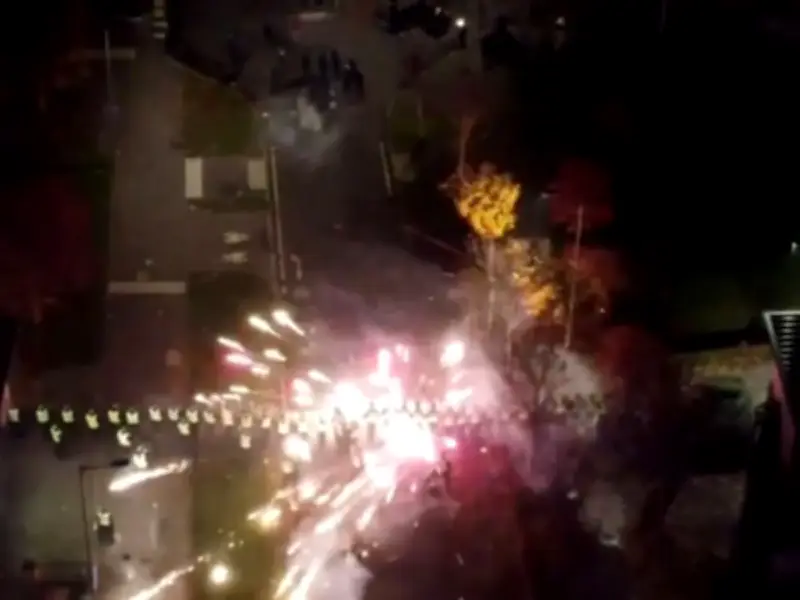
Last year Operation Moonbeam took place at known Bonfire Night troublespots across the country in an attempt to avoid a repeat of disorder seen in previous years, and the police reported a “notable” reduction in disorder – with calls down by 37%. But a public meeting held in Dumbarton in recent days to address anti-social behaviour has heard bonfire celebrations have started early in the area, with one inspector warning fireworks are “significantly more powerful” than previous years after “multi-shot barrages” were fired at a police van last year.
A Police Scotland spokeswoman said: “Local policing divisions assess intelligence and community concerns within their own areas and take appropriate enforcement action where necessary. This activity is supported by national specialist resources and coordinated through Operation Moonbeam. While proactive enforcement and prevention activity have helped reduce large-scale disorder in recent years, we continue to see incidents where fireworks are used recklessly or deliberately as weapons. Tragically, police officers, emergency workers and members of the public have all been placed at risk by this behaviour. Any attack involving fireworks is completely unacceptable and will be treated as a serious offence. We would encourage anyone with information about planned disorder, antisocial behaviour involving fireworks, or the sale and use of illegal fireworks to contact Police Scotland. Our message is clear: fireworks should be enjoyed safely and responsibly. Anyone using them to cause harm, fear or disorder can expect robust police action.”
Control zones introduced in Glasgow and Edinburgh
Fireworks will be banned in four parts of Glasgow from the end of the month, meaning residents cannot set them off anywhere in the zones – including in private gardens. Those who do risk being jailed for up to six months and fined as much as £5,000. Glasgow City Council introduced control zones last year, after long-running debate over noise and disruption caused by fireworks. This year’s crackdown – starting from October 30 and running until November 9 – covers Broomhouse, Pollok, Glasgow Harbour and Govanhill and Pollokshields.
The City of Edinburgh Council announced control zones between the same dates in 14 areas: Balerno, Calton Hill, Corstorphine, Gracemount, Liberton, Lochend, Longstone, Moredun, Niddrie, Seafield, Stenhouse/Gaskill, Sighthill/Broomhouse, West Pilton and Wester Hailes. More applications were submitted but not all were granted.