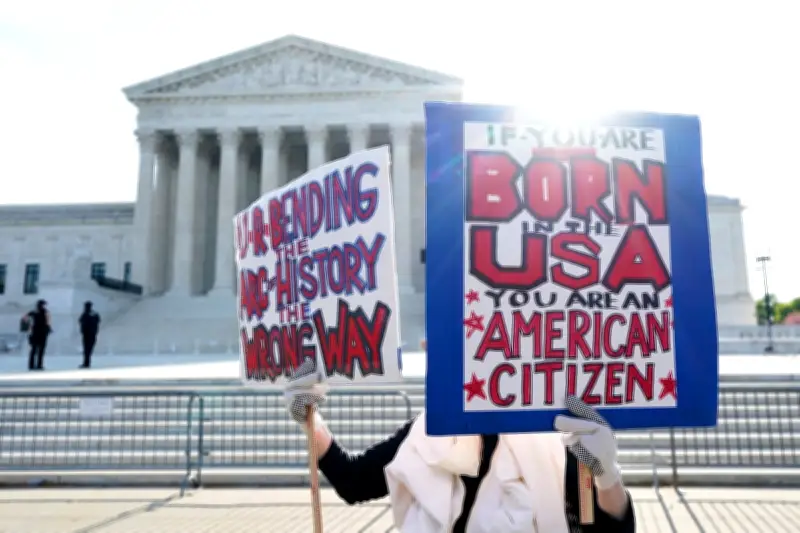
The US Supreme Court's decision on Tuesday to uphold birthright citizenship brought a wave of mixed emotions for immigrant families, advocates, and legal scholars. For Monica, an asylum seeker from Venezuela and one of the immigrant mothers at the center of the legal battle, the ruling affirmed that her son is unequivocally a US citizen. "I feel relief," she said. "He has a future." However, she noted lingering uncertainty for herself and her husband, both asylum seekers, given the broader immigration crackdown.
Court Blocks Trump's Executive Order
In a 6-3 ruling, the Supreme Court halted President Donald Trump's effort to unilaterally end the longstanding principle that almost everyone born on US soil is a citizen. The decision averted a crisis where more than 250,000 children each year would have been born in the US without citizenship, many of whom would be stateless. The court upheld the 14th Amendment's guarantee of citizenship to "All persons born or naturalized in the United States."
However, the ruling was not unanimous. Justice Brett Kavanaugh, in a concurring opinion, wrote that Trump's executive order ran counter to federal law but did not, in his view, violate the Constitution. The three conservative justices who dissented gave weight to fringe legal theories challenging the traditional understanding of citizenship, sparking concern among advocates.
Mixed Reactions and Broader Concerns
Lindsay Toczylowski of the immigrant advocacy group ImmDef said, "Today is not a day to celebrate but to reflect on the damage this case has done to our democracy." The decision comes amid Trump's broader immigration crackdown, which has enacted over 700 restrictions since January 2025. Recent Supreme Court rulings have upheld the stripping of legal status from 350,000 Haitians and 4,000 Syrians, allowed border officials to turn away asylum seekers, and granted broad discretion to deport lawful permanent residents.
Net migration to the US is in historic decline, and enforcement raids have separated tens of thousands of families. Sirine Shebaya of the National Immigration Project said, "We are watching this country move toward authoritarianism. Today's decision lets us hold on to increasingly slippery hope."
A Personal Triumph Amid Uncertainty
Monica, whose baby was born 10 months ago, expressed gratitude for the ruling. She plans to write a book detailing her fight against Trump's executive order, including how she managed morning sickness while speaking to lawyers and media. "We fought for him and all the children like him," she said. "We fought for the truth."