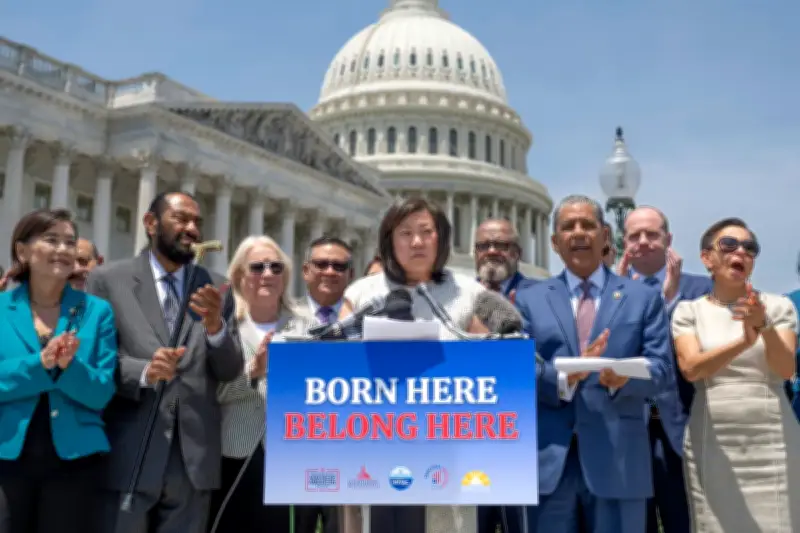
The US Supreme Court on Tuesday struck down Donald Trump's executive order seeking to end birthright citizenship, ruling that the order violated the 14th Amendment. Chief Justice John Roberts authored the majority opinion, joined by the court's three liberal justices and conservative Justice Amy Coney Barrett.
Majority Opinion: Citizenship as 'Right to Have Rights'
Roberts wrote that 'citizenship, then and now, was the right to have rights – to freely participate in our political community.' He emphasized that the 14th Amendment's framers extended that promise to 'every free-born person in this land.' The court found 'scant evidence' for the Trump administration's 'dramatically revisionist view' of the amendment, rejecting arguments that allegiance or domicile should limit birthright citizenship.
Concurrence and Partial Dissent
Justice Ketanji Brown Jackson wrote a concurring opinion, joined in part by Justice Sonia Sotomayor. Jackson rebuked Justice Clarence Thomas's reading of the 14th Amendment, calling his interpretation a 'narrow vision' that 'bears little relationship to the history of its ratification.' She warned against 'the distortion of historical facts' and argued that the amendment's universalist aims reject bloodline as a marker of birthright.
Justice Brett Kavanaugh agreed with the judgment but dissented in part, arguing that the executive order violated federal law rather than the Constitution. He noted that Congress could amend existing statutes to establish exceptions for children born to foreign citizens unlawfully or temporarily in the country, but has not done so.
Dissenting Opinions
Three conservative justices – Clarence Thomas, Samuel Alito, and Neil Gorsuch – filed dissenting opinions. Thomas argued that Black people were entitled to citizenship because they were Americans with 'no other homeland,' but that the same did not apply to children of foreign temporary visitors or illegal aliens. He wrote that 'many potential applications of the President's Order are consistent with the original public meaning of the Citizenship Clause' and expressed doubt that 'today's opinion will stand the test of time.'
Alito called the decision 'one of the most important in the history of the Court' and said the court 'has made a serious mistake.' He argued that the 14th Amendment confers citizenship only on children who owe 'allegiance solely to this country' at birth, not 'virtually everyone who happens to be born in this country.'
Historical Context and Impact
The court's writings totaled nearly 200 pages. The ruling delivers a blow to a central piece of Trump's second-term agenda and reaffirms the principle of birthright citizenship, which has been settled law for over a century. Roberts concluded: 'The Framers of the Fourteenth Amendment extended that promise to every free-born person in this land. We keep that promise today.'