The UK Supreme Court has reserved judgment on a Government appeal against a decision compelling it to hold a public inquiry into a Troubles killing linked to state agents.
Sean Brown, 61, chairman of Bellaghy Wolfe Tones Gaelic Athletic Club in Co Londonderry, was ambushed, kidnapped and murdered by loyalist paramilitaries as he locked the gates of the club in May 1997.
Government appeal over inquiry ruling
The UK Government appealed to the Supreme Court against a decision by Belfast courts to compel it to hold a public inquiry into the killing.
The murder investigation by the Royal Ulster Constabulary into the death of Mr Brown, who was shot six times in the head, closed in July 1998, but a later report by the Police Ombudsman for Northern Ireland concluded there was no evidence of an earnest effort to identify the killers.
Preliminary inquest proceedings in 2024 heard that more than 25 people had been linked by intelligence to the murder, including several state agents.
Family's long battle
The Court of Appeal in Belfast ruled that the ongoing failure to hold a public inquiry was unlawful after legal proceedings brought by Mr Brown's 89-year-old widow, Bridie Brown.
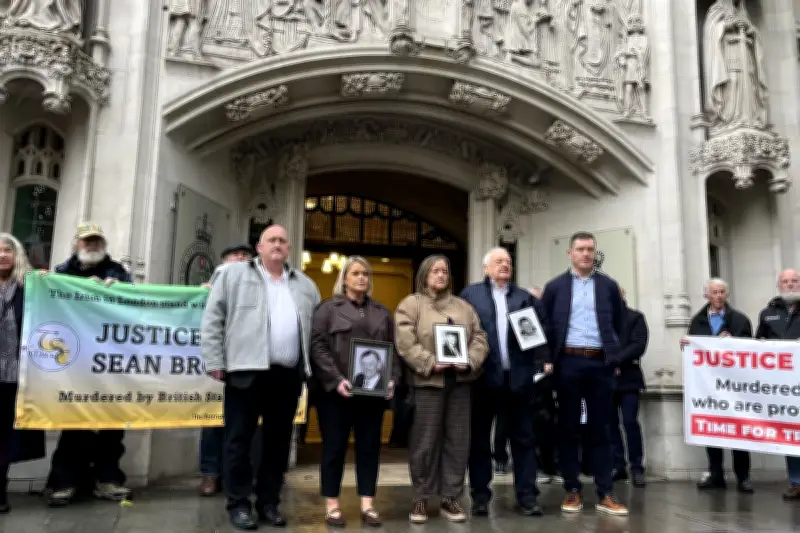
Mr Brown's daughters, Siobhan Brown and Clare Loughran, arrived at the Supreme Court in London on Tuesday carrying framed photographs of their father and were applauded by supporters.
Siobhan Brown told the crowd: "It's a really emotional day for us as a family. We never expected to be in this position but unfortunately the Government have taken us here."
She added: "It's been a long battle, almost 30 years since we lost our father, and the fight continues, and we're not gonna give up."
Arguments at the hearing
The Government agrees with the family that there has been no adequate investigation into the death, but in 2024 the then-Northern Ireland secretary Hilary Benn decided this should be done by the Independent Commission for Reconciliation and Information Recovery (ICRIR) without the need for a public inquiry.
In May, the Supreme Court ruled in another case that the independent commission, which investigates deaths related to the Troubles, was capable of delivering an investigation which did not diminish victims' rights.
At Tuesday's hearing, Sir James Eadie KC, for the Northern Ireland Office, said the decision of the Belfast court to compel a public inquiry had been made on the same basis that the Supreme Court had found to be in error in May. He said: "That should be the end of this appeal."
He argued the independent commission is capable of carrying out an appropriate investigation. In written submissions, Sir James said there was nothing about the case which should have caused the courts to "overstep the normal constitutional boundaries and, for the first time in any court anywhere in the UK, order that the executive establish a public inquiry".
He added: "The policy context is complex. It involves consideration of how legacy matters should be addressed going forward in Northern Ireland generally."
Sir James argued that an investigation by the commission could take place more quickly than a public inquiry, which could take two to three years.
In written submissions, Des Fahy KC, for Mrs Brown, said: "The murder of Sean Brown was initially attributed to the Loyalist Volunteer Force (LVF). It is now clear that state agents were involved."
He said the failures of the police investigation had been "egregious", adding: "There is good reason to believe that approach was deliberate and was undertaken with the objective of protecting state agents in the LVF."
Mr Fahy said the "exceptional circumstances of the murder and the failed state investigations that followed" justified the Court of Appeal's ruling despite the recent decision of the Supreme Court. He argued an investigation by the independent commission would lead to information being kept from the family and public "under the guise of national security".
He said the independent commission could not properly examine "whether agents of the state's executive security services and police in the Loyalist Volunteer Force were involved in the murder".
Sinn Féin MP John Finucane, who joined other MPs from the party outside court, said the treatment of Bridie Brown and her family had been "disgraceful". He said: "Almost three decades later, his family are still being denied the truth and are being dragged through court case after court case by a British Government clearly determined to conceal what happened. Rather than supporting the Brown family in their pursuit of truth and justice, the British Government has fought them every step of the way."
The hearing before Lord Sales, Lord Hamblen, Lord Leggatt, Lord Stephens and Lord Snowdon concluded on Tuesday afternoon, with a decision expected at a later date.