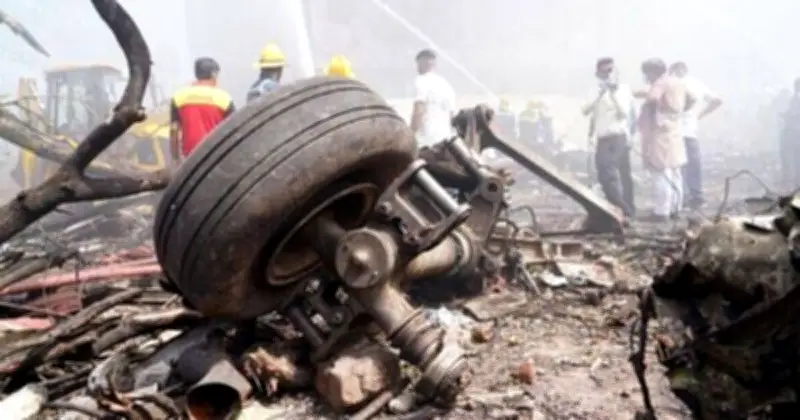
A year after the tragic Air India crash that claimed 260 lives, the official report has disclosed the harrowing final words exchanged between pilots. The Aircraft Accident Investigation Bureau (AAIB) report into Air India Flight AI171 reveals the chilling cockpit conversation captured on the voice recorder seconds before the Boeing 787 Dreamliner plummeted to the ground.
Air India Flight 171 departed from Vallabhbai Patel International Airport in Ahmedabad, Gujarat, India, on June 12, bound for London. On board were 230 passengers and 12 crew members. Just 32 seconds after take-off, the plane crashed into student accommodation approximately one mile from the airport. All but one of those on board were killed, along with 19 people on the ground. A further 67 people sustained serious injuries.
Chilling Cockpit Exchange
The disturbing details of the conversation moments before the catastrophic end were disclosed in the AAIB report. Data from the black box confirmed that within less than 60 seconds of departure, the plane plunged and struck a building used as doctors' accommodation at BJ Medical College and Civil Hospital.
Investigators believe that the fuel flow switches for both engines were incorrectly toggled almost simultaneously, just seconds after take-off, cutting off the fuel supply and triggering engine failure. The cockpit voice recording captured one pilot asking the other, "why did you cut off?" The other pilot responded that he did not do so.
The report states: "At about 08:09:05 UTC, one of the pilots transmitted 'Thrust not achieved... falling... MAYDAY MAYDAY MAYDAY'. The ATCO enquired about the call sign. ATCO did not get any response but observed the aircraft crashing outside the airport boundary and activated the emergency response."
Critical Questions Raised
The cockpit conversation has raised critical questions within the aviation community. Experts are questioning how the fuel switches could have been accidentally switched mid-flight, given they are designed to be 'highly reliable' and engineered to prevent inadvertent activation. To disengage each lever, it must first be lifted upwards before it can be switched, and they are equipped with protective guard brackets.
A Canada-based air accidents investigator told the BBC: "It would be almost impossible to pull both switches with a single movement of one hand, and this makes accidental deployment unlikely." US aviation safety expert John Cox reiterated: "You can't bump them [the fuel switches that feed the engines] and they move."
According to preliminary findings, there is no evidence of any obvious defect with the Boeing aircraft or its engines, indicating that neither GE nor Boeing will be held responsible for the accident.
Fuel and Flight Details
The AAIB report reveals the jet was carrying 54,200kg of fuel, well within 'allowable limits'. Fuel samples taken from refuelling were found to be 'satisfactory'. The report further stated: "The aircraft achieved the maximum recorded airspeed of 180 Knots IAS at about 08:08:42 UTC and immediately thereafter, the Engine 1 and Engine 2 fuel cutoff switches transitioned from RUN to CUTOFF position one after another with a time gap of 01 sec."
As fuel supply was cut off, engine N1 and N2 began to decrease from take-off values. The cockpit voice recording captured one pilot asking the other why he cut off, and the other pilot responded that he did not do so. The report stops short of explaining how the switch could have moved to its cutoff position.
Final Moments and Aftermath
The doomed flight had barely climbed to approximately 625 feet before crashing into a medical college complex. Contrary to early speculation, the AAIB ruled out bird strikes causing dual engine failure, as there was "no bird activity" near Ahmedabad at the time. The report notes: "No significant bird activity is observed in the vicinity of the flight path. The aircraft started to lose altitude before crossing the airport perimeter wall."
The damage assessment states: "The Aircraft was destroyed due to impact with the buildings on the ground and subsequent fire. A total of five buildings were impacted and suffered major structural and fire damages." Detailing the final moments, the report reveals the aircraft initially made contact with trees and an incineration chimney inside the Army Medical Corps compound before impacting the northeast wall of the first building.
Vishwash Kumar Ramesh, a British national, was the only survivor among the 242 passengers and crew. He miraculously escaped the wreckage despite sustaining injuries and has since provided a statement to investigators.