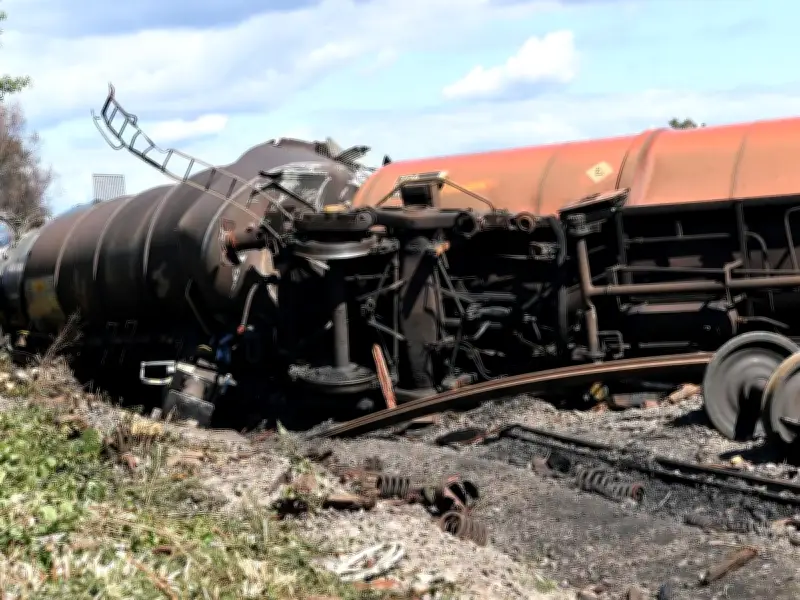
Network Rail, which is being sued over the train derailment near Llangennech in August 2020, has said in court documents that it should receive more than £30 million instead. The rail infrastructure manager filed a High Court claim in August against DB Cargo UK and Touax Rail, seeking more than £5 million in damages over the incident.
The derailment saw 10 wagons of a 25-wagon train leave the tracks, spilling 446,000 litres of fuel. Officials said the spill could have caused a "total environmental disaster".
Cause of the derailment
The Rail Accident Investigation Branch (RAIB) concluded in January 2022 that the derailment was caused by a set of wheels on one of the wagons locking, likely the result of a brake defect "arising from deficiencies in the design and maintenance of components".
Network Rail has claimed in court documents that Touax, which owned the wagon, was negligent in maintaining it, and that DB Cargo UK breached a contractual duty to ensure that "reasonable care" was taken in the maintenance.
Counterclaim and allegations
But in its defence to the claim, DB Cargo UK denied liability and said it was counterclaiming more than £30 million for Network Rail's alleged "breach of contract" and "negligence". Isabel Hitching KC, for the company, said this included more than £24.5 million spent on the emergency response and remediation following the derailment.
The barrister continued that the derailment was "caused or contributed to by Network Rail's negligence", claiming a signaller at a signal box "failed competently to observe the train" as it passed before the derailment. She said: "Had the signaller done so, they would have heard an unusual metal-on-metal sound or seen sparking emanating from (the wagon) and identified this as unusual or wrong."
"Upon noticing something unusual or wrong with the train, Network Rail's signaller ought immediately to have contacted the driver to stop the train. Had Network Rail's signaller done so, the train would have been brought to a safe stop, and the derailment would not have occurred." Ms Hitching also said Network Rail was "misconceived" to claim that DB Cargo UK was liable to pay damages, and that it "did not, and could not, exercise any control over Touax's maintenance" of the wagon.
Touax's defence and impact
Gerard Rothschild, for Touax, said in its defence that it "denies liability for the claim in full". He continued that negligence by "multiple other parties involved in the operation and maintenance of train, (the wagon), and the railway network", including DB Cargo UK and Network Rail, caused or contributed to the derailment. He said it is "denied that Touax committed any of the breaches of duty alleged", and that "at no material time did Touax undertake any direct maintenance" of the brakes on the wagon.
Mr Rothschild also said that the derailment "would have been averted but for Network Rail's failure to exercise reasonable care", and that if Touax was found liable, it would seek a "just and equitable reduction" due to Network Rail's "contributory negligence". DB Cargo UK and Touax have both also issued separate legal challenges over the derailment, which both companies asked to be heard alongside Network Rail's claim.
Following the derailment, 116,000 litres of fuel ignited, and 330,000 litres drained into surrounding wetlands which form part of a site of special scientific interest and a special area of conservation. No one was injured, but about 300 people were evacuated from the area due to the blaze, which took firefighters nearly two days to put out. The line was closed for six months after the incident and did not fully reopen for almost a year, with 30,000 tonnes of fuel-soaked soil having to be excavated.
The RAIB did not establish blame or liability for the derailment, but made nine recommendations to avoid similar accidents. A hearing in the claim is yet to take place.