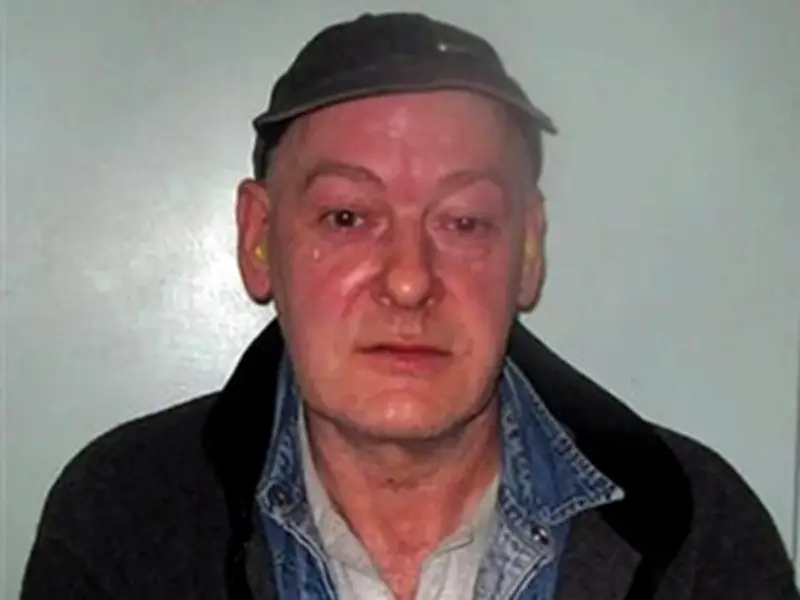
One of the UK's most notorious serial killers has died in prison without revealing what he did with his victims' heads. Kirkdale-born John Sweeney, who became known as the "canal killer", received a whole-life sentence in 2011 for the murders of two former girlfriends, Melissa Halstead and Paula Fields.
He threw their mutilated bodies into canals in England and the Netherlands and was not linked to their disappearances until he was convicted of an axe attack on another girlfriend. Police suspected he had murdered other former partners who had not been seen for years.
Death in prison
The ECHO reported on Wednesday that Sweeney had died at HMP Whitemoor in Cambridgeshire on August 14 aged 69. The Times reported Sweeney, who called himself the "scalp hunter", died of cancer.

A spokesperson for the Prison Service said: "These were horrific crimes and our thoughts remain with the victims and their loved ones. As with all deaths in custody, the prisons and probation ombudsman is investigating and it would be inappropriate to comment further before the conclusion of its findings."
Victims and investigation
The dismembered body of American photographer and former model Ms Halstead, 33, was found in a bag floating in a canal in Rotterdam in May 1990. Her remains were not identified for 18 years.
The body of Halewood mum Ms Fields, 31, was found in ten pieces in six bags by schoolboys in the Regent's Canal in Camden, London, in February 2001.
Police questioned Sweeney over the disappearance of three other former girlfriends but he was never charged with any further killings. Dutch police also investigated claims that Sweeney boasted of killing two German men.
Background and crimes
Sweeney, a carpenter by trade, boasted of his violence in lurid paintings and verses found at his home. In one picture, which showed a bloody axe, he gave himself the heinous nickname.
He was born in north Liverpool in 1956 and spent most of his early years living with his mother in Skelmersdale, where he trained as a carpenter and joiner. He married in 1976 and had children, but the relationship was deeply troubled and they divorced three years later. They tried to rekindle the relationship, but with the issues remaining, Sweeney had moved to London by the mid-1980s.
This is where he met Ms Halstead and the pair started a relationship. She was deported from the UK in 1988, but Sweeney followed his then-girlfriend to Vienna and Amsterdam. Her family in America had lost contact with her in the years after she was deported - and at the turn of the 1990s her remains were fished out of the Westersingel canal.
Just months after murdering Ms Halstead, Sweeney met his new girlfriend Delia Balmer in a pub in Camden. During their three-year relationship, she was subjected to a terrifying campaign of violence at the hands of Sweeney. At one point, she claims he kept her prisoner in her flat and placed a gun to her head.
Then, three days before Christmas in 1994, Delia got home from her job as a nurse to find Sweeney waiting for her with an axe. He attacked her with an axe and pulled out a rusty knife. The horrifying ordeal in her apartment stairwell left her with stab wounds to her breast and thigh, and without the little finger on her left hand.
By the time police turned up Sweeney was long gone and went on the run from authorities. When Sweeney was finally caught in 2001, he was arrested for the attempted murder of Ms Balmer - but not before he claimed his next murder victim.
Ms Fields was a 31-year-old mum from Liverpool, who became addicted to class A drugs in the late 1990s and worked the streets of London as a sex worker. It was while in this vulnerable position that Ms Fields met Sweeney, who was back in the capital living under a false name.
Conviction and aftermath
Ms Fields went missing in December 2000 with her remains being dredged two months later. Like Ms Halstead, Ms Field's head, hands and feet were missing. Sweeney was tracked down by authorities in 2001 and convicted of the attempted murder of Ms Smith back in 1994.
While he was serving his time for the attack on his former girlfriend, Sweeney was finally convicted of the two gruesome murders that occurred a decade apart.

Sweeney's home revealed horrifying references to his violence, including "demonic" drawings of women's body parts, references to "666" and a female skull hanging from a belt. A poem also referenced Ms Halstead's murder, revealing she was "food to feed the fish".
Brian Altman KC, for the prosecution, told Sweeney's trial how these possessions revealed "an obsessive and virulent hatred of women". Sweeney refused to leave his prison cell to attend his sentencing, with Mr Justice Saunders, presiding, imposing a whole-life order.
The judge said: "These were terrible, wicked crimes. The heads of the victims having been removed, it is impossible to be certain how they were killed. The mutilation of the bodies is a serious aggravating feature of the murders."
"Not only does it reveal the cold-blooded nature of the killer, but it has added greatly to the distress of the families to know that parts of the bodies of their loved ones have never been recovered."
Speaking following Sweeney's sentencing, Ms Fields' family said: "We and the rest of Paula's family want the public to know that this time in 1999 to 2000 was a very small part of her life that led to her demise. For 29 years Paula was a normal girl, a loving mother, daughter, sister and aunt."
"God has given us strength and courage to bear and to fight this awful blow. What it has meant to lose Paula, no one will ever know or understand. She has suffered this terrible thing and we know she is never coming back. We were never able to say goodbye. We hope to God that John Sweeney will never be released, for him to do to another person what he did to Paula."
Following Sweeney's murder convictions, detectives appealed for information about five other people they believed could be his victims.
Detective Chief Inspector Howard Groves said at the time: "This investigation will continue as we seek to identify and trace other potential victims in the UK, Netherlands and elsewhere in Europe, who may have suffered a similar fate to that of Melissa and Paula."
Ms Balmer later wrote the book Living With a Serial Killer which was turned into the four-part true crime drama called Until I Kill You.