
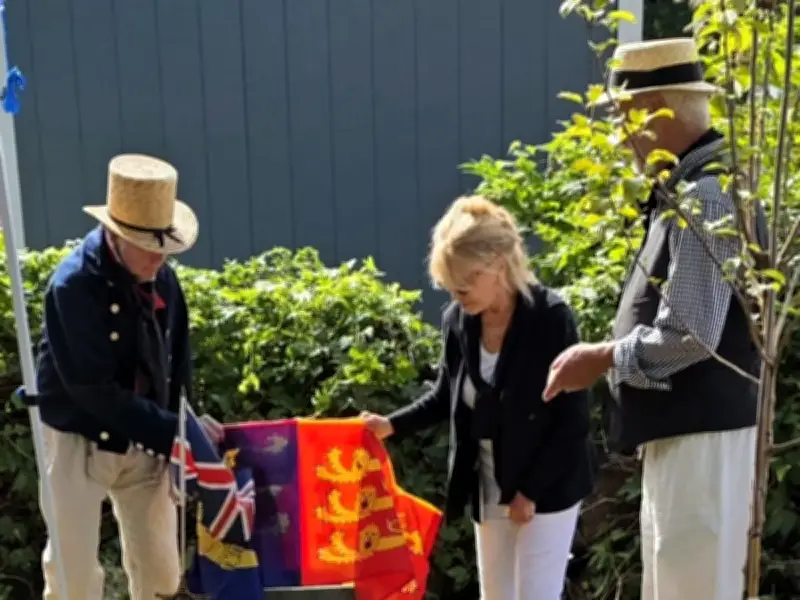
A Scottish sailor who died in a war more than 200 years ago has finally been identified after spending centuries under a gravestone marked simply as 'unknown'.
William Adamson, from Pittenweem in Fife, was killed in 1814 during the War of 1812 between Britain and the USA. He was buried in the village of Mystic, Connecticut, after a confrontation between American militia and a British cutter from the HMS Terror bomb ship.
Although the militia never learned his name, they buried him “with reverence”, according to historical accounts, treating the fallen enemy with dignity and respect.
Research uncovers the sailor's identity
Now, painstaking research by local historians has finally uncovered his identity, as reported by What's The Jam.
Researcher Grace Cleere said Adamson had joined the Royal Navy in 1807 as an able seaman, either signing up or being forced into service, before rising to the rank of quarter-gunner.
By 1814, he was serving aboard HMS Terror, a specialised warship involved in the North American campaign during the War of 1812.
Records reveal his final days
Cleere and other historians spent years investigating the ship's records before finding that Adamson's name appeared in its personnel logs during the second week of August 1814, then disappeared after the skirmish.
She said: “By August 17th, he was no longer in the rolls.”
Adamson, who was about 43 when he died, was probably manning a small artillery piece at the front of an armed British rowboat, known as a cutter, when he came under American fire.
Commemoration and legacy
He was the sole casualty of the encounter, while other crew members were taken prisoner in what is now the Groton Long Point neighbourhood.
The skirmish came days after a squadron of British ships led by Captain Thomas Masterman Hardy bombarded Stonington in August 1814, exchanging cannon fire with local militia.
The Americans first sent a boat down the Mystic River to test the British blockade before ambushing a cutter sent to respond to the incursion.
Adamson was buried beneath an apple tree in Packer Cemetery, leaving behind a widow and two daughters in Scotland.
In August, a gathering was held at the cemetery to honour him by name for the first time, with plans to place a new brass plaque at his gravesite.
Cleere said: “We have discovered more and more descendants of William Adamson's family still living in the Pittenweem area of Scotland. I'm hoping to hold a tribute every year at William's gravesite.
“Will try to make it on or around the date he was buried in 1814.”
She added: “The story of how William Adamson lost his life is extraordinary.
“He was buried with reverence by the Americans, and why he lay unidentified for more than two centuries.”
The discovery was made possible through research into Royal Navy archives.
Cleere, a former civilian writer and educator for the US Navy, has helped organise a further event at the historic cemetery on New London Road in West Mystic.
HMS Terror later became associated with another chapter of British naval history. The ship took part in the siege of Fort McHenry in Baltimore, which inspired Francis Scott Key's poem that eventually became the US national anthem.
In 2016, the wreck of HMS Terror was found in the Arctic Ocean, where it had been lost in the 1840s during a failed British expedition to find the fabled Northwest Passage to the Pacific.




