

Mathematical Model Explains Why Overtaken Cars Keep Reappearing at Traffic Lights
Have you ever experienced the frustration of overtaking a vehicle, only to find it pulling up right beside you minutes later at a red light? This common driving phenomenon now has a scientific explanation, complete with a name inspired by horror cinema.
The Voorhees Law of Traffic
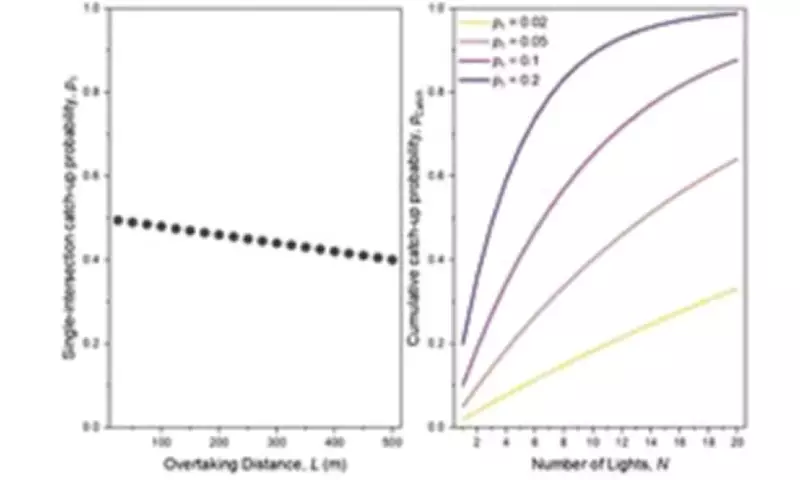
Researchers from Dublin City University have developed a mathematical model to explain this infuriating occurrence, dubbing it 'The Voorhees Law of Traffic' after Jason Voorhees, the slow-walking yet persistently catching antagonist from the Friday the 13th film franchise. Dr Conor Boland, who led the research, explained that traffic light timing systematically erases small speed advantages, allowing slower vehicles to repeatedly catch up.
'You pass a car, and then a few minutes later, it ends up beside you again,' Dr Boland told the Daily Mail. 'The opposite scenario also occurs regularly. A car overtakes you, and then you find yourself catching up with it further down the road.'

Psychology Meets Statistics
According to Dr Boland, this phenomenon operates on two levels. First, there's a psychological component: we tend to remember these moments vividly because they feel surprising and frustrating. Second, and more fundamentally, the effect is built directly into how traffic systems function.
'Traffic lights and stop-start driving naturally shuffle cars around,' he explained. 'You might gain a temporary advantage, but small delays, red lights, and variations in driving behavior tend to neutralize that lead. Over time, this means the same vehicles frequently end up near each other repeatedly. The effect isn't horror—it's statistics at work in everyday driving.'
Compounding Probabilities at Intersections
The research, published in the prestigious journal Royal Society Open Science, demonstrates how probabilities compound across multiple intersections, creating what feels like an almost supernatural inevitability. Dr Boland elaborated that red-light timing specifically cancels out minor speed differences, enabling consistently slower cars to catch up again and again.
'Every time this would happen in traffic, I would point it out,' Dr Boland recalled. 'I kept saying it was like Jason Voorhees—no matter what you do, he somehow keeps appearing. Eventually my wife told me I should probably stop talking about it and actually do something with it. That was when I sat down to investigate whether there was a simple explanation behind it.'
Practical Driving Implications
When it comes to practical advice for drivers hoping to maintain their position, Dr Boland's findings suggest that aggressive lane-changing provides less advantage than many believe. 'Any benefit from switching lanes is often short-lived,' he noted. 'In reality, staying in your lane and maintaining steady driving works just as effectively and creates far less stress.'
In simple terms, whether you pass another vehicle or get passed yourself, there's a significant probability you'll end up alongside that same car again. 'That is simply how traffic behaves,' Dr Boland concluded, emphasizing that this phenomenon reflects the statistical nature of traffic flow rather than any mysterious force.






