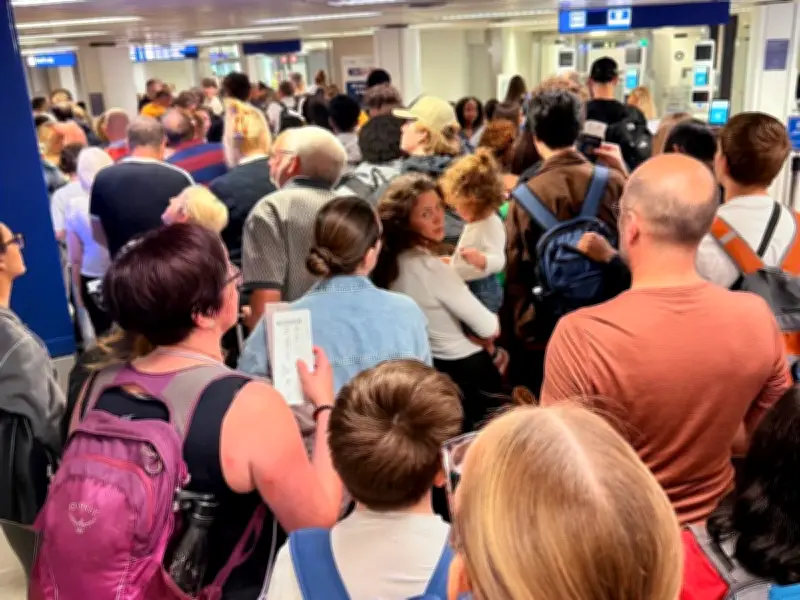
Ryanair has issued a stark warning to passengers ahead of the summer holiday season, citing the European Union's new Entry/Exit System (EES) as a major cause for concern. The airline has called for the EES, which was fully rolled out in April 2026, to be postponed until later in the year to avoid 'long and avoidable queues' during peak travel months.
Ryanair's Urgent Call for Postponement
Ryanair is urging travellers flying between Schengen and non-Schengen destinations this summer to arrive at airports earlier than usual. The airline warns that tourists 'face passport queue chaos' because of the EES, which replaces manual passport stamping with biometric data collection for non-EU travellers entering the Schengen Area.
Ryanair’s chief operations officer Neal McMahon stated: “As schools break up and Europe enters the busiest travel period of the year, it is clear that EES is still not ready for peak summer volumes. Passengers and families should not be used as guinea pigs for a half-baked passport control system that risks creating long queues, missed flights and unnecessary stress at airports this summer. It is as simple as postponing EES until September, as other EU countries like Greece have already done.”
Port of Dover Echoes Warnings
The warnings are echoed on the UK side of the Channel. Doug Bannister, Chief Executive of the Port of Dover, cautioned that the cross-channel gateway faces 'repeated episodes of severe congestion' as summer traffic peaks. The port previously declared a 'critical incident' during the May half-term when peak wait times reached four-and-a-half hours against a volume of 8,500 tourist vehicles. Daily traffic volumes are expected to exceed 12,000 vehicles in the coming weeks.
In a letter to the House of Commons’ Business and Trade Committee (BTC), Bannister revealed that despite a £40 million investment in a purpose-built processing facility, the site cannot be used as intended due to the 'inoperability of the EES kiosk technology' – an issue he stated is 'completely beyond the control of the port'.
How the Entry/Exit System Works
The Entry/Exit System, fully rolled out in April, replaces manual passport stamping for non-EU travellers entering the Schengen Area. Under the new regulations, passengers from third-party nations – including the UK – must have their biometric data registered to enter the 29-country zone. This protocol requires travellers to have their fingerprints scanned and a digital photograph taken.
For most British travellers, this biometric registration takes place upon arrival at European airports. However, due to juxtaposed border arrangements, these checks are conducted prior to departure at the Port of Dover, Eurotunnel’s Folkestone terminal, and London St Pancras railway station.
Parliamentary Scrutiny and Government Response
The escalating situation has drawn sharp focus in Parliament. Liam Byrne MP, Chair of the BTC, pressed the government on the matter, stating: 'The modelling has been done and we know the chaos that will follow.' He also questioned what measures were being taken to 'avoid this peril'.
Business Secretary Peter Kyle responded that the Department for Transport is actively engaged with EU counterparts to mitigate the disruption. Kyle emphasised that the government is utilising its 'functional' and 'productive' relationship with the EU to ensure the worst-case gridlock scenarios do not materialise.