

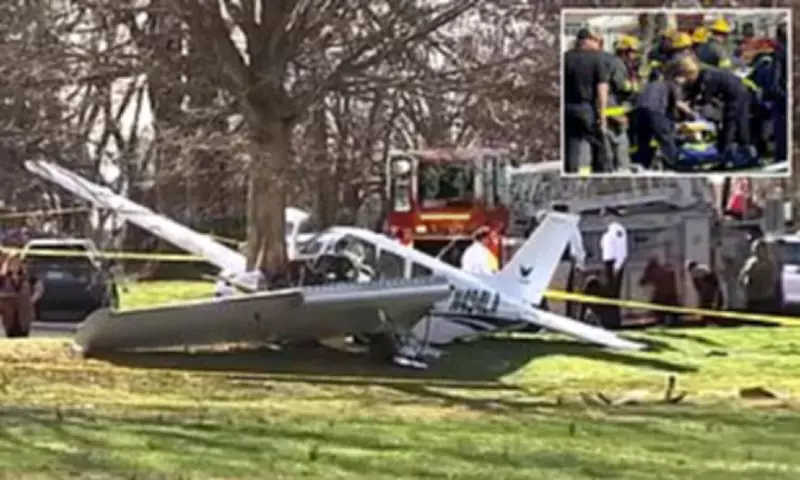
Philadelphia Flight School Plane Crashes in Park After Engine Failure
A flight instructor and a student pilot miraculously survived a terrifying crash into a tree at a Philadelphia park after their aircraft suddenly lost all engine power. The incident occurred on Wednesday when the Piper Pilot 100i plane, owned by flight school Fly Legacy Aviation, experienced catastrophic engine failure and clipped a tree while attempting an emergency landing at Friends of Fluehr Park.
Severe Injuries and Hazardous Conditions
Both the flight instructor and the student pilot sustained severe injuries in the dramatic crash. The student pilot was identified as a 43-year-old off-duty Philadelphia police officer with seventeen years of distinguished service. Philadelphia Fire Commissioner Jeffrey Thompson confirmed both men remained conscious and alert following the impact, though emergency responders faced additional challenges.
'They were both alert and oriented. We were very fortunate there was no resulting fire,' Commissioner Thompson stated. 'We were very lucky. This is a residential neighborhood, so this could have been very different.' The crash caused a small but significant fuel spill that required immediate attention from hazardous materials teams dispatched to secure the scene.

Desperate Emergency Communications
The terrifying sequence of events unfolded as the aircraft was returning to Northeast Philadelphia Airport following approximately forty minutes of routine flight training. Audio recordings obtained by local media reveal the pilot's increasingly urgent communications with air traffic control as the situation deteriorated rapidly.
'We are having a little bit of engine problems right now,' the pilot initially reported to controllers. When asked if they required an emergency landing, the response became more desperate: 'We need to land now.' Air traffic controllers attempted to provide landing instructions, but the pilot insisted they lacked sufficient time to reach the runway safely.
'Turn left immediately and then left down by the runway,' instructed the air traffic controller. The pilot's chilling reply captured the imminent danger: 'We are not making it through.' With options disappearing, the controller ultimately advised: 'Wherever you can, just try to find an open area and put it down.'
Flight School's Safety Record and Investigation
Fly Legacy Aviation General Manager Alex Souponetsky expressed profound gratitude that both individuals survived the harrowing incident. The company has operated in Philadelphia for eleven years without previous accidents, maintaining a fleet of twenty-four aircraft that complete approximately thirty flights daily with over two hundred active students.
'I'm just very grateful everybody is alright. This is not common. This is our first accident,' Souponetsky emphasized. 'We have 30 flights every day. We have a fleet of 24 airplanes. We have over 200 students with thousands of graduates.'
Souponetsky detailed how the pilots lost engine power while flying over the Delaware River, immediately reported the emergency via radio, and attempted to glide the aircraft back toward the airport. 'Very grateful to the skill and knowledge of our instructor who took control of the plane and started gliding it towards the airport and he almost made it,' he acknowledged.
Remarkably, the involved aircraft was manufactured in 2021, representing what Souponetsky described as 'a brand-new airplane' in flight training terms. The general manager stressed the school's adherence to strict maintenance guidelines, noting regular inspections but expressing uncertainty about the engine failure's specific cause.
Federal Investigations Launched
The National Transportation Safety Board and Federal Aviation Administration have initiated formal investigations into the crash. In an official statement to local media, the NTSB confirmed: 'The NTSB has opened an investigation. The NTSB will work with the FAA, which has personnel on the ground to conduct documentation and the initial examination. There are no immediate plans to send an NTSB investigator to the scene.'

This incident highlights the inherent risks of flight training while demonstrating the critical importance of pilot training and emergency procedures. The miraculous survival in a residential area underscores how much worse the outcome could have been, with investigators now working to determine precisely what caused the engine failure that nearly ended in tragedy.





