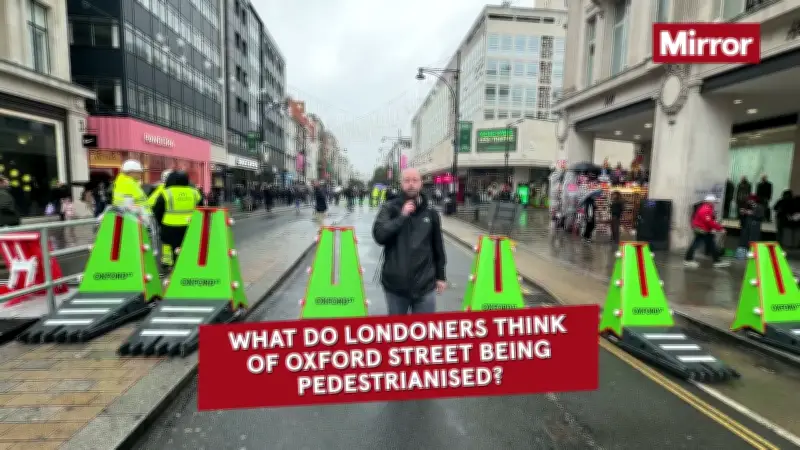
Oxford Street has gone traffic-free, with buses, taxis and cyclists no longer able to access the famous London high street between 7am and midnight each day. The change took effect from 7am today, covering the half mile between Orchard Street and Great Portland Street, with vehicles being directed to nearby roads instead.
Delivery drivers will be able to access the road between midnight and 7am. Barriers at each end of the pedestrianised space will be lowered in an emergency, allowing ambulances to enter without restriction.
Visitors welcome more space
Despite gloomy and wet weather on the first day, many visitors said they were happy with the change. Angie Saunders, 58, a therapist from north London, told The Mirror: "There might be a sense of community...We get people from all over the world coming here, so I think the fact that you can, perhaps sit, and chat."
"Just hang out on the street instead of it being really busy with cars, I think that's quite nice. I hope that's what the idea of this is about, To try and create a bit more of community sense up here as well."
Rachel Harvey, 53, who works at a school in Lowestoft, Suffolk, said: "I think it's fantastic what they've done. You're not worried about the traffic so much, you can walk at ease, knowing you're safe, and actually have a good, proper look [around]." Her husband, factory worker John, 62, said they came specifically to see the changes.
Concerns over safety and congestion
Trainee teacher Loraine Anderson, in her 40s, from Romford, east London, said she and her husband Anthony, 50, came to Oxford Street at Christmas but were put off by the packed pavements. "We just decided to go home," she said. "And then we just came up separately without the children because of safety, even if they've got a hold of your hand. So, hopefully with the opening up of pedestrianisation, it'll be a much nicer trip. It's much calmer."
Communications director Andrew Johnson, 59, from south London, said: "These pavements got absolutely rammed with people. [It was] really difficult to walk around, particularly if you wanted to get down to that western end there where the big department stores are. So, clearly having more space and simply being able to walk around and do your shopping is a good thing." Headteacher Andrew Pickering, 50, from Lewisham, southeast London, added: "I get so frustrated walking slowly behind tourists, I'm a fast walker. So, I would benefit from more space and I'd use it more."
However, Christine Hill, who works at a business in the area, raised concerns about unintended consequences. She said: "I suppose it king of makes me think of the terrorism situation. If it's a target. I run a five-storey building and we sometimes have to call ambulances for some elderly people in our building. It just means all the surrounding roads are now much more congested, and they've closed the main route that came into our building. We have concerns around security. I work in a high-value goods business. Will there be different patterns of pickpockets targeting people. It's just changed the dynamics and we will have to see how that actually plays out."
Parking and future works
There is no parking in the traffic-free zone, said Transport for London (TFL). Blue Badge parking bays and taxi ranks have been relocated to nearby roads. Works along Oxford Street are expected to continue as "public spaces" are developed, with TFL adding disruption would be "kept to a minimum" during the Christmas period.
The Mayor of London hailed the change as a "truly momentous occasion for the capital". He said: "For centuries, Oxford Street has reinvented itself, adapting to changing times and helping shape British culture along the way. There has been talk of pedestrianising Oxford Street for decades. After so many false dawns, and now working with a Government who share the scale of my ambition, I'm proud that we're finally unlocking a new era for the street."
He added that the transformation will turn the high street into a world-class pedestrian space, with flagship retailers alongside new shops and workplaces, and bring experiences from sport to fashion and cultural events. Revitalising Oxford Street, he said, will boost jobs and economic growth in the capital and help build a "better, greener and more prosperous London for everyone".