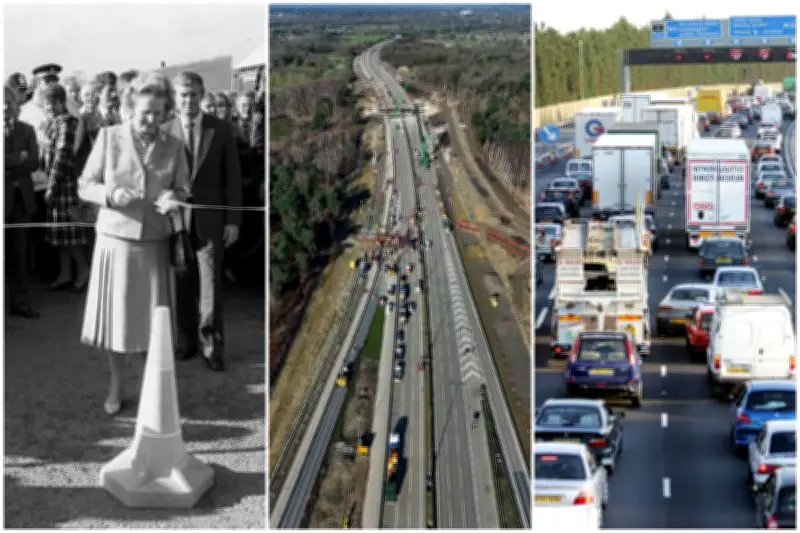
The M25 celebrated its 40th anniversary on 29 October, prompting fresh research into how much businesses still depend on London's orbital motorway, even as a quarter of local van drivers have declined jobs because journeys on it are too unpredictable.
The motorway's queues inspired Chris Rea's 1989 hit The Road to Hell, and it has been dubbed the UK's biggest car park. Those nicknames have proven harder to shift than the traffic, yet the M25 has also inspired sightseeing trips and acquired a following for some of its graffiti; there is even a cricket ground above it.
A route decades in the making
Margaret Thatcher opened the final section of London's orbital motorway on 29 October 1986, completing a route intended to take traffic away from London and surrounding towns. The idea of an outer ring road had been discussed as far back as 1905, with the first stretch, between South Mimms and Potters Bar, opening in 1975 and the final link between London Colney and South Mimms following 11 years later.
Even at the opening ceremony, there were complaints that it wasn't big enough. Thatcher criticised "those who carp and criticise when they ought to be congratulating Britain on a magnificent achievement". However, widening a section was already on the government's to-do list.
The 117-mile motorway doesn't quite complete the circle: the Dartford Crossing is officially the A282. Its first service area arrived after the completed road, with South Mimms opening in 1987 and Thatcher returning for the official ceremony that June.
From sightseeing to safety
Building the M25 involved planting some two million trees to help it blend into the countryside. Near Epping, a cricket ground was reinstated above the Bell Common Tunnel, giving the motorway an unusually sporting roof.
In 2012, a four-hour sightseeing coach tour around the M25 cost £15 a head and sold out, prompting extra dates. Heathrow's Terminal 5 and a shopping centre were among the attractions.
The "Give Peas a Chance" graffiti on the Chalfont Viaduct, between junctions 16 and 17, had a Facebook following of more than 8,000 by 2018. When it was painted over that September, a petition called for its restoration and protection.
The M25 has other cultural connections. Dance duo Orbital took their name from the road and the rave scene around it. In Terry Pratchett and Neil Gaiman's Good Omens, the motorway is treated as evidence of demonic interference.
Safety record and business reliance
On 11 December 1984, before the full route had opened, nine people were killed in a 26-vehicle pile-up in dense fog. The police investigation identified excessive speed by some drivers for the conditions, and Ministers subsequently announced trials of fog detectors on the motorway.
Analysis of Department for Transport data for 2021 to 2025 shows the M25 recorded about 7.5 injury collisions per 100 million miles travelled by vehicles, compared with 4.8 on the M1. However, its rate of fatal collisions was lower. Motorways generally compare favourably with other roads: in 2025, they carried 21 per cent of Great Britain's traffic but accounted for 6 per cent of road deaths.
A survey commissioned by vehicle data company Geotab, involving 1,000 regular M25 van drivers from the South East, found 84 per cent said their businesses couldn't operate as effectively without it. Some 79 per cent described it as frustrating, while a quarter had declined jobs because journeys could be too unpredictable.
Geotab's analysis of connected vehicles found the M25's eight most congested stretches were all between junctions 10 and 20. Across 12 sample weeks between September 2025 and August 2026, the clockwise journey from Heathrow towards the M4 averaged 9.2 minutes at 4pm, compared with three minutes at 7pm.
Geotab vice-president Aaron Jarvis said, "The M25 is easy to complain about, but the research shows how much businesses across the South East depend on it. For many operators, there simply isn't a practical alternative."
Drivers favoured a range of improvements, including quicker incident clearance, better coordination of roadworks and better traffic information. Forty years on, the road to hell still has an essential job to do; its regulars would simply like a better chance of arriving when they said they would.