

LaGuardia Airport Tragedy: A Minute-by-Minute Reconstruction
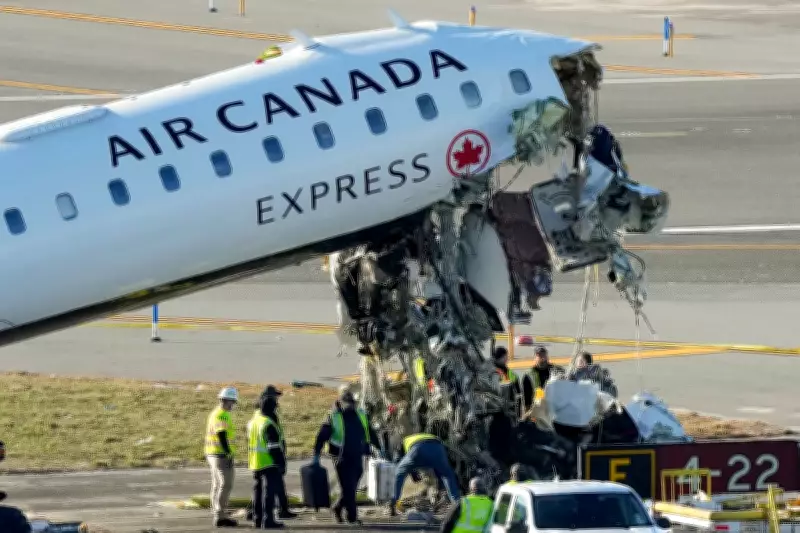
In less than sixty seconds, a routine Sunday evening landing at New York's LaGuardia Airport descended into a catastrophic and deadly collision. The fatal impact between an Air Canada Express flight and an airport fire truck, however, was the devastating culmination of a chain of events that began much earlier that night.
This detailed timeline has been constructed based on a comprehensive review of air traffic control recordings, data from the Federal Aviation Administration (FAA), publicly available flight tracking information, and preliminary findings from the National Transportation Safety Board (NTSB), which included analysis from the jet's cockpit voice recorder.
The Prelude: Delays and Disturbances on the Ground
10:12 p.m.: The sequence of events initiates with a significant delay. Air Canada Express Flight 8646, operated by Jazz Aviation, finally departs from Montréal–Trudeau International Airport. Its takeoff is two hours and thirteen minutes behind schedule, placing it among a surge of late-arriving flights into a congested LaGuardia.

11:16:42 p.m.: On the ground at LaGuardia, United Airlines Flight 2384 aborts its takeoff for a second consecutive time due to an anti-ice warning light illuminating in the cockpit.
11:20:48 p.m.: The situation escalates. The United pilot reports a strange odor onboard. "We have an odor on the plane as well here at this time," he states, adding, "We are going to be going back to the gate, request fire as well," using aviation shorthand to summon the airport's fire and rescue team.
11:21:12 p.m.: Another pilot chimes in on the frequency, suggesting, "If that’s a sewer smell … we smelled that too going around the terminal there."
11:22:24 p.m.: A controller inquires if the odor is smoke. The United pilot clarifies, "No, it was a weird odor. I don’t know exactly how to describe it," and notes he cannot reach anyone to secure a gate assignment.
11:24:49 p.m.: The controller confirms no gate is available but asks, "Do you still need us to send fire there?" The pilot affirms, citing the persistent odor.
11:27:44 p.m.: The United pilot informs the controller he does not plan to evacuate the aircraft. He is instructed to move to another taxiway.
11:29:54 p.m.: Confusion mounts as United 2384 makes an incorrect turn, ending up in a different section of the taxiway. The controller, seemingly unconcerned, advises, "You can just stay over there … and we’ll have the guys go over there."
11:31:41 p.m.: The situation reaches a critical point. United 2384 declares an emergency. The pilot reports, "The flight attendants in the back are feeling ill because of the odor. We will need to go into any available gate at this time."
11:31:59 p.m.: The controller urgently reiterates the request for a gate, telling his colleague, "now they’re declaring an emergency. They want to get out."
11:33:39 p.m.: With no gate available, the controller informs United 2384 that fire trucks are en route with a stair truck should they choose to evacuate. "Let me know if you do," he says.
Converging Paths: Landing Clearance and Emergency Response
11:34:18 p.m.: Meanwhile, Air Canada Express Flight 8646 is on final approach. In a standard procedure, the approach controller instructs the pilots to contact LaGuardia's control tower for landing guidance.
11:35:08 p.m.: Flight 8646 receives clearance to land on Runway 4/22.
11:36:45 p.m.: At the airport, a controller asks, "Is there a vehicle that needed to cross the runway?"
11:37:00 p.m.: A firefighter responds, "Truck 1 and company, LaGuardia Tower, requesting to cross 4 at Delta," indicating a request to use Taxiway D to cross the very runway where Flight 8646 is moments from touching down.
11:37:05 p.m.: The controller authorizes, "Truck 1 and company cross 4 at Delta." Simultaneously, on another frequency, the pilot of the odor-plagued United flight reports finally receiving clearance to proceed to a gate.

11:37:08 p.m.: A firefighter in Truck 1 confirms, "Truck 1 and company crossing 4 at Delta."
11:37:11 p.m.: An electronic callout in Flight 8646’s cockpit signals the aircraft is just 50 feet above ground level.
11:37:12 p.m.: A controller instructs the pilot of an outbound Frontier Airlines flight to halt on a taxiway.
The Collision: Sixty Seconds of Chaos
11:37:15 p.m.: Realization dawns. A controller urgently says, "Sorry, Truck 1," as Flight 8646 descends onto Runway 4/22.
11:37:16 p.m.: Panic erupts over the frequency. The controller frantically commands the fire crew, "Stop. Stop Stop. Stop. Truck 1. Stop. Stop. Stop. Stop."
11:37:17 p.m.: Flight 8646’s cockpit voice recorder captures a sound investigators identify as consistent with the landing gear making contact with the runway surface.
11:37:19 p.m.: The first officer, who was piloting the aircraft, transfers control to the captain.
11:37:20 p.m.: The controller continues his desperate pleas, "Stop Truck 1. Stop. Stop Truck 1. Stop." As he speaks, an alarm begins to beep in the background.
11:37:25 p.m.: Flight 8646 slams into the fire truck. The cockpit voice recording ceases abruptly.
Immediate Aftermath and Controllers' Anguish
11:37:45 p.m.: A controller directs the next inbound aircraft to "go around," aborting its landing. He then attempts to contact Flight 8646. "I see you collided with a vehicle there. Just hold position. I know you can’t move. Vehicles are responding to you now." Emergency vehicles race toward the crash site.
11:55:37 p.m.: The pilot of another aircraft tells a controller, "That wasn’t good to watch." The controller, visibly distressed, responds, "Yeah, I know. I was here ... We were dealing with an emergency earlier. I messed up." The pilot offers a somber consolation: "Nah, man, you did the best you could."
This tragic timeline underscores the complex, high-pressure environment of air traffic control and how a cascade of minor issues—a delayed flight, a mechanical warning, a mysterious odor, and gate congestion—can intersect with catastrophic consequences, leaving investigators to piece together the final, fatal seconds at LaGuardia.





