
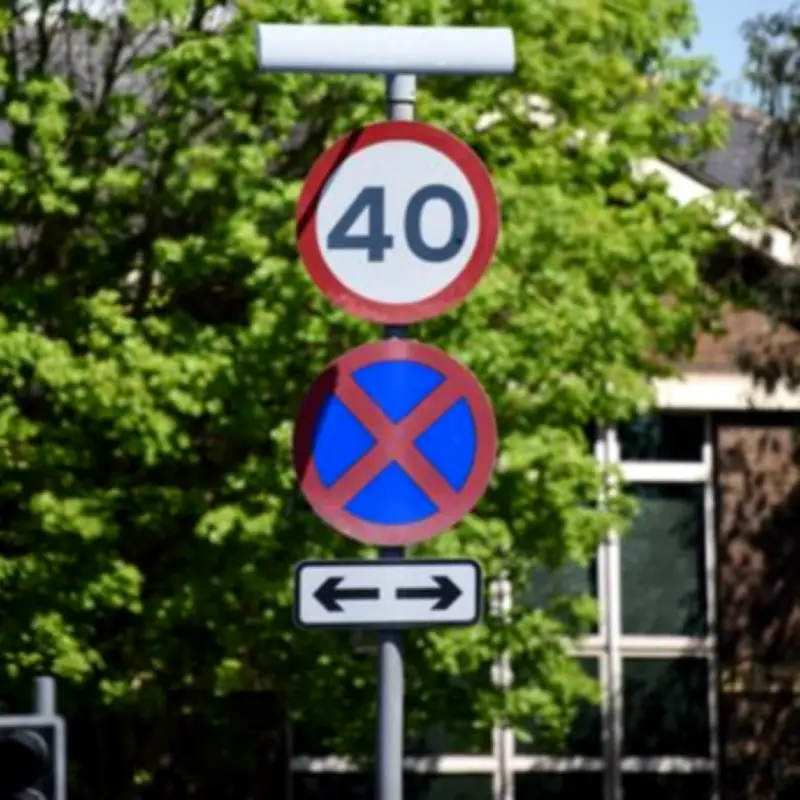
Drivers are being encouraged to refresh their understanding of traffic signs following revelations from industry specialists that a substantial proportion of us remain baffled by particular symbols. The UK Government's official publication, Know Your Traffic Signs, extends to an impressive 172 pages, so it's hardly surprising that certain signs leave road users perplexed.
Social media channels are frequently utilised by road users seeking explanations regarding the significance of different road markings and signs.
This specific sign, featuring a red cross on a blue background, is widespread across the UK, meaning there's every likelihood you've encountered it — in fact, one Reddit user replied to an enquiry about its significance by declaring: "This is one of the basic signs people who drive in this country should know. Not knowing what the sign is or how to check is an absolute failure."
Another contributed: "How do you exist as a driver with a license without knowing what a sign like this means?"
Notwithstanding those blunt remarks, there's a good chance you don't know what this sign means, even if you've seen it countless times. The sign features a red circle with a blue background and a red diagonal cross within.
According to insurance experts at One Sure Insurance, misinterpretation of road signs is considerably more common than many realise. Furthermore, figures from the AA show that while the vast majority of drivers consider themselves to be safe motorists, approximately half acknowledge they find certain elements of the Highway Code difficult. This knowledge gap can result in motorists inadvertently contravening the regulations or misinterpreting signs while driving.
What does the red-and-blue cross sign mean?
The red-and-blue cross sign denotes a clearway, meaning motorists are prohibited from stopping at any time. Unlike certain other restrictions that operate only during specified hours, the clearway regulation means you cannot halt your vehicle on that section of road for any purpose whatsoever, unless faced with an emergency.
This includes stopping to:
- Pick up or drop off passengers
- Check directions
- Make a phone call
- Wait briefly in the car
The UK Government's official guidance states: "The red cross means no stopping, not even to pick up or set down passengers. The sign is used to indicate a 24-hour clearway (usually on a rural road) or may be incorporated into other signs with the words 'No stopping' (eg the 'no stopping except local buses' sign at bus stops)."
"On a 24-hour clearway, the prohibition of stopping applies to the main running carriageway, slip roads and any acceleration and deceleration areas. You may stop in a lay-by unless there are signs to say otherwise. A 24-hour clearway does not have any special road markings, but smaller repeater signs might be provided at intervals along the road as a reminder to drivers."
Since stopping is entirely prohibited, any motorist who halts within a clearway area risks receiving a fine or penalty notice. However, one significant reason the sign generates such confusion is its resemblance to other blue-and-red traffic signs throughout Britain, each with marginally different meanings.
For instance, a sign displaying a single red line through a blue circle denotes an "urban clearway". An urban clearway operates in a comparable manner to a standard clearway, but with specific conditions. These are generally accompanied by supplementary information, such as the exact times and days when restrictions apply. Mixing up the two could lead to drivers thinking they're adhering to the law when, actually, they're violating it.
Clearways are generally implemented on heavily-trafficked routes where stopping could create congestion or pose safety hazards, such as major roads leading into city centres or heavily-used main roads. By preventing vehicles from stopping entirely, authorities seek to maintain free-flowing traffic and minimise the risk of sudden braking or obstructions on the road.
For motorists uncertain about road markings and signage, experts advise referring to the Highway Code to develop a comprehensive understanding of the regulations - particularly as misinterpreting them can result in financial penalties or hazardous situations. Refreshing your knowledge of road signs, they suggest, could assist drivers in avoiding fines, collisions, and insurance claims.
A spokesperson for One Sure Insurance said: "We see a lot of accidents or traffic violations happen because drivers simply don't understand or recognise certain road signs. These mistakes may seem minor at first, but they can lead to fines, insurance claims, and in worst-case scenarios, serious accidents. It's vital to take the time to understand every road sign you encounter."




