

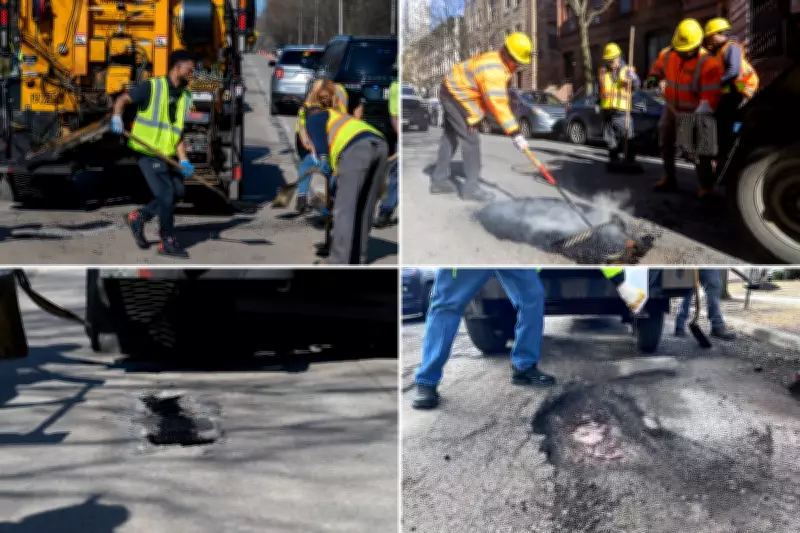
US Cities Launch Emergency Pothole Blitzes Following Devastating Winter Season
Municipalities across the United States are engaged in a frantic race against time to repair tens of thousands of potholes that have emerged following one of the most brutal winter seasons in recent memory. A combination of heavy snowfall, prolonged sub-zero temperatures, and repeated freeze-thaw cycles has created what officials are describing as a perfect storm for road damage, prompting emergency repair operations from coast to coast.
The Ice-Mageddon Aftermath
Baltimore Mayor Brandon Scott has been personally joining road crews to address what he calls the aftermath of "ice-mageddon." The Maryland city experienced below-freezing temperatures for nearly a month during January and February, creating persistent ice conditions that normally would have melted quickly. "We had below-freezing temperatures for basically a month," Scott explained. "So it wasn't going anywhere, and it was chunks of ice." The extensive use of road salt to combat icy conditions has ironically worsened the pothole problem by lowering water's freezing point and allowing it to seep deeper into pavement.
Baltimore is now overhauling its resurfacing program with new data dashboards and contracting changes, aiming to fill 25,000 potholes within the next 90 days. This comes after the city addressed 134,000 potholes throughout the previous year. The work involves breaking up ice blocks that feel like concrete, according to Scott, who describes himself as a hands-on leader who enjoys the physical work reminiscent of his family's HVAC business.

Record Complaints and Regional Crises
New York City has witnessed a dramatic 119 percent increase in pothole complaints to its 311 system compared to the same period last year, representing the largest year-over-year increase ever recorded. Since January, the city has filled more than 66,000 potholes using over 80 dedicated repair teams. Other regions are facing even more severe situations.
In Sumpter Township within the Detroit metropolitan area, officials declared a public safety emergency in February due to gravel roads that had become "severely washboarded, rutted and potholed, contain standing water due to drainage failures, and significant segments of road are nearly impassable." Connecticut drivers reported more potholes on state roads during the first two weeks of March than in the entire month of March 2025.
The Human and Financial Toll
The pothole crisis extends beyond mere inconvenience to genuine safety hazards and significant financial costs. In Queens, New York City, a 46-year-old man was fatally thrown from his motor scooter last month after hitting a pothole in the Ozone Park neighborhood. Meanwhile, tire shops in affected areas like Manchester, New Hampshire are reporting record numbers of damaged tires and rims resulting from road craters.
Chris Leo, a Manchester resident who recently lost a tire to a massive pothole while returning from dinner, described the experience vividly: "Think of a black abyss, like a black hole, and then double it, is basically the deepness of these potholes. It was like the Mariana Trench." His sentiment echoes that of Nashua, New Hampshire officials who warned that a "very wet winter with very low lows, and weirdly strange high temps" created ideal conditions for pothole formation.
Innovative Solutions and Equipment
Faced with this overwhelming challenge, cities are deploying innovative approaches and specialized equipment. Bridgeport, Connecticut Mayor Joe Ganim has implemented what he calls "the pothole killer" – a truck equipped with spray injection machines and a "hot box" asphalt recycler. "We've had hundreds and hundreds of people calling after one of the worst winters on record," Ganim explained, "and that's why I decided to put together a massive public facilities operation to repair the potholes."
Many municipalities are utilizing mobile apps for residents to report potholes, along with dedicated tip lines and rapid-response patch teams. However, smaller communities face particular challenges. The Pittsburgh-area borough of Homestead has already exhausted its entire supply of 2,000 pounds of cold patch asphalt, highlighting the resource strain on local governments.

Long-Term Challenges and Climate Concerns
Addressing the pothole epidemic involves more than just temporary fixes. Rising global temperatures, stronger storms, and unusual weather patterns associated with climate change are expected to exacerbate pothole problems in coming years. Meanwhile, cities like Baltimore face persistent funding challenges that complicate long-term solutions.
Unlike other Maryland municipalities, Baltimore maintains responsibility for both local and state roadways within its jurisdiction while having lost nearly $1 billion in expected state funding following years of post-recession budget cuts. "You're talking about thousands upon thousands of lanes of road that didn't get surfaced that would have," Mayor Scott noted. He is now lobbying state lawmakers to secure sustained funding increases for infrastructure maintenance.
While Pittsburgh Public Works Director John Samuelson reported that his city is managing well with pothole repairs typically completed within 24 hours of notification, most communities face a daunting task. As cities deploy everything from mayoral elbow grease to high-tech equipment, one certainty remains: the battle against potholes represents an ongoing challenge that requires both immediate action and long-term planning.





