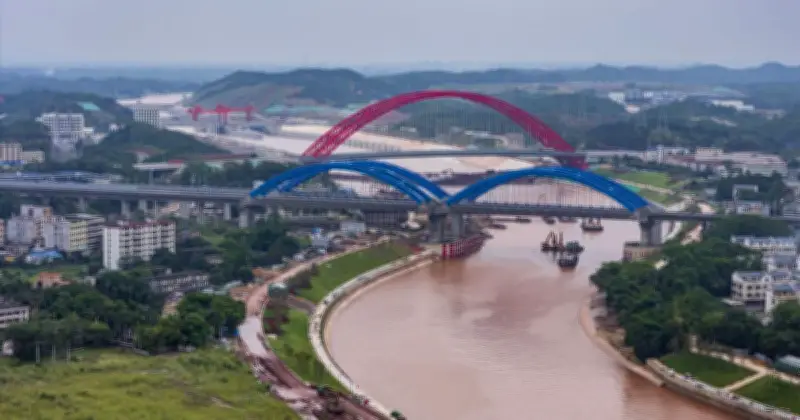
China has officially opened the Pinglu Canal, an 83-mile (134km) artificial waterway built to serve as its answer to the Suez Canal, after four years of intensive construction. The megaproject creates a direct path from China's inland regions to the Pacific, linking the manufacturing hub of Nanning in the Guangxi region to the Gulf of Tonkin, which is flanked by China and Vietnam.
The canal cost 72.7 billion yuan (£8.1 billion) and marks the first man-made, river-to-sea waterway constructed since the founding of the People's Republic of China in 1949. State broadcaster CCTV broadcast footage of the first barge navigating its waters, hailing the megaproject as the "project of our century".
Part of Belt and Road Initiative
The canal operates as a vital pillar of the New International Land-Sea Trade Corridor under President Xi Jinping's Belt and Road Initiative, which seeks to connect China to Europe and Africa. The flagship project is expected to reshape trade routes in Asia by cutting out thousands of miles of roundabout shipping through eastern ports like Guangzhou.

The route slashes the journey from inland river systems to the ocean by up to 350 miles (560km), saving an average cargo ship some 28 hours of sailing time. It will also result in 30% cheaper logistics, with transport costs projected to drop by up to 30%, saving businesses over £570 million annually.
Vessel capacity and construction scale
The Pinglu Canal has a huge vessel capacity, capable of accommodating 5,000-tonne ships, allowing bulk goods - coal, ore, grains, chemicals, and agricultural products - to hit global markets faster than ever.
To complete the 83-mile link, engineers excavated roughly 339 million cubic meters of material - enough to cover an area larger than Luxembourg to a depth of 100 metres and three times more earth moved than during the construction of the Three Gorges Dam, the largest hydroelectric plant in the world.
Human toll and regional impact
However, the rapid push to complete the canal exacted a steep human toll. Thousands of local families across Guangxi and Hengzhou were forced to evacuate and relocate from their ancestral lands. Chinese authorities provided financial compensation, custom-built housing designed around local traditions and vocational training, alongside promises of construction jobs, to ease the displacement.
The opening comes at a crucial moment as Beijing seeks to solidify its economic grip on Southeast Asia. Amid heightened tensions in West Asia and shifting global supply lines, China is banking heavily on the Association of Southeast Asian Nations (ASEAN), which remains among its largest trading partners. Total trade between China and ASEAN surged past $860 billion (£650 billion) in the first eight months of 2026 alone - up 25.6% year-on-year.
By drastically improving connectivity in less-developed inland provinces such as Sichuan, Chongqing and Yunnan, Beijing has created a direct, high-speed trade superhighway to the heart of Southeast Asia.