

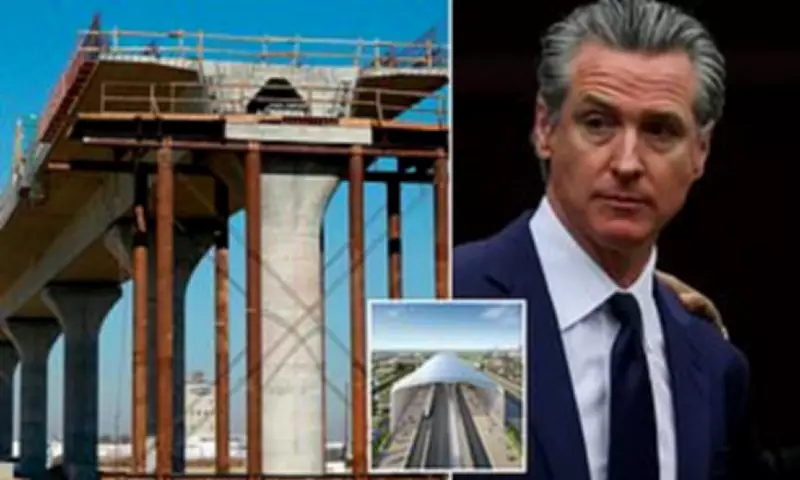
California's High-Speed Rail Project Faces Massive Cost Overruns and Delays
Experts have revealed that California Governor Gavin Newsom's ambitious high-speed rail initiative is projected to escalate dramatically in cost, reaching an estimated $126 billion. This staggering figure emerges despite the fact that not a single piece of track has been laid to date. The project, originally approved in 2008 with a completion target of 2020, has become a significant political liability for the liberal governor, frequently mocked by former President Donald Trump.
Original Budget Quadruples Amid Construction Delays
The rail project was initially budgeted at a modest $33 billion, but according to Anthony Williams, a member of California's high-speed rail board, that amount is expected to quadruple by the time construction concludes. In a recent interview with 60 Minutes, Williams stated, "Today, we estimate with the right optimization just over $125 billion. I think $126 billion is the current estimate for that." He further emphasized the scale of the funding challenge, noting, "That's more funding than Amtrak has received in its history and still leaves a shortfall of roughly $90 billion."
Williams expressed confidence that the state could bridge this financial gap through cost-cutting measures and attracting private investment. However, Republican critics remain deeply skeptical, particularly after Donald Trump announced the cancellation of $4 billion in federal grants for the train. Trump labeled the project "the worst cost overrun I've ever seen," while Congressman Vince Fong denounced it as a "bait and switch" that exemplifies government waste and mismanagement.

Mixed Reactions from Transportation Officials
Toks Omishakin, California's secretary of transportation, acknowledged some validity in the criticism, admitting, "I don't think the voters fully understood and neither did we in the public sector what it was gonna take to actually get this project delivered." In contrast, Sean Duffy, Trump's Secretary of Transportation, condemned the initiative as a blight on the White House's vision for a "Golden Age of Transportation." Duffy asserted that the administration would not support "boondoggle projects like Newsom's Train to Nowhere that wasted billions in taxpayer dollars yet delivered nothing to the American people."
Governor Newsom did not respond to interview requests from 60 Minutes. A spokesperson for the California High-Speed Rail Authority, however, disputed the negative media framing, stating, "These claims ignore the facts on the ground." The spokesperson highlighted potential benefits, including the creation of 16,000 construction jobs and an economic impact of $25 billion upon completion. The Authority also confirmed plans for the first installation in the Central Valley by 2026, promising wide platforms, sprawling plazas, and spacious parking lots at stations.
Project History and Federal Funding Controversy
Conceived as the first high-speed rail system in the United States, the project has been plagued by delays and escalating costs. Despite zero train tracks being laid so far, estimates now suggest a final price tag of up to $128 billion. In 2025, Trump ridiculed the initiative on Truth Social, proclaiming, "I have officially freed you from funding California's disastrously overpriced, 'High speed train to nowhere.'" He criticized Governor Newsom's leadership, claiming the project had cost taxpayers hundreds of billions without tangible results.
The Transportation Department recently rescinded $4 billion in federal funding, noting that less than a quarter of the project's financing came from federal sources. In a press release, the DOT pointed out that "the $135 billion projected total cost of the project could buy every San Francisco and LA resident nearly 200 roundtrip flights between the cities." Duffy attributed the massive delays and cost overruns to California government incompetence, vowing that the Trump administration would fight to redirect tax dollars to more effective projects.

Legal Battles and Future Prospects
California High Speed Rail Authority CEO Ian Choudri announced that the state would challenge the federal funding withdrawal in court, citing legally binding agreements and compliance with federal reviews. The Authority reports that 171 miles are under active construction and design, with over 50 major structures completed since 2015. However, passenger service is not expected to commence until between 2030 and 2033.
Amid this controversy, Governor Newsom, widely considered a potential candidate for the 2028 presidential race, has publicly clashed with Trump on multiple issues. Recently, he filed a lawsuit challenging the White House's deployment of the National Guard in Los Angeles, though a federal appeals court ruled unanimously in Trump's favor. As the high-speed rail project continues to face scrutiny, its future remains uncertain, balancing promises of economic growth against accusations of fiscal irresponsibility.





