
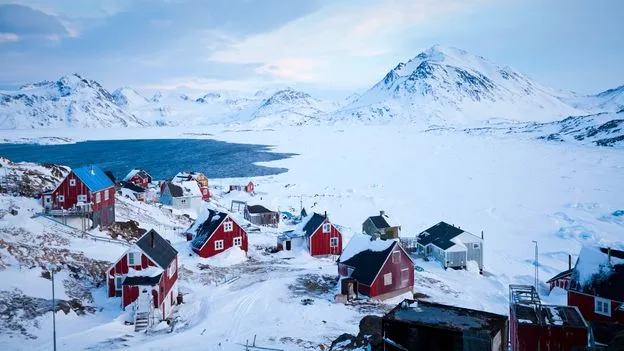
Interest in Greenland's mineral wealth has intensified after US President Donald Trump revived attempts to acquire the vast Arctic island. The territory, a semi-autonomous region of Denmark, is believed to hold significant reserves of rare earth elements and critical minerals used in green energy technologies, as well as suspected fossil fuel deposits. However, extracting these resources remains a formidable challenge due to Greenland's harsh climate, remote location, and the multi-layered, multi-decadal nature of mining operations.
This is not the first time the US has sought control of Greenland. Historical attempts include a proposal in 1867 by then Secretary of State William Seward, an offer to exchange the island for the Dutch Antilles and Mindanao in 1910, and a $100m gold bullion bid in 1946. Trump’s earlier interest in 2019 was dismissed as 'absurd' by Danish Prime Minister Mette Frederiksen.
Greenland's geology records billions of years of Earth's history. Once part of a supercontinent that included Europe and North America, it split apart around 60 million years ago to form the North Atlantic. This complex geological past has endowed the island with a wide array of rocks containing valuable minerals, from Precambrian basement to glacial sediments.
Beyond hard rock minerals, scientists estimate that Greenland holds enormous offshore oil and gas reserves. Since the 1970s, oil and gas companies have explored the Greenlandic coast, but commercial extraction has yet to take off due to technical difficulties and environmental concerns.
Despite the allure, the sheer scale of Greenland – about 2 million square kilometres, roughly the size of the Democratic Republic of Congo – and its extreme Arctic conditions make resource extraction a long-term, multinational effort. The geopolitical tensions surrounding Trump's recent threats to annex the island have further complicated the outlook for any future development.




