

Oil Prices Hold Near $105 as Iran Intensifies Gulf Attacks
Brent crude oil is trading close to the $105 per barrel mark as Gulf nations report increased military actions by Iran, with the ongoing conflict now entering its third week. The international benchmark saw a rise of 1.6%, reaching $104.73 per barrel, after initially opening above $106. Since the war began, Brent has surged more than 40%, reflecting significant market volatility.
Global Stock Markets Show Divergent Trends
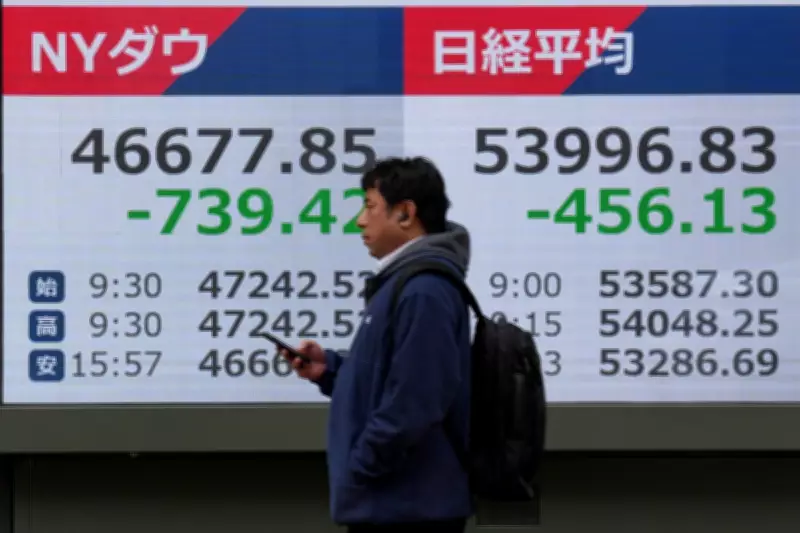
Share prices across Asia presented a mixed picture on Monday. In Tokyo, the Nikkei 225 index declined by 0.4% to 53,609.49, while South Korea's Kospi advanced 0.6% to 5,521.17. Hong Kong's Hang Seng rose 1.1% to 25,755.53, but the Shanghai Composite fell 0.7% to 4,066.40. Australia's S&P/ASX 200 dropped 0.4% to 8,583.50, with Taiwan's Taiex edging up 0.1% and India's Sensex dipping 0.1%.
U.S. futures indicated a positive start, with the S&P 500 contract up 0.5% and the Dow Jones Industrial Average contract rising 0.4%. This follows a difficult session on Friday, where Wall Street experienced deeper losses as the war pushed oil prices above $100 per barrel, exacerbating inflationary pressures globally. The S&P 500 fell 0.6% to 6,632.19, marking a 3.1% decline year-to-date. The Dow lost 0.3% to 46,558.47, and the Nasdaq composite dropped 0.9% to 22,105.36, with all three indexes recording their third consecutive weekly loss.

Strait of Hormuz Closure Disrupts Oil Supply
Iran has retaliated against attacks by Israel and the U.S. by effectively halting cargo traffic through the narrow Strait of Hormuz, a critical chokepoint that typically handles a fifth of the world's oil shipments. This blockade has forced oil producers to cut production, as their crude has no viable export routes. According to independent research firm Rystad Energy, over 12 million barrels of oil equivalent per day have been taken offline in just over a week since the strait's closure.
"The truth is that at this point, much of the market is operating in the fog," commented Stephen Innes of SPI Asset Management. "For context, the strait normally handles roughly 25 oil and LNG tankers every single day." Despite reports of a few tankers navigating through, uncertainty remains high. If the conflict continues to impede oil production and transportation from the Persian Gulf, it could trigger a damaging surge in inflation worldwide.
Inflationary Pressures and Economic Indicators
Higher inflation expectations are complicating the Federal Reserve's efforts to lower interest rates to support economic growth. The U.S. central bank is not anticipated to cut rates at its policy meeting this week. Recent data shows that inflation crept higher in January, even before the Iran war caused spikes in oil and gas prices. The Commerce Department reported that consumer prices rose 2.8% year-over-year in January, with core prices—excluding volatile food and energy—increasing 3.1%, the largest jump in nearly two years.
Despite these pressures, consumer spending remained robust, rising at a solid 0.4% pace in January, matching the growth in incomes. However, the University of Michigan's latest gauge of consumer sentiment declined slightly to its lowest reading of the year, attributed to gasoline price hikes since the war began. Additionally, U.S. economic growth for the October-December quarter was revised downward to a sluggish 0.7% annual rate, hampered by last fall's 43-day government shutdown.
International Response and Currency Movements
In response to the supply disruptions, members of the International Energy Agency are releasing a record 400 million barrels of oil from emergency reserves, though this move has done little to reassure jittery markets. In early Monday trading, currency markets saw the U.S. dollar slip to 159.47 Japanese yen from 159.55 yen, while the euro rose to $1.1442 from $1.1425.
The ongoing conflict and its ripple effects underscore the fragile balance in global energy markets and the broader economic landscape, with investors closely monitoring developments for further impacts on prices and stability.






