
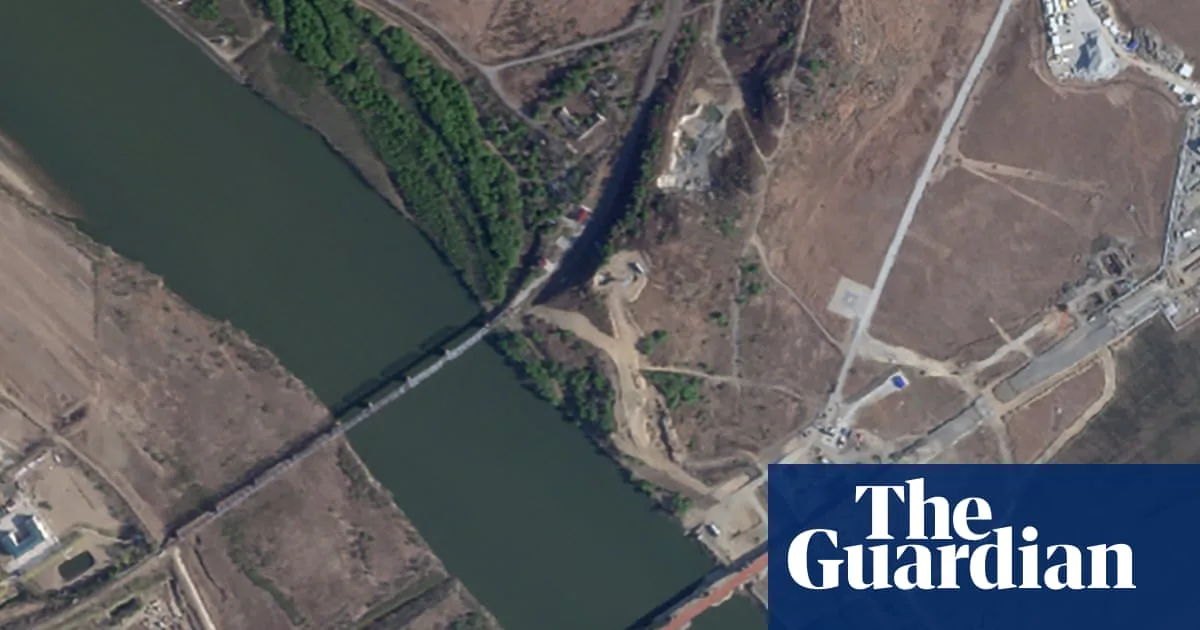
Russia and North Korea are close to completing their first ever road bridge, raising concerns that the infrastructure is designed to facilitate military cooperation in the Ukraine war. The bridge spans the Tumen River between Russia’s Khasan and North Korea’s Tumangang, a remote border area where the river marks the final stretch of the frontier.
The crossing is largely finished, with North Korea completing its side, including customs and quarantine facilities, ahead of a planned opening on 19 June. However, Russia has fallen behind on its own side, and no new opening date has been confirmed. Authorities from both countries have said the bridge aims to boost trade and tourism.
But an investigation by Ukrainian human rights group Truth Hounds, shared with the Guardian, suggests the bridge is intended more as a discreet military logistics corridor. Lead researcher Nazar Myhun noted that road transport is harder to monitor via satellite than rail, making it easier to evade Western surveillance. Trucks can be loaded anywhere and look similar in satellite imagery, unlike railcars which are exposed longer and reveal cargo types.
The new road bridge runs alongside the existing Friendship Bridge, the sole rail link. Russia’s transport minister, Andrey Nikitin, said the bridge would increase mutual trade, optimise logistics, and strengthen cultural ties. North Korea’s KCNA similarly portrayed it as a way to boost travel and commerce. However, Truth Hounds argues the economic rationale is weak, noting the bridge cost over $100 million while bilateral trade was only $34 million in 2024. Tourism from Russia to North Korea remains limited, with most visitors heading to Pyongyang, over 500 km away.
The investigation concludes the bridge is better understood as strategic infrastructure for moving North Korean troops, construction brigades, and military officials into Russia, and for Russian technology and resources in return. The deepening relationship between Moscow and Pyongyang has made weapons and technology exchanges easier and less transparent, posing a threat beyond Ukraine.
The Kremlin has been contacted for comment but has not responded. The bridge is about one kilometre long and seven metres wide, with two lanes, part of a 4.7 km crossing including approach roads. Satellite imagery also shows a helicopter landing pad being built on the Russian side.




