

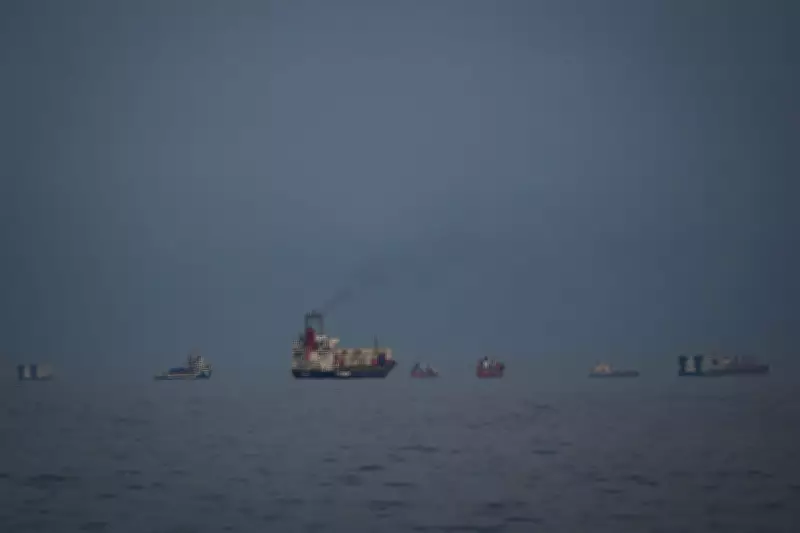
Iran's Oil Exports Persist Through Strait of Hormuz Amid War
Despite the ongoing war and the effective closure of the Strait of Hormuz, Iran has successfully exported millions of barrels of oil, with about 90 ships, including oil tankers, crossing the strategic waterway since early March. According to maritime and trade data platforms, this activity highlights Iran's resilience in maintaining its oil trade amidst global tensions.
Dark Transits and Sanctions Evasion
Maritime data firm Lloyd's List Intelligence reports that many of the vessels passing through the strait were so-called "dark" transits, evading Western government sanctions and oversight, likely with ties to Iran. More recently, ships affiliated with India and Pakistan have also navigated the strait as diplomatic negotiations intensified.
Since the war began in early March, most shipping traffic through the Strait of Hormuz—a crucial conduit for global oil and gas transport, supplying roughly one-fifth of the world's crude oil—has been halted, with about 20 vessels attacked in the area. However, trade data and analytics platform Kpler estimates that Iran has exported well above 16 million barrels of oil during this period, with China being the largest buyer due to Western sanctions and associated risks.

Diplomatic Interventions and Safe Corridors
Analysts note that Iran has managed to profit from oil sales and preserve its export artery by leveraging control over the chokepoint. Richard Meade, editor-in-chief of Lloyd's List, suggests that vessels may be transiting "with at least some level of diplomatic intervention," potentially creating a safe corridor near the Iranian coast.
Specific examples include the Pakistan-flagged crude oil tanker Karachi, controlled by the Pakistan National Shipping Corp., which passed through the strait recently, and India-flagged liquefied petroleum gas carriers Shivalik and Nanda Devi, owned by the state-owned Shipping Corp. of India, which traveled through around March 13 or 14. India's foreign minister confirmed that these passages followed talks with Iran, while Iraq is also negotiating to allow its oil tankers through.
Impact on Oil Prices and Global Response
Oil prices have surged more than 40% to above $100 per barrel since the war began, with Iran threatening to block oil destined for the U.S., Israel, and their allies. In response, the U.S. has allowed Iranian oil tankers to cross the strait to stabilize prices, as stated by Treasury Secretary Scott Bessent. Despite U.S. military actions, such as bombing sites on Kharg Island, key to Iran's oil network, President Donald Trump has left Iran's oil infrastructure untouched for now.
Kun Cao, client director at consulting firm Reddal, emphasizes that the strait is not simply "closed" but selectively restricted, functioning for Iranian exports and a narrow set of tolerated non-Iranian movements. However, Dutch bank ING's strategists warn that if Iran aims to inflict pain through higher energy prices, it may limit tanker passages further.
This situation underscores the complex dynamics of global oil markets and Iran's strategic maneuvering in the face of conflict and sanctions.






