

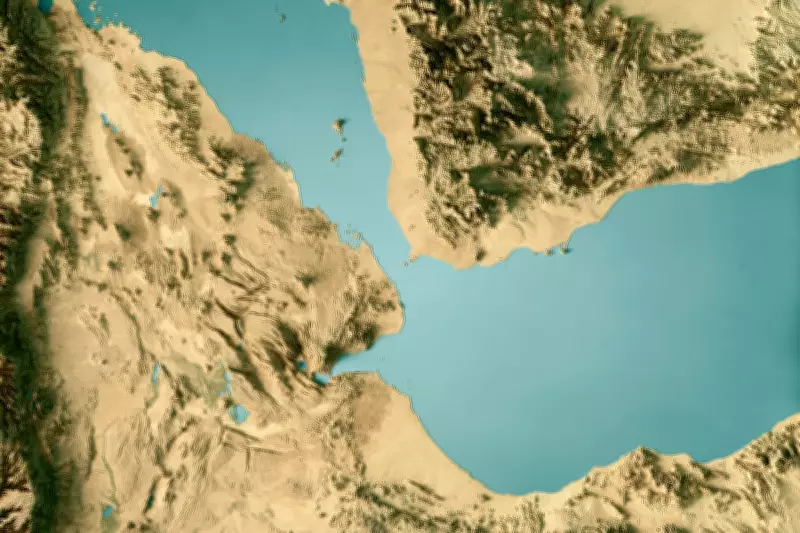
Houthi Threat to 'Gate of Tears' Shipping Route Could Paralyse Global Trade
The strategic Bab al-Mandab strait, a crucial maritime passage in the Middle East, faces an escalating threat of blockade by Houthi rebels, potentially disrupting global oil supplies and exacerbating economic instability. Known ominously as the "Gate of Tears", this narrow waterway has become a focal point of geopolitical tension following Iran's involvement in regional conflicts.
Strategic Chokepoint Under Threat
Positioned between Yemen and Djibouti, the Bab al-Mandab strait serves as a vital link connecting the Red Sea to the Arabian Sea, forming an essential component of the maritime trade route between the Mediterranean and Indian Ocean via the Suez Canal. This 50-kilometre long, 16-kilometre wide passage handles approximately 12 percent of global oil shipments alongside substantial volumes of liquefied natural gas and commercial goods.
The potential closure of this corridor by Houthi forces, acting as Iranian proxies, represents a severe threat to international trade networks. Mona Yacoubian, an expert at the U.S. Center for Strategic and International Studies, warned that Iran could deploy Houthi militants to blockade Bab al-Mandab in retaliation for any U.S.-led actions against the Strait of Hormuz.

Economic Implications of Disruption
Historical data reveals the strait's critical economic importance. Between 2020 and 2023, daily oil transit through Bab al-Mandab peaked at 9.3 million barrels before plummeting to 4.1 million barrels in 2024 following systematic Houthi attacks on commercial shipping. This dramatic reduction has already triggered significant consequences for global trade.
Major shipping companies have been forced to reroute vessels around South Africa's Cape of Good Hope, adding 10-14 days to journey times and substantially increasing transportation costs. Insurance premiums for vessels navigating the region have surged, while trade through the Suez Canal fell by 50 percent during the first two months of 2024 compared to the previous year.
Saudi Arabia's Vulnerable Export Route
Saudi Arabia has become particularly dependent on Bab al-Mandab following the closure of the Strait of Hormuz. The kingdom has strategically utilised its Yanbu port on the west coast, which receives oil through the east-to-west pipeline system, to maintain crude exports via the southern route.
Freight analyst Matthew Wright of Kpler revealed that Saudi Arabia currently exports 4.6 to 5 million barrels per day from Yanbu, with 80 percent destined for Asian markets. "The pipeline is being pushed to the maximum," Wright noted, emphasising that any disruption to Yanbu operations would deliver "a massive blow to continued crude exports from the Middle East."
Broader Regional Energy Crisis
The potential closure of Bab al-Mandab would compound existing energy market disruptions. Iran's control of the Strait of Hormuz has already constrained approximately 20 percent of global oil supplies since the outbreak of regional hostilities - nearly triple the impact of the 1973 oil crisis.
Brent crude prices surged past $102 per barrel recently, reflecting market anxieties about escalating tensions. While prices had temporarily fallen below $100 following a two-week ceasefire agreement between the U.S. and Iran, the spectre of additional chokepoint closures continues to threaten global energy security.
The simultaneous disruption of both Hormuz and Bab al-Mandab would create catastrophic conditions for international trade, potentially severing energy supplies from the region and triggering widespread economic repercussions across import-dependent nations worldwide.






