

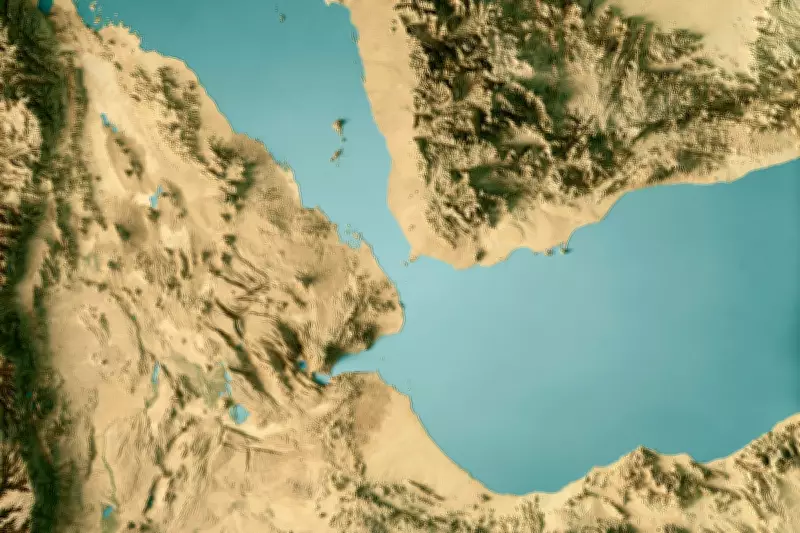
Houthi Threat to Bab-al-Mandab Strait Could Trigger Global Economic Earthquake
The entry of Yemen's Houthi rebels into the Iran war has escalated fears that another critical Middle Eastern waterway, the Bab-al-Mandab Strait, could be effectively blocked to oil tankers, potentially causing further economic chaos worldwide. This development follows the closure of the Strait of Hormuz, which has already strained global energy markets.
A Vital Shipping Route Under Threat
Like the Strait of Hormuz, the Bab-al-Mandab Strait serves as a crucial chokepoint in the region, facilitating the passage of large volumes of petroleum and liquefied natural gas. It acts as a vital strategic link in the maritime trade route between the Mediterranean Sea and the Indian Ocean, connecting via the Red Sea and the Suez Canal.
The Strait of Hormuz accounts for approximately one-fifth of the world's oil and gas transits. With it currently under strict control by the Islamic Revolutionary Guard Corps, countries globally have been forced to grapple with rationing and soaring prices, highlighting the fragility of global supply chains.

Global Economic Fallout Intensifies
An energy emergency was declared in the Philippines last Wednesday, as the government warned it had just 45 days until fuel supplies ran out completely. India has implemented rationing for cooking gas, Sri Lanka introduced a four-day working week, and Bangladesh deployed troops to prevent fuel hoarding amid the crisis.
Brent Crude, the global oil benchmark, surged to $116 per barrel as markets opened on Monday, a stark increase from $78 per barrel prior to the war in Iran. This price spike underscores the mounting pressure on economies reliant on Middle Eastern imports.
Bab-al-Mandab: The "Gate of Tears"
The Bab-al-Mandab Strait, also known as the "Gate of Tears," is situated between Djibouti and Yemen. This route, approximately 50km long and 16km wide, serves as the passage for vessels transiting between the Red Sea and the Arabian Sea. It provides access to key ports, including Saudi Arabia's Yanbu, Djibouti's Doraleh, Eritrea's Assab, Somalia's Kismayu, and Somaliland's Berbera.
While Bab-al-Mandab does not handle the same volume of oil as the Strait of Hormuz, its closure would deliver another severe blow to economies dependent on Middle Eastern energy exports, exacerbating existing shortages and price hikes.
Economic Significance and Recent Disruptions
According to the US Energy Information Administration (EIA), Bab-al-Mandab saw daily oil transits peak at 9.3 million barrels between 2020 and 2023. However, this figure plummeted to 4.1 million barrels in 2024 after Houthi rebels launched systematic attacks on commercial ships associated with Israel passing through the strait.
The International Monetary Fund reported that trade through the Suez Canal fell by 50% year-on-year in the first two months of 2024, while trade through the Panama Canal declined by 32%. As traffic dwindled, insurance costs surged, prompting major shipping firms to reroute vessels via the Cape of Good Hope in South Africa, adding 10-14 days to journey times.
Potential Catastrophic Impact of Closure
The closure or disruption of two of the world's primary strategic waterways could prove catastrophic for global trade, with energy supplies potentially severed. Bab-al-Mandab has allowed a limited flow of oil to exit the Middle East through alternative routes, with Saudi Arabia strategically using the strait to export crude via its vital Yanbu port.
Yanbu, located on Saudi Arabia's west coast, receives oil through the country's east-to-west pipeline. Matthew Wright, a freight analyst at Kpler, noted that this pipeline is "being pushed to the maximum." He emphasized that Yanbu is currently the most active port in the Middle East Gulf, and any disruption there would severely impact crude exports from the region.
Recent data from shipping firm Vortexa, cited by CNN, indicates that up to 4.6 million barrels per day have been loaded onto vessels at Yanbu over the past two weeks—more than triple the average for 2025. Previously, experts estimated that 2.5 to 3 million barrels per day were exported from Yanbu.

Mr. Wright warned that losing even this amount, combined with the 15 million barrels of oil absent daily from the Hormuz market, would constitute a "major problem" for global energy stability.
The Houthi rebels' history of attacking ships in the Bab-al-Mandab Strait, backed by Iran, raises alarms about further escalations. As global economies already reel from the Strait of Hormuz closure, the threat to Bab-al-Mandab underscores the precarious balance of international trade and the urgent need for contingency planning in the face of geopolitical instability.





