

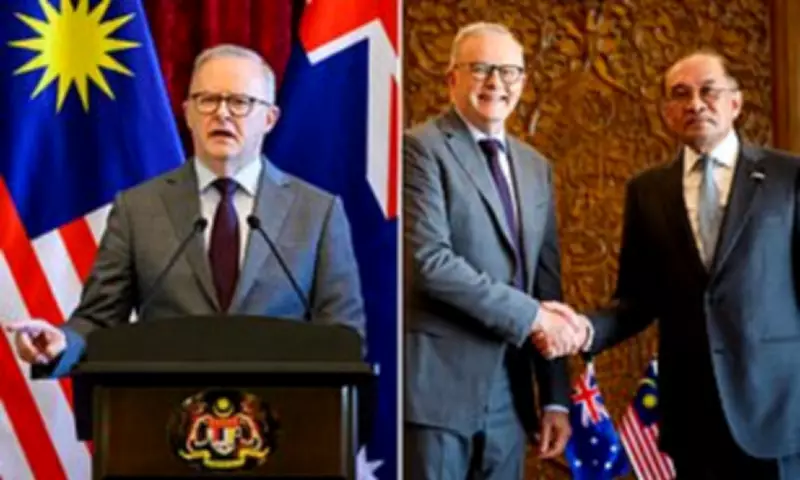
Australia has successfully secured an additional 100 million litres of diesel shipments to bolster its fuel reserves during the ongoing global energy crisis. This significant development follows a series of high-level meetings between Prime Minister Anthony Albanese and Asian leaders, aimed at addressing supply chain disruptions and ensuring stable energy flows.
Key Agreements with Malaysia
The details of these enhanced fuel supplies were unveiled by Prime Minister Albanese after formal discussions in Kuala Lumpur with Malaysian counterpart Anwar Ibrahim. The talks centred on maintaining uninterrupted energy trade between the two nations amidst the current oil crunch. In a joint statement signed at the Malaysian government's Perdana Putra complex, the leaders committed to a 'no surprises' policy regarding the trade of critical oil and fuel supplies, a move prompted by recent disruptions linked to the Iran war.
Mr Anwar emphasised the gravity of the situation during a joint media conference, stating, 'The world looks very different to when you were here last year ... global energy markets are under serious stress.' He reassured Australia, saying, 'Malaysia will always be a reliable partner to Australia.' Malaysia holds a crucial role as Australia's third-largest fuel supplier, providing 14 per cent of its diesel, 10 per cent of its petrol, and 11 per cent of its jet fuel.

Mutual Energy Dependence
In return, Australia supplies nearly all of Malaysia's liquefied natural gas imports. However, there are concerns among Asian nations that the Albanese government might introduce new export taxes on resources in the upcoming May budget. The joint statement affirmed, 'We commit to promote open and stable trade flows between our two countries, including for essential energy supplies.' It further highlighted plans to exchange views on energy trade matters on a 'no surprises' basis and deepen practical cooperation on energy security, underscoring the mutually important energy security relationship.
Ceremonial Welcome and Broader Discussions
Prior to the meeting, Mr Albanese received a formal welcome outside Mr Anwar's office, featuring rows of dignitaries and a guard of honour. The leaders stood for the national anthems of Australia and Malaysia on the stone forecourt, with the iconic Putra Mosque providing a backdrop. Mr Albanese later met with senior executives from Petronas, Malaysia's state-owned oil extraction and refining giant. It is noteworthy that Malaysia imports hundreds of millions of dollars worth of Russian oil and fuel annually, some of which is subsequently sold to Australia, despite Ukraine's calls for a total ban on Russian oil.
Brunei's Role and Regional Concerns
These discussions followed a 24-hour visit to Brunei, where Mr Albanese obtained assurances that the sultanate would not restrict fuel or fertiliser shipments to Australia. In exchange, Australia, as Brunei's largest trading partner, will continue providing crucial food shipments. Brunei supplies 11 per cent of Australia's fertiliser, and in 2024, Australia accounted for approximately three-quarters of Brunei's meat imports. During a meeting at Brunei's royal palace, both Mr Albanese and Sultan Haji Hassanal Bolkiah expressed deep concern over the war in the Middle East and pledged to strengthen energy supply chains while maintaining open trade flows. The monarch remarked, 'Australia has always been a trusted friend and partner. Over the years, our relations have continued to prosper.'
Opposition Criticism and Future Challenges
Despite these efforts, opposition sources have downplayed the announcement, arguing that 100 million litres of fuel represents little more than a single day's supply, given Australia's daily consumption of about 90 million litres. They have called for a long-term solution to the crisis, highlighting the need for more sustainable energy strategies. The imports, facilitated under export finance regulations, will come via shipments from Brunei and South Korea, marking a critical step in Australia's response to the global fuel shortage.






