For many British holidaymakers, Tunisia is synonymous with package deals and all-inclusive beach resorts. But this is just a fraction of the story. As I discover, this is a place layered with history and culture, ripe for travellers who want to experience an adventure beyond the scramble for sun loungers. And now, more than ever, people are taking note.
Travel experts at First Choice have just revealed a surge in bookings to Tunisia, with demand up 19% year-on-year as travellers look for better-value, last-minute alternatives to busy European hotspots. Flights start from £43 one-way in September (from London Luton to Enfidha), and rooms in five-star hotels can be as little as £100 a night.
Tunisia’s seaside suburbs
I flew direct to Tunis, the capital of Tunisia, with Nouvelair, a journey that takes about three hours from London Gatwick. To get my bearings, I meet French-Tunisian journalist, Hedi Mehrez, who is determined to show me the best his country has to offer.

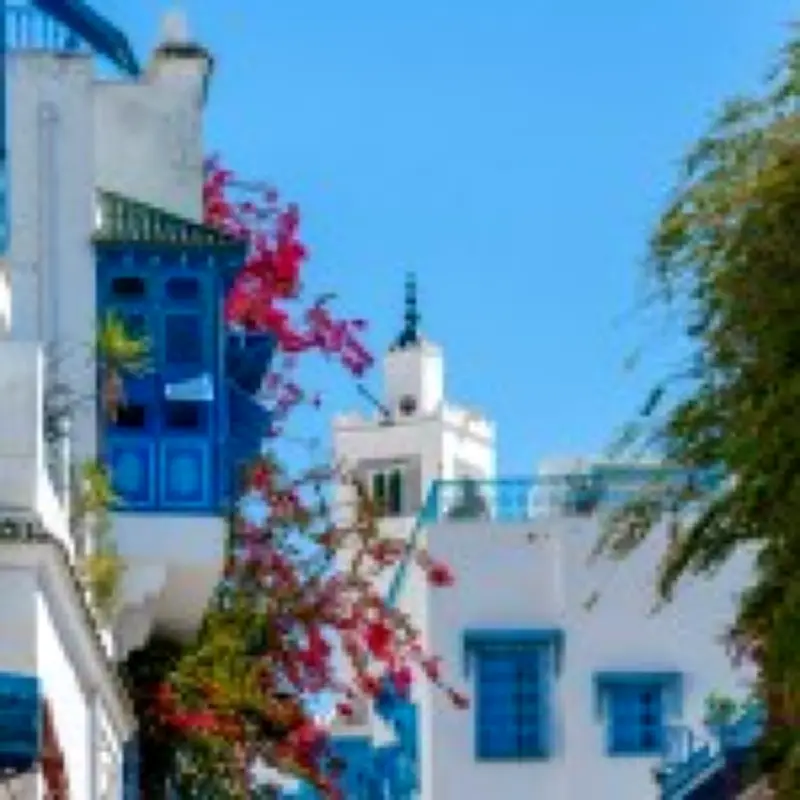
Our first stop is the town of Sidi Bou Said. Perched high above the Mediterranean, just 30 minutes from central Tunis, it feels like it belongs in a postcard. Whitewashed buildings shimmer in the 25°C sun, their bright blue shutters mimicking the colours of the sea. It is those characteristics that often draw comparisons to the Greek island of Santorini. And indeed Sidi Bou Said has a similar feel, without the crowds.
Hedi tells me that the town is a ‘true source of pride’ for Tunisians. ‘It is always one of the first places I take my foreign friends, as it beautifully showcases the rich culture Tunisia has to offer,’ he says. ‘I am truly attached to Sidi Bou Said. I often go simply to take in the breathtaking views.’
Before taking on the cobbled streets, we stop for food. The Tunisian Assida Zgougou, a delicious custard-type dessert made out of Aleppo pine powder and topped with crushed pistachios, does the job. We also grab a refreshing cold brew from trendy Ben Rahim Coffee.
The stroll through Sidi Bou Said reveals something charming at every turn: tiny shops spilling over with locally-made jewellery and hand-crafted ceramics. Nomad is one of several art galleries worth checking out, showcasing traditional and also more modern pieces that honour Tunisia’s rich history. As we descend, a crowd has gathered at a lookout point at the end of the path. From here, the view is cinematic: the sun bouncing off the golden sands below and the waves of the sea crashing against the shoreline.
Another taxi ride – a much shorter and calmer one – takes us to La Marsa, a larger coastal town next to Sidi Bou Said. This is where one of my favourite artists, Palestinian singer Saint Levant, once posted a video from, so I secretly hope to bump into him. Sadly, no trace. Maybe next time. Instead, I watch an elderly couple feeding the packs of stray dogs and cats, tossing slabs of salami at them. Couple goals in 50 years’ time.
The seafront at La Marsa is where Tunisians come to unwind. Teenagers are skating along the palm-lined promenade, families with children playing in the sand and friends sipping on cocktails at rooftop bars. The vibe here is stylish and cool, but also warm and welcoming. Considering the lack of third spaces in London, it is both sad and inspiring to see that community lies at the heart of daily life in Tunisia. Whether it’s feeding animals at the beach, sharing food with neighbours or simply gathering at the local café for late-night conversation over a sizzling shisha, connection here is everything.
Dinner is at one of the many upscale restaurants that surround the beach at La Marsa. Before we know it the sun has set and it is time for the next adventure at nearby Gammarth. Once a small fishing village, it blossomed into a resort following Tunisia’s hard-fought independence from French colonial rule in 1956. Today it is a buzzy nighttime hub, famous for its nightclubs, five-star hotels and sprawling beaches. The taxi speeds past several clubs pumping loud music – Foll’Amour, Zebra, Molo and eventually Gingembre, a very liberal open-concept venue playing Latin trap and Arab tunes from the 2000s. I dance the night away, sipping on a lovely Tunisian lager called Celtia.

Tunisia is for adventure
Tunisia may not be the easiest destination for first-time travellers, but it is certainly one of the most rewarding. Public transport can be confusing to navigate, so if you don’t drive, taxis quickly become your best friend. Expect to haggle here: it is an art form. A drive from the centre of the capital to Sidi Bou Said, for example, should cost around 20 TND (£5). Considering that the average monthly salary in the country is £400 – and an Uber ride in London for a similar distance could cost up to £50 – it is a small price to pay to be welcomed here.
It’s worth arriving with an open mind and a flexible attitude. Infrastructure is not always tourist-friendly, but people are helpful and warm. A few words of French – or even better, Tunisian Arabic – go a long way. Uber does not operate in Tunisia, and while Bolt was once an alternative, its services were suspended last month following money laundering allegations. Download a local ride-share app (Yassir, eTaxi or inDrive) instead.
Beyond Tunisia's Mediterranean coastline
Beyond Tunisia’s beaches there is much to explore, from the towering Roman amphitheatre of El Jem to the Great Mosque of Kairouan. Both are about 2 hours and 30 minutes from Tunis, but if you have a couple of days to spare, the day trips are well worth it. The town of El Jem is home to the famous amphitheatre, where parts of the Oscar-winning film Gladiator were filmed. Only the Colosseum in Rome and the ruined theatre of Capua are larger. The Great Mosque in the ancient city of Kairouan is the oldest Muslim place of worship in Africa. It’s widely regarded as the fourth holiest site in Islam.
A version of this article was originally published on 8 June, 2025, and has been updated to reflect rising interest in Tunisia.