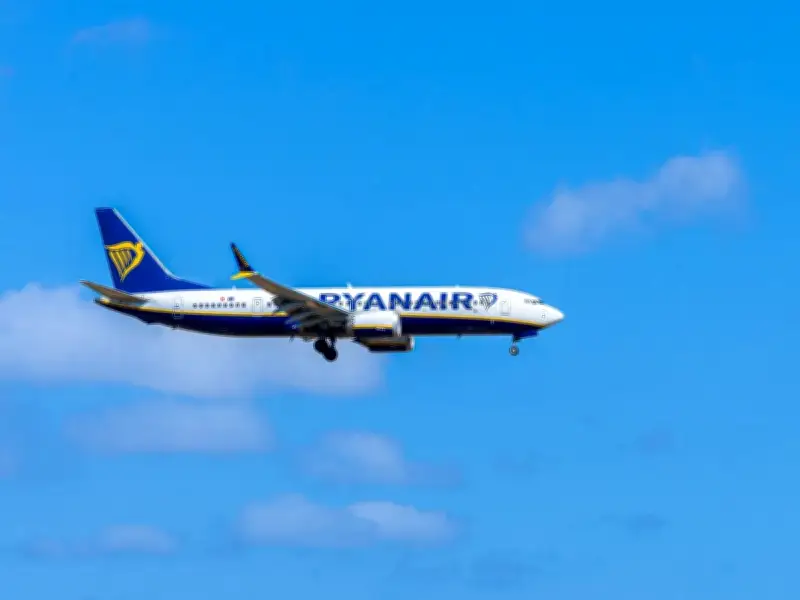
Ryanair has added six new routes from Liverpool John Lennon Airport as part of a major expansion of its winter schedule from a number of UK airports, including Manchester, Bristol, Birmingham and Stansted.
Starting this winter, the budget airline will fly from Liverpool to Milan Bergamo, Copenhagen, Gdańsk, Porto, Tirana and Warsaw. While most of those destinations are colder cities where festive activities will be at the top of the itinerary, Porto can offer a slice of sunshine during the winter months.
Full list of new routes
The full list of new routes added is:
- Birmingham – Copenhagen
- Birmingham – Rome Fiumicino
- Birmingham – Marrakech
- Birmingham – Tirana
- Birmingham – Warsaw Modlin
- Bristol – Knock
- Bristol – Warsaw Modlin
- East Midlands - Budapest
- Edinburgh – Milan Malpensa
- Edinburgh – Tirana
- Edinburgh – Warsaw Modlin
- London Stansted - Glasgow
- London Stansted - Malmö
- London Stansted - Parma
- London Luton – Venice
- Liverpool - Milan Bergamo
- Liverpool - Copenhagen
- Liverpool - Gdańsk
- Liverpool – Porto
- Liverpool – Tirana
- Liverpool – Warsaw
- Manchester – Warsaw Modlin
O'Leary's tax attack
The routes were unveiled as Ryanair CEO Michael O'Leary launched his latest attack on taxation, threatening to withdraw services from UK airports to reduce his company's tax bill. The CEO claimed that holidaymakers face being "double taxed" under Labour's plans for a tourist levy on overnight stays.
The Government has proposed giving regional leaders across large parts of England the power to introduce the charge to raise money for their local areas. Mr O'Leary argued it would add another tax for travellers who already pay air passenger duty (APD). The levy is understood to have no proposed upper limit. However, Government sources suggested mayors were unlikely to set charges at a prohibitive level, with most indicating they would amount to a few per cent.
Call to abolish APD
Speaking at a press conference in London on Wednesday, the Ryanair chief executive said he did not oppose the plans outright, but called for APD to be abolished - something that would hugely benefit his company's balance sheet.
He said: "We don't have any great fundamental philosophical difference with his regional tax, where you allow the regional mayors to add a tax on hotel nights, but that is a double tax on tourism. Abolish APD. You can't tax tourists on the way into the UK and then double tax them for the hotel night."
APD is levied on flights departing from most UK airports. Rates depend on the length of the flight and cabin class, and rose in April. Economy passengers are currently charged £8 for a domestic flight and £15 for a short-haul flight of up to 2,000 miles.
Mr O'Leary warned that Ryanair would consider moving some operations to "zero-tax, lower-cost destinations elsewhere in Europe" if the tourist levy plans went ahead. Given how large the UK market is, it's unclear how viable such a plan would be.
Environmental concerns
Ryanair's boss has been campaigning for tax cuts for years. At the same time, climate campaigners have warned that tax breaks would be devastating for the environment. Flying is by far the most polluting form of travel. A flight from the UK to Australia emits CO2e amounts similar to those a typical Brit is responsible for over the course of a year, which, in itself, is far greater than is needed to meet net zero targets by 2050.
The Aviation Environment Federation explains how the industry has enjoyed low tax rates for years.
"Historically, the aviation industry has benefitted from many tax breaks. Even now, no fuel duty is paid on jet fuel, and no VAT is applied. This irregularity becomes harder to explain when we look at how tax is applied to other transport modes. When compared to car travel, for example, aviation’s exemption from fuel duty and VAT appears more like an indirect subsidy that allows airfares to be kept artificially low. The absence of tax has helped to fuel passenger growth and the sector’s CO2 emissions have increased 125% since 1990. Over the same period, the UK’s overall emissions decreased by 43%," the AEF writes.