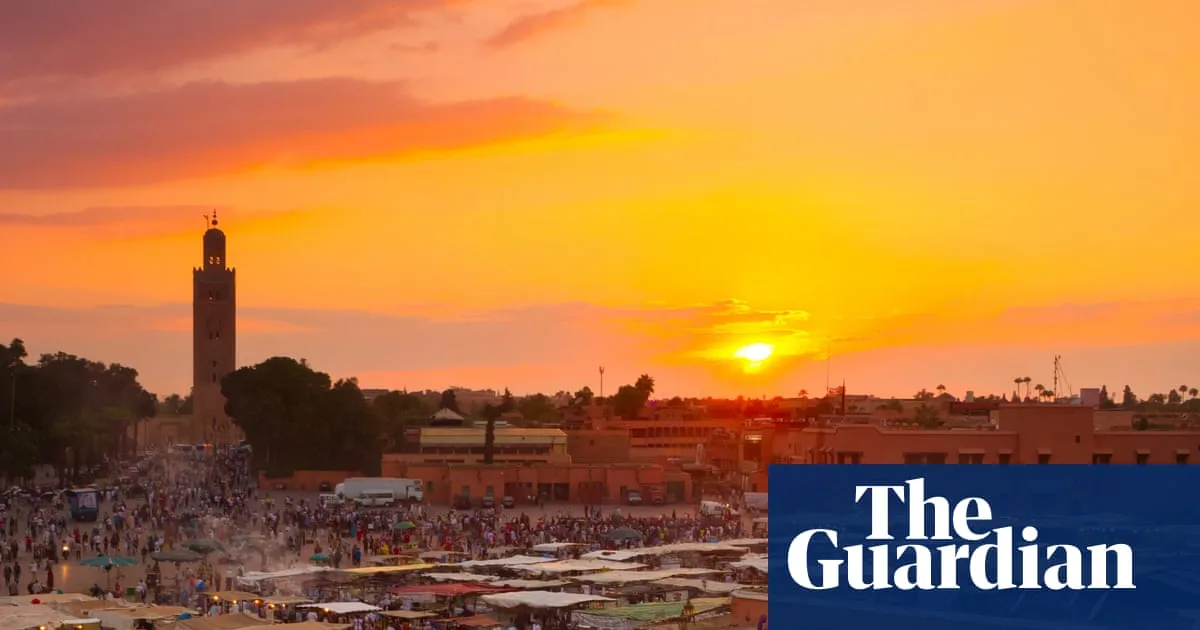
With its never-ending street theatre and labyrinthine medina, this timeless city swallows you whole – and reveals new secrets with each visit. The rising sun sets fire to the snow-covered caps of the Atlas mountains, and within moments, the shadowy gorges gleam with warm terracotta hues. Turning my back on north Africa’s highest peaks, I look north where Marrakech – nicknamed the Red City – rests like a jagged ruby amid the jade swathes of palms and the silvery sheen of olive groves.
Swinging 800 metres above the stony desert in a giant wicker basket, I try to imagine what this scene would have looked like when camel trains trooped this way, loaded with salt, spices and enslaved humans bound for Marrakech’s souks. The sky around us is filled with dozens of hot-air balloons, drifting like pollen on a Saharan breeze. The biggest baskets hold 16 passengers, most of whom will have left guesthouses and riads in the labyrinthine old town before the dawn prayer call.
“That’s the Koutoubia minaret there, to the west,” says our pilot Daniel Penet, founder of Ciel d’Afrique. “That shadowy area to the north of the minaret is the medina.” I realise that “shadowy” may be the perfect word to describe the medina. While the high-rise tower-blocks of Gueliz catch the first rays, it takes longer for sunlight to seep into the medina’s alleys and marketplaces. I can now make out the vast triangular Djemaa el-Fna (Place of the Dead), said to be named for the heads of rebels and criminals that once decorated the walls of the vast plaza.
Ever since I first visited 30 years ago, I’ve delighted in the atmosphere of “shadowiness” whenever I step through the gates in the city walls. I revelled in the jolt of adrenaline that came with running the gauntlet of hustlers and faux guides, though the city is an infinitely more relaxing place these days, thanks to the tourist police. But the medina still defies orientation. It swallows you whole. No matter how carefully I study the warren of tunnels, arches and boltholes, I will at some point become utterly lost.
Safely back on land after my early morning balloon ride, I fall into step behind a djellaba-clad figure driving a heavily loaded mule. The rabbit warren leads me to Derb Farnatchi, where wood-burning ovens heat the hammam steam baths and bake the quarter’s daily bread. I arrive at Riad Le Farnatchi, a converted mansion with suites, restaurant, spa and swimming pool – a respite from the world outside. There are now more than 7,000 riads in Marrakech, and many shun signs, forcing you to memorise the doors’ ancient features. Guests should look on the challenge of navigation as part of the thrill.
Marrakech has its share of world-famous sights, but to dig deeper into the secrets of this mysterious city an experienced local guide is priceless. I sign up for a tour with Intrepid, who help Moroccan women make inroads into the traditionally male-dominated tourism industry. Atika Aït Nejjar leads us into timeless sections of the souks where donkeys outnumber tourists and introduces us to stall owners who have sold pastries, olives and mint tea for generations. She knows the women who gather at surviving farnatchi ovens each morning with trays of dough balanced on their heads. She leads us through a humble quarter where crumbling adobe walls still stand as testament to the devastating earthquake that struck in 2023.