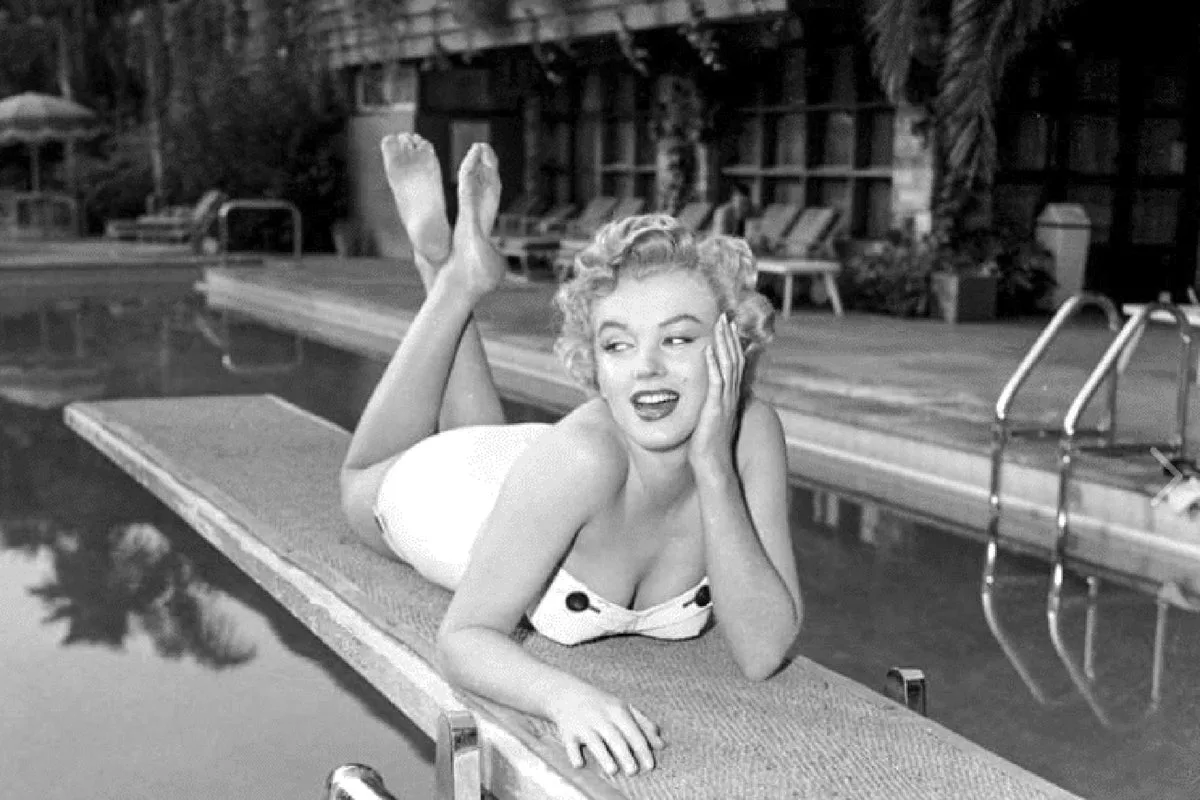
Could I summon the spirit of Marilyn Monroe? It’s a question I ponder as I lie in my four-poster bed at the Hollywood Roosevelt, where the actress lived for two years in a cabana overlooking the twinkly pool decorated by David Hockney. It’s not as big a reach as it sounds given that Monroe is said to haunt her former residence. “Over the years, several guests and staff have reported seeing her reflection in this mirror which was once in her suite,” one of the bellmen says, pointing it out in the lobby when I check in.
I am in Hollywood, the central region of Los Angeles that has become a larger-than-life emblem of showbiz, where Monroe was born Norma Jeane Mortenson on 1 June 1926, and lived until her death in 1962, aged just 36. The prospect of encountering Hollywood’s most famous ghost alone in my darkened room felt scarier than I’d thought. Still, it’s a fitting start to my five-night Marilyn Monroe-themed trip around Los Angeles. As a superfan of the actor, I’m visiting during what would have been her 100th birthday year, ahead of the launch of the city’s Academy Museum’s blockbuster exhibition Marilyn Monroe: Hollywood Icon.
In a way, I had already met her earlier that evening at my first stop – the buzzy Formosa Cafe, a kitschy, crimson-hued Chinese American restaurant. It opened in 1939 opposite “The Lot”, a historic operational Hollywood film studio campus, and fast became a hangout for Hollywood Golden Age mobsters and movie stars, like Monroe, a regular visitor while filming "Some Like It Hot” in 1958. “She loved the chow mien,” says my waitress Kelly Mullis, a fellow Monroe superfan and actress who wrote a one-woman show, “Marilyn: The Last Interview” and performed it at the Hollywood Fringe Festival for several years. “I could talk about Marilyn Monroe all day,” she says, pointing out a photo of the star on the wall above my seat. “This is what we call the ‘Marilyn’ booth’.”
The next morning, I dodge throngs of tourists posing for photos on the Hollywood Walk of Fame, on my short walk to the TCL Chinese Theatre – with its cartoonish 90-foot pagoda-like entrance and orange columns topped with wrought-iron masks, you can’t miss it. It opened in 1927, hosts big-name film premieres and is famous for its star-studded Forecourt of the Stars, featuring the cemented hand and footprints of over 200 icons including Monroe. “At the last minute, she took out her diamond earring and planted it into the cement,” says my guide, Lacey Noel, on a tour of the theatre.
Later, I lose myself in the underrated Hollywood Museum, which is jam-packed with old Hollywood memorabilia spanning 100 years, from original costumes to movie posters, spread across five floors. It’s also a must-stop on the Monroe trail for its setting inside the beautifully restored Max Factor Studios building. “It’s where her trademark platinum look was developed and styled in the ‘for blondes only’ room painted in complementary pastel blue,” museum founder, Donelle Dadigan, explains. Today, it’s a shrine to the icon, filled with Monroe-related memorabilia including annotated scripts, her honeymoon dress and her makeup chair.
From here, I’m conveniently close to classic haunt, Musso and Frank’s Grill, open since 1919 on Hollywood Boulevard. I like to imagine that after a trip to the salon, Monroe would sashay here to drink champagne with her first husband, baseball star Joe DiMaggio, in the restaurant’s “back room”, a private haven for celebrities, executives, and the era’s greatest literary minds. It closed in 1955, so instead I huddle into a dark wood-panelled booth for two in the dining room, where over a martini, I watch in awe at the waiters in red blazers buzzing up and down its storied walkways, balancing trays heaving with steaks and drinks.
The next day, I blow a kiss goodbye to Hollywood and cross over into West Hollywood. This walkable city grew into a nightlife hub where Monroe and other stars escaped Hollywood studio control, at venues on the Sunset Strip – the 1.7-mile West Hollywood section of Sunset Boulevard – I was excited to discover. I check into The Charlie, a tranquil boutique hotel consisting of a 1920s-era gated collection of cedar-clad English-style cottages. It’s set on a peaceful, tree-lined street and named after previous owner Charlie Ch