LA Bids Farewell to Historic Taix Restaurant as Echo Park Loses a Landmark
LA Says Goodbye to Historic Taix Restaurant in Echo Park

LA Bids Farewell to Historic Taix Restaurant as Echo Park Loses a Landmark

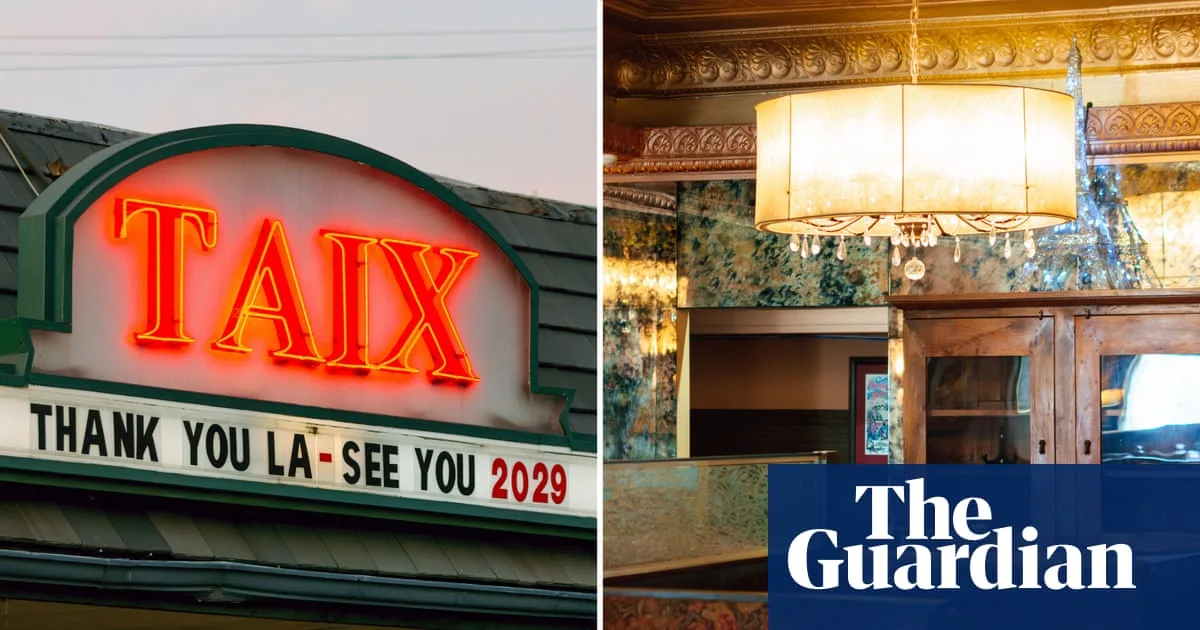
Taix stood as a symbol of the old Echo Park: a place for communion with the spirits of the past, where memories flowed as freely as the martinis. Photograph: Kayla Eremita. Long lines, martinis, and cherished memories marked the emotional adieu as Los Angeles said goodbye to the beloved restaurant Taix. The 99-year-old Echo Park favorite is being bulldozed to make way for apartments, leaving Angelenos to mourn the loss of a significant slice of city history.

I arrived at Taix on Thursday night without hunger, a common occurrence for visitors to this venerable French restaurant and de facto museum of a bygone fine-dining era. It's not that I don't relish their french onion soup, mussels, or decadent hamburger; rather, Taix is never my first stop. It isn't merely a destination—it's a nexus point for LA, a cultural heartbeat that many never imagined would cease beating until the announcement came. Sunday will host the final service for a restaurant that has anchored Echo Park for 64 years, before demolition paves the way for a large-scale luxury apartment development. This impending closure has ignited an end-of-an-era frenzy, with lines stretching down the street, packed tables, and loyal fans snatching menus and memorabilia as keepsakes.

A Symbol of City Grief Amidst Change

As Los Angeles grapples with a growing cost-of-living crisis and other historical meeting places like Cole's French Dip shutter after decades, the loss of Taix (pronounced "Tex") emerges as a poignant symbol of the city's collective grief. From civic leaders to artists and writers, people from all corners of LA have gathered at Taix's bar or luxuriated in its massive dining rooms. Its closure resonates deeply, particularly for Echo Park residents, a neighborhood long roiled by gentrification.

Wide Pickt banner — collaborative shopping lists app for Telegram, phone mockup with grocery list

Taix represents the old Echo Park: a sanctuary for communion with the past, a venue for conversations with old friends or new acquaintances. It could serve as a launching pad for a rollicking night out or a soft landing spot at the end of one. This ornate, crumbling, cavernous space has long been a playground of possibilities, a contradiction that offered a safe haven for the city's gay arts community while embodying traditional LA values. Although the restaurant plans to reopen on the ground floor of the new apartment complex, doubts linger about whether it can retain its original charm.

Final Visits and Nostalgic Conversations

During my final visit this week, a line to enter threatened to spill onto the sidewalk in front of its sprawling parking lot and valet stand. On weekends, this lot buzzes with vintage shoppers at an outdoor market, but it's typically empty. Taix first opened in 1927 and relocated to its current site in 1962 from downtown. In the 1960s, Los Angeles boasted many restaurants with grand awnings welcoming automobiles in this car-centric city.

While LA still loves its cars, the concept of a restaurant occupying such valuable real estate with its own parking lot is becoming antiquated in the age of ride-sharing. Yet, in Taix's final days, the lot proved a godsend, allowing brave patrons to valet, mingle, and share stories about their love for this place. The line moved at a crawl reminiscent of rush hour on the 110 freeway, prompting me to step aside and chat with Peter Recine, a 38-year-old freelance musician, and his partner, Cassie Dailey, a 35-year-old dancer, who were smoking nearby and losing hope of entry.

"History is so important," Dailey remarked. "It creates a precedent for the future. A lot of creative artists have been here. Maybe a dancer was in there fixing up her makeup or having a phone call." Recine mentioned the old rotary phone in the hallway, one of the few items not yet stolen by diners. "It's incredible to preserve a period of time for people that weren't in that time to enjoy it in the future," Dailey added.

Pickt after-article banner — collaborative shopping lists app with family illustration

Economic Pressures and Future Uncertainties

Los Angeles is undergoing a period of reinvention and economic turmoil, mirroring much of the US. Jobs are fleeing due to artificial intelligence, rising inflation, pricey real estate, and the decline of the traditional entertainment industry. Taix's closure stems primarily from the high costs of maintaining its large building. The current space spans 15,000 sq ft, with massive banquet halls—occupying 50% of the building—often empty. It requires 55 employees on a normal night, while the new restaurant will be a more modest 4,000 sq ft.

Worse than the size is the need for costly repairs to the venerable brick and wood structure, which would run into hundreds of thousands of dollars—financially impossible for a restaurant that saw sparse attendance post-Covid. Karri Taix, wife of owner Michael Taix, revealed that the family used personal savings to cover payroll. "If it wasn't for the developer, we would have closed in 2019," she explained over the phone. "They only made us pay a dollar a year in rent for the last seven years. It was very important for Holland Partner Group to keep Taix open for the community. There was no way for us to stay in business if it wasn't for Holland." In the interim, the Taix family is releasing a cookbook and operating pop-ups to serve beloved dishes with lower overhead.

Despite these efforts, diners like Recine and Dailey remain skeptical of the new space, fearing it will lack the charm and historic qualities of the current building. "It's just gonna be one of those condo buildings, giant, modern condo complexes," Recine said, pointing to another new build in the neighborhood. "The one right over there that nobody can even afford to live in."

Community Legacy and Wild Memories

Echo Park has historically been home to blue-collar workers and artists, many of whom can no longer afford to stay as rents soar 19% above the national average. Taix long served as the community's heart, hosting events like "Gay Guy Night," where the city's hippest queer creatives and their straight friends mingled over martinis. Few spaces in Echo Park can accommodate such hard-partying throngs, and many of these events may fade into legend.

Mia Carucci, a DJ who worked the last Gay Guy Night, described it as a rapture: "It felt like a renaissance after a few years of silence. Bacchanalia-style, erotic, sensual, no inhibitions. Gorgeous chaos. DJing the final one was absolutely iconic and brutal in the most delicious way. My 6in stripper heels snapped in half, my left ankle blew up, but I was dedicated to making that DJ set happen for the people."

Yet Taix's legacy extends beyond wild parties. After realizing no one was policing the line, I ventured inside and met Matthew Darrow, a 55-year-old defense contractor who has frequented Taix since childhood. His family has been customers since the 1940s, and he used Taix to unwind during college. "You'd see a lot of famous people," Darrow recalled. "The mayor was here fairly regularly. This place is centrally located to the corridors of power." He bought me a martini—served in two parts due to a glass shortage—and urged me to try the calamari, praising the cocktail sauce and his favorite, moules maison.

When asked if he'd visit the new Taix, Darrow responded without hesitation: yes. To him, Taix isn't about the building, light fixtures, or neon signs—it's about life and food. "People are the thing that animates the space. Without people, it's just building. It's the memories of the people who are living. My grandparents are gone, my parents are gone. We're making our own memories here." As Karri Taix noted, "Every day is a brand new memory."

Human beings naturally obsess over physical places, touching buildings and imagining different times. That's the beauty of spots like Taix, but ultimately, a building is merely a venue for being alive. And isn't being alive what truly matters?