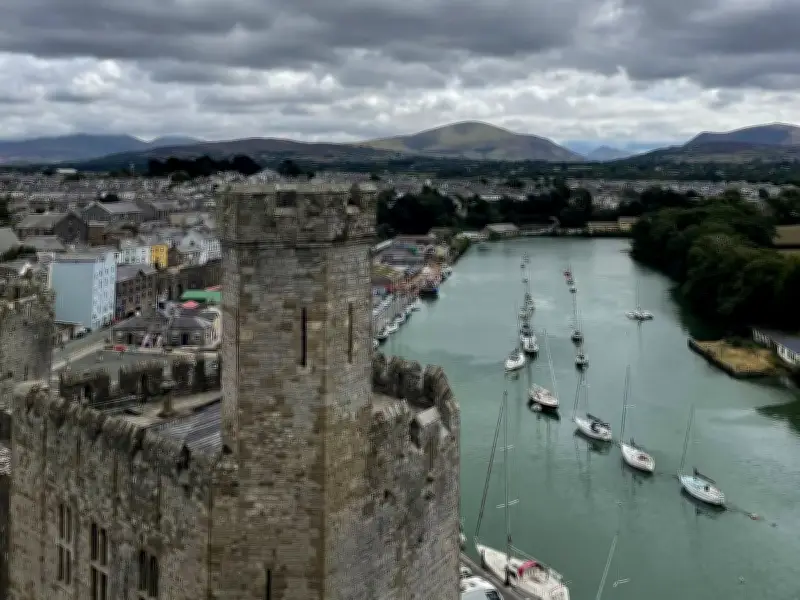
Caernarfon Castle, one of North Wales' most famous fortresses, offers a journey back to the medieval era, with thick walls, towering turrets, and steep spiral staircases that can test even the most confident visitor. A recent visit highlighted both the castle's impressive scale and the practical considerations for those who aren't fond of heights.
Exploring the Castle's Towers and Walls
The castle's walls are thick and sturdy, but peering over the edge from the top of a turret can make your legs turn to jelly. Ascending one turret, it was only possible to relax with a back firmly against a wall, moving only to pose for a photo. The narrow spiral staircases, which would have been climbed by soldiers in heavy armour and laden with bows and arrows, are a reminder of the castle's military past.
Caernarfon Castle bears a striking resemblance to Conwy Castle, and it's no coincidence—both were established by King Edward I of England, along with Harlech and Beaumaris Castles. Together, they form a UNESCO designated World Heritage Site, recognised as the "finest examples of late 13th century and early 14th century military architecture." While both Conwy and Caernarfon are impressive, the latter has the upper hand due to its huge size.
Key Features and Attractions
One standout feature is the Eagle Tower, topped with three turrets and with walls 18-feet thick, where royalty would have slept. The castle also houses the Royal Welch Fusiliers Museum in two of its towers. While many features are reached via steep and uneven steps, a modern viewing platform above the castle entrance, accessed via a lift, ensures everyone can enjoy the views from the top.
Visitors are free to explore at their own pace. Entering via the Chamberlain Tower, dark stone corridors lead towards the Black Tower, where a display explains the myths surrounding the castle, many rooted in medieval tales from The Mabinogion, including that of Macsen Wledig (Magnus Maximus), Emperor of Rome from 383 to 388, who dreamt of a magnificent castle at the mouth of the river.
History and Modern Exhibitions
Construction of the castle began in 1283, with the Eagle Tower completed by 1284 ready for King Edward's Queen Eleanor to stay there when heavily pregnant. By 1330, the castle was largely finished. The castle features several sculptures, 'The Hands that Built the Castle', representing the people who built and operated the fortress. One tower also features a magical display documenting the life of Eleanor of Castile.
A more recent chapter of Caernarfon's history is documented in an exhibition about the investiture of Prince Charles as the Prince of Wales in 1969, watched by more than 500 million people globally. On display were the red seats which guests could take home for a hefty fee. The Investiture Dais, a disk of Welsh slate at one end of the castle grounds, is still visible today.
Visitor Information and Practical Tips
Caernarfon Castle is open from 9.30am to 6pm until August 31, closing at 5pm from September 1 until October 31. From November 1 until February 28, it is open from 10am to 4pm. Until August 31, tickets are £15.60 for adults, £10.90 for children aged 5-17, and £14 for seniors. All under fives receive free entry. From September 1 to March 31, adult tickets are £14.90, children are £10.40, and seniors are £13.40.
The castle is located at Castle Ditch, Caernarfon LL55 2AY. It's a great day out if you're holidaying in North Wales, but be warned: make sure you've got a head for heights before climbing any of the towers.