

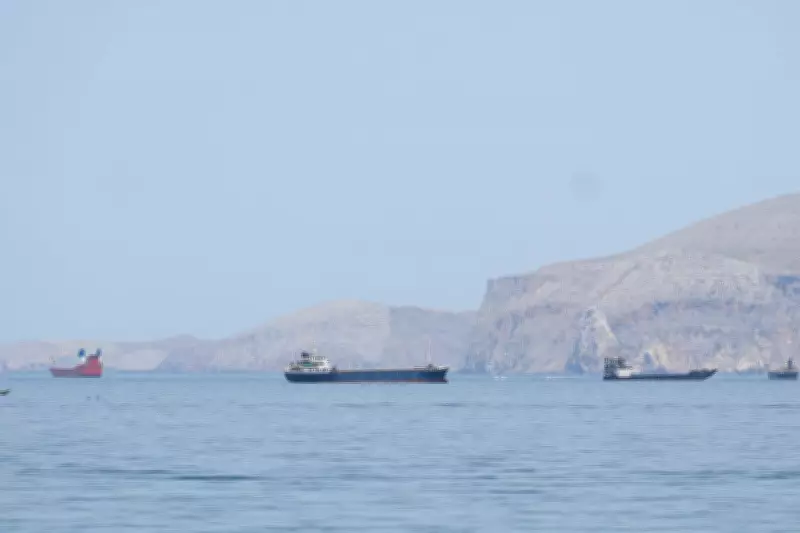
Oil prices are soaring due to the Strait of Hormuz blockade, and now the internet is under threat. Several fibre-optic cables snake across the seabed of the strait, a critical chokepoint for global digital connectivity.
Undersea Cables: The Backbone of the Internet
Subsea cables, fibre-optic or electrical lines laid on the seabed, transmit vital data and power. According to the International Telecommunication Union (ITU), these conduits carry around 99 per cent of global internet traffic. They are also crucial for international telecommunications, electricity, cloud services, and online communications.
Geopolitical and energy analyst Masha Kotkin stated: "Damaged cables mean the internet slowing down or outages, e-commerce disruptions, delayed financial transactions, and economic fallout from all of these disruptions."

Gulf countries, notably the UAE and Saudi Arabia, are investing billions in artificial intelligence and digital infrastructure to diversify their oil-dependent economies. Both have established national AI companies serving the region, all reliant on undersea cables for rapid data transfer.
Major Cables Through the Strait
Key cables include the Asia-Africa-Europe 1 (AAE-1), connecting Southeast Asia to Europe via Egypt, with landing points in the UAE, Oman, Qatar, and Saudi Arabia; the FALCON network, connecting India and Sri Lanka to Gulf countries, Sudan, and Egypt; and the Gulf Bridge International Cable System, linking all Gulf countries including Iran. Additional networks are under construction, including a system led by Qatar's Ooredoo.
Risks to Subsea Cables
While the total length of submarine cables has grown considerably between 2014 and 2025, faults have remained stable at around 150–200 incidents per year, according to the International Cable Protection Committee (ICPC). State-sponsored sabotage remains a risk, but 70–80 per cent of faults are caused by accidental human activities—primarily fishing and ship anchors, according to the ICPC and experts.
Other risks include undersea currents, earthquakes, subsea volcanoes, and typhoons, said Alan Mauldin, research director at telecom research firm TeleGeography. The industry addresses these by burying cables, armouring them, and selecting safe routes.
The Iran war, nearing the two-month mark, has brought unprecedented disruption to global energy supply and regional infrastructure, including hits to Amazon Web Services data centers in Bahrain and the UAE. Subsea cables have been spared so far.
However, an indirect risk exists from damaged vessels inadvertently hitting cables by dragging anchors. "In a situation of active military operations, the risk of unintentional damage increases, and the longer this conflict lasts, the higher the likelihood of unintentional damage," Kotkin said. A similar incident occurred in 2024, when a commercial vessel attacked by Iran-aligned Houthis drifted in the Red Sea and severed cables with its anchor.
The degree to which damage to the cables might impact connectivity in Gulf countries depends largely on how much individual network operators rely on them and what alternatives they have, according to TeleGeography.
No Easy Fix
Repairing damaged cables in conflict zones poses a separate challenge to securing them. While the physical repair itself is not overly complicated, decisions by repair vessel owners and insurers may also be impacted by the risk of damage from fighting or the presence of mines, experts say.
Permits to access territorial waters add another layer of difficulty. "Often one of the biggest problems with doing repairs is you have to get permits into the waters where the damage is. That can take a long time sometimes and can be the biggest source (of problems)," Mauldin said.
Once the conflict ends, industry players will also face the challenge of re-surveying the sea floor to determine safe cable positions and avoid ships or objects that may have sunk during hostilities.
Alternatives to Subsea Cables
While potential damage to subsea cables would not cause a complete connectivity loss—due to land-based links—experts agree that satellite systems are not a feasible replacement, as they cannot handle the same volume of traffic and are more expensive.

"It's not as though you could just switch to satellite. That's not an alternative," Mauldin said, noting that satellites rely on connections to land-based networks and are better suited for things in motion, like airplanes and ships.
Low-Earth-orbit networks such as Starlink are "a boutique solution, which is not scalable to millions of users, at this time," Kotkin added.





