

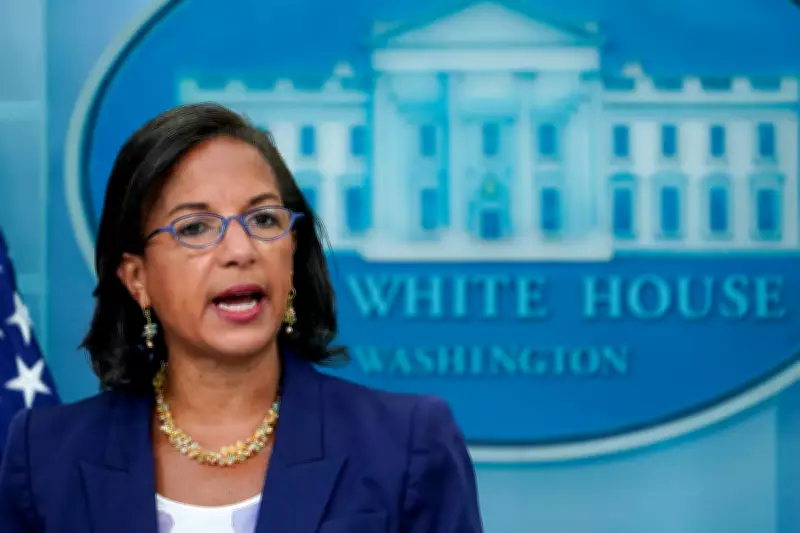
Netflix CEO Responds to Trump's Call for Susan Rice's Removal from Board
Netflix co-CEO Ted Sarandos has publicly addressed President Donald Trump's demand to remove former national security adviser Susan Rice from the streaming service's board, characterizing the president's social media outburst as "not ideal" but ultimately dismissible as background noise in the current political climate.
Trump's Truth Social Rant Against Rice
In a February 21 post on Truth Social, President Trump launched a vehement attack against Susan Rice, describing her as "racist" and "Trump Deranged" while demanding her immediate removal from Netflix's board. The president wrote: "Netflix should fire racist, Trump Deranged Susan Rice, IMMEDIATELY, or pay the consequences. She's got no talent or skills – Purely a political hack! HER POWER IS GONE, AND WILL NEVER BE BACK. How much is she being paid, and for what???"
Trump's comments came in response to an X post by far-right agitator Laura Loomer, who had accused Rice of threatening corporations that made concessions to Trump's agenda. Loomer questioned whether Netflix supported "their board member threatening half of the country with weaponized government and political retribution for choosing who they wanted to vote for as president," adding that this represented anti-American behavior.

Sarandos' Dismissive Response
Speaking to Politico during his visit to Brussels for meetings with European regulators, Sarandos addressed the presidential demand with notable nonchalance. "He does a lot of things on social media," the Netflix executive remarked, adding that he didn't believe Trump's interjection had "crossed a line."
"I think it's really important to be able to separate noise from signal, and I think a lot of what happens in a world where we have a lot of noise," Sarandos explained, emphasizing his ability to distinguish between substantive concerns and political theater.
Susan Rice's Netflix History
Susan Rice, who served as national security adviser under President Barack Obama, originally joined Netflix's board in 2018. She departed in 2020 to work for the Biden administration before returning to the streaming company following Trump's victory in the 2024 presidential election. Her continued presence on the board has become a point of contention for the current administration.
White House Meeting and Industry Discussions
Sarandos revealed that he recently met with President Trump at the White House to discuss Netflix's failed acquisition of Warner Bros. Discovery, which was ultimately purchased by Paramount for $110 billion. Despite the president's volatile social media presence, Sarandos described their conversations as substantive and focused on industry matters.
"He makes statements sometimes that lead to the beliefs of things that do and sometimes that don't materialize at all," Sarandos noted. "But I found my conversations with him were 100 percent about the industry, protecting the industry. And I think it's very healthy that the president of the United States speaks to business leaders about industries that are important to the economy."
Tariff Policy Discussions
The Netflix CEO also disclosed that he discussed Trump's controversial tariff policies during their meeting, particularly as they relate to the film and television industry. Sarandos advocated for production incentives over tariffs, arguing that competitive incentives between states have successfully attracted production away from traditional hubs like California to locations including Georgia and New Jersey.
"He has brought up tariffs for the movie and television industry many times," Sarandos revealed. "And I've hopefully talked to him the way out of them. I just said basically the same thing I said earlier. I think that incentive works much better."
The streaming executive emphasized that incentive-based approaches allow companies to "put more on the screen" while avoiding the negative impacts of protectionist trade measures.






