

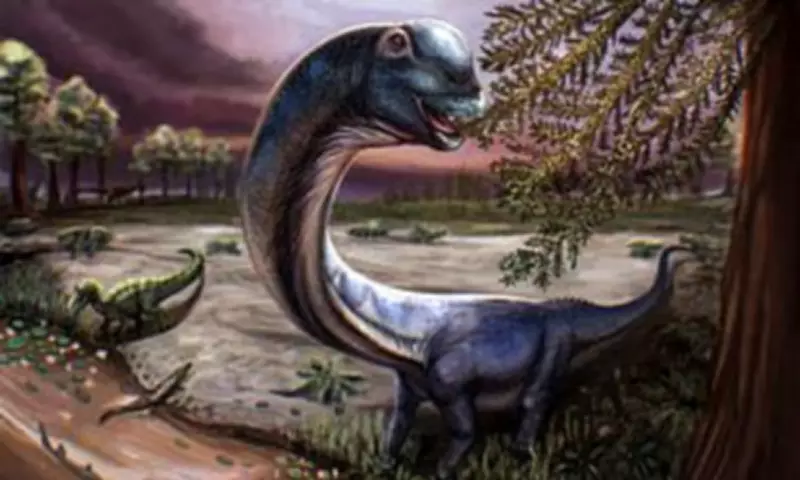
An enormous dinosaur three times the size of a London bus roamed Southeast Asia 120 million years ago, scientists have discovered. The monstrous creature, dubbed Nagatitan chaiyaphumensis, would have grown to 88 feet (27 metres) in length and weighed 27 tonnes – as much as nine adult Asian elephants. This makes it the biggest dinosaur ever found in Southeast Asia.
Discovery and Analysis
After analysing its skeletal remains, scientists say the gentle giant was a member of the sauropod family, which includes the largest creatures ever to walk the Earth. The gargantuan bones were first spotted 10 years ago on the edge of a pond by a villager in Thailand's northern Chaiyaphum region. Since then, palaeontologists have painstakingly excavated pieces of spine, ribs, pelvis, and a front leg bone as big as a human.
Co-author Thitwoot Sethapanichsakul, a PhD student at University College London, told the Daily Mail that Nagatitan took on 'the role of a mega herbivore browsing on the treetops without much fear of predation due to their sheer size.' He added: 'Much like other sauropods, Nagatitan was probably a bulk browser that focused on consuming high volumes of vegetation that require little to no chewing.'

Environment and Predators
Between 100 and 120 million years ago, when Nagatitans wandered through Southeast Asia, Thailand would have been a very different environment from today. Rather than sub-tropical and humid, the region would have been more arid, featuring forests alongside savanna-like and shrubland habitats. The area where this specimen was found would also have been part of a meandering river system, home to fish, freshwater sharks, and crocodiles.
As for potential predators, the Nagatitan shared its home with relatives of the Spinosaurus and the giant African meat-eating dinosaur Carcharodontosaurus. But, with the largest of these predators reaching just 26 feet (8 metres) long and around 3.5 tons, Nagatitan would have dwarfed even the fiercest carnivores.
Adaptation to Climate
While it might seem odd to find such a large creature in an environment marked by intense seasonal dryness, sauropods like Nagatitan actually thrived in these climates. As the planet's climate moved through a natural warming phase, scientists think sauropods used the massive surface area of their necks and tails to regulate their body temperature.
Co-author Professor Paul Upchurch, of University College London, told the Daily Mail: 'Between around 115 million years and 95 million years ago, CO2 levels rose and so did global temperatures. This seems to be associated with an increase in the body size of many sauropod dinosaurs, such that we see super gigantic 70 metric tonne forms living around 95 million years ago. This allowed them to become some of the most successful and widespread species during the Early Cretaceous period.'
Size and Classification
While the exact nature of this connection is 'not fully understood', Nagatitan offers researchers a glimpse into the early stages of this process. However, even though Nagatitan dominated its own habitat, it would have looked relatively puny to some of the giants from this period. Mr Sethapanichsakul says: 'When compared to other sauropods, it ranks in the upper middle of the size range. Sauropods from the middle Cretaceous of South America, China, and probably North Africa were the true super giants and would have had body masses that exceeded 60 tonnes.'
From the outside, Nagatitan would have looked very similar to its larger cousins, with a long neck and tail, column-like legs, and a tiny head. But the scientists were able to spot unique characteristics in its legs, hips, and spine that mark it out as a unique species.
Anatomical Features
Nagatitan belonged to a subgroup of sauropods with bones that contained lots of internal air sacs and thin walls, making their skeletons lighter. This group emerged about 140 million years ago, spread all over the world and, around 90 million years ago, became the only sauropods left worldwide, holding on until the dinosaur age ended 66 million years ago.

Its scientific name, Nagatitan chaiyaphumensis, is a reference to the 'Naga', a mythological serpent often depicted in Southeast Asian mythology and often connected with water. 'Its specific name of chaiyaphumensis pays homage to the fact that the fossils were found in Chaiyaphum province, Thailand,' says Mr Sethapanichsakul.
Significance and Extinction
While the moniker 'titan' refers simply to the dinosaur's enormous size, it is fitting as the researchers refer to the animal as Southeast Asia's last 'titan'. Sometime after this specimen lived, Thailand was submerged by a shallow sea, which may have driven out the dinosaurs. Professor Upchurch says: 'Although animals like this continue to live elsewhere in the world, it may be that large portions of Southeast Asia were flooded by sea level rise afterwards. So it might not have been possible for these animals to have lived there much after the time of Nagatitan.'
How the Dinosaurs Became Extinct
Dinosaurs ruled the Earth around 66 million years ago, but suddenly disappeared in what is known as the Cretaceous-Tertiary extinction. It was believed for many years that changing climate destroyed the food chain of the huge reptiles. However, in the 1980s paleontologists discovered a layer of iridium – an element that is rare on Earth but found in vast quantities in space. When this was dated, it coincided precisely with when the dinosaurs disappeared from the fossil record. A decade later, scientists uncovered the massive Chicxulub Crater at the tip of Mexico's Yucatán Peninsula, which dates to the period in question. Scientific consensus now says that these two factors are linked and they were both probably caused by an enormous asteroid crashing to Earth. With the projected size and impact velocity, the collision would have caused an enormous shock wave and is likely to have triggered seismic activity. The fallout would have created plumes of ash thought to have covered the whole planet, making it impossible for dinosaurs to survive. Other animals and plant species had a shorter time-span between generations which allowed them to survive. There are several other theories as to what caused the demise of the dinos. One early theory was that small mammals ate dinosaur eggs and another proposes that toxic angiosperms (flowering plants) killed them off.





