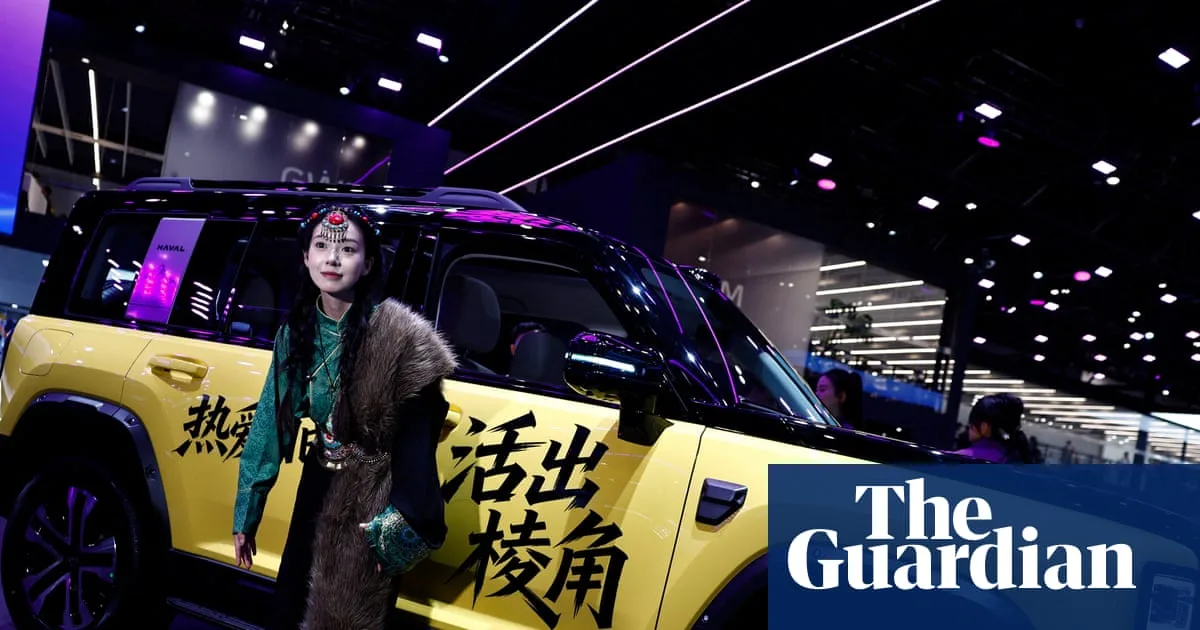
At the Beijing Auto Fair, officially called Auto China 2026, which opened on Friday, hundreds of manufacturers displayed more than 1,000 vehicles, with a strong emphasis on autonomous driving technology. The focus comes as domestic sales slow, pushing Chinese carmakers to invest heavily in AI and seek growth in overseas markets.
Huawei announced it would invest up to 80bn yuan (£8.7bn) over the next five years to develop its autonomous driving software and computing power. Xpeng showcased an AI model that allows drivers to give commands such as 'park near the entrance to the shopping centre', while Xiaomi demonstrated an AI-powered operating system that can make restaurant reservations and detect driver stress.
Domestic car sales in China fell 17% in the first quarter of this year as the government phased out a subsidy programme. BYD, the leading EV maker, reported seven consecutive months of declining sales. In contrast, Chinese exports soared by more than 60% in the first quarter.
Chery, China's largest car exporter, has become one of the fastest-growing brands in the UK since launching in August 2025, with 13,500 cars sold in six months. On Friday, the company announced a goal of 10m global annual sales by 2030. Geely also revealed plans to deploy thousands of driverless taxis globally next year through its ride-hailing arm, Caocao.
Robotaxis are already operating in several Chinese cities, but widescale adoption has been limited by regulatory barriers. Last month, several of Baidu's Apollo Go robotaxis stalled in Wuhan, stranding passengers. Nonetheless, Lyft and Uber have announced partnerships with Baidu to use its self-driving software in London this year.
Faced with tariffs in the US and EU, Chinese carmakers are focusing on smaller markets such as the UK and Canada. One industry professional noted that the UK is seen as 'culturally agnostic' about allowing Chinese EVs.