

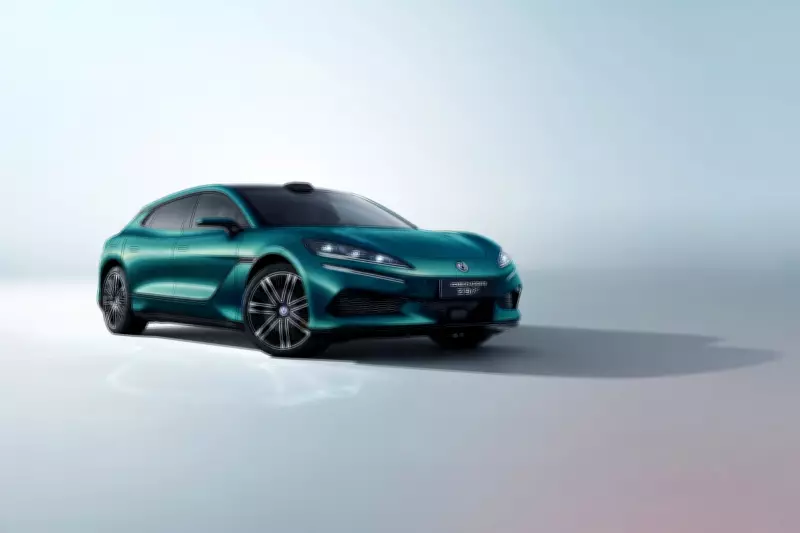
BYD's Flash Charging EV Achieves Near-Full Battery in Under 10 Minutes
Chinese automotive giant BYD is set to revolutionise the electric vehicle market with a breakthrough in charging speed, introducing its Flash Charging technology that promises to dramatically reduce recharge times. This innovation highlights how car manufacturers and charging networks are racing to cut EV charging durations, moving the industry's focus away from simply extending range.
Denza Z9GT: A Game-Changer in Rapid Charging
The premium Denza brand, owned by BYD, will launch in Europe next month with the Z9GT grand tourer, which boasts unprecedented charging capabilities. Using Flash Charging, the vehicle can top up from 10 to 70 per cent in just five minutes and reach 97 per cent in approximately nine minutes. These figures bring EV recharging times closer to the duration of filling a traditional petrol tank.
Even more impressively, the system is claimed to maintain near-optimal performance in extreme cold conditions. At temperatures as low as -30°C, a charge from 20 to 97 per cent takes about 12 minutes, addressing a common concern for EV users in harsh climates.

Technology Behind the Breakthrough
The Flash Charging technology relies on a new iteration of BYD's Blade battery, combined with ultra-high-power charging stations capable of delivering up to 1,500kW. BYD has announced plans to begin installing these chargers in the UK as part of the Z9GT's launch later this year, with the model expected to be showcased at the Goodwood Festival of Speed in July.
This launch underscores a rapid shift in the EV market, where reducing charging times is becoming as critical as increasing range. For years, critics have cited long charging stops as a major barrier to adopting electric vehicles, but advancements like Flash Charging suggest this argument may soon become outdated.
Industry-Wide Move Towards Faster Charging
Other major automakers are following suit with similar technologies. The new BMW iX3, built on the next-generation Neue Klasse platform, features an 800-volt electrical architecture that allows charging speeds of up to 400kW, adding over 200 miles of range in about 10 minutes. Mercedes is adopting a comparable approach with its all-new electric CLA, which also uses 800-volt technology to enable charging speeds of around 320kW, adding roughly 200 miles of range in ten minutes.
Upcoming models like the Mercedes electric GLC SUV promise up to 330kW charging capability, allowing for around 160 miles of range to be added in 10 minutes. The shift to higher-voltage battery systems, such as 800-volt designs, is central to these improvements, enabling higher power delivery without overheating cables or batteries.
Infrastructure Expansion to Support Ultra-Fast Charging
However, ultra-fast charging is only effective if the supporting infrastructure exists. Following Tesla's lead with its Supercharger network, manufacturers are increasingly investing directly in charging networks. BYD's Flash Charging system is designed specifically for its own ultra-powerful stations, with thousands already installed in China and more planned globally.
Across Europe, the rapid-charging network is expanding quickly, with high-power chargers capable of 350kW becoming common at motorway services and charging hubs in the UK. This infrastructure growth is essential to realising the full potential of fast-charging technologies.
In summary, the direction of the EV industry is clear: early emphasis on range is giving way to a new competition focused on recharging speed. If BYD's claims prove accurate, the gap between plugging in an EV and filling up a petrol car may soon become negligible, marking a significant milestone in electric vehicle adoption.






